49 works in this view — arrow keys or swipe to move between them.
Dance in Art
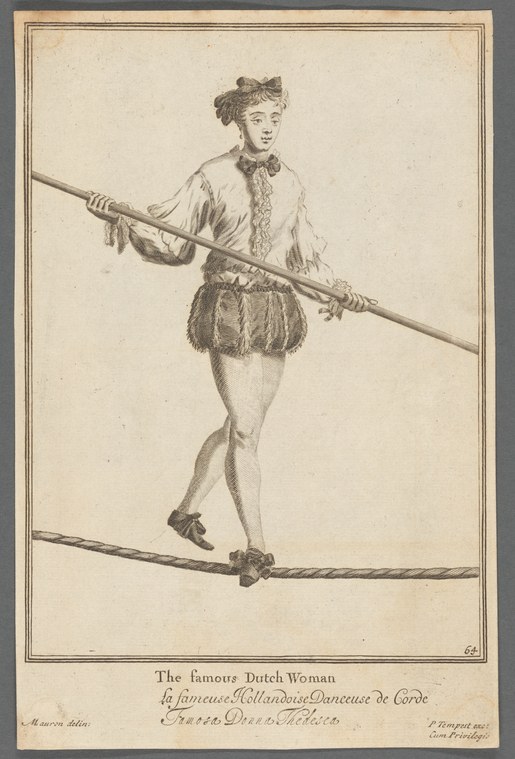
The famous Dutch woman
Unknown artist
- Collection:
- Prints depicting dance
- Source:
- New York Public Library
- Rights:
- Public domain — free to use, share and adapt.
- Recorded as:
- Public Domain
Rope-walking was a distinct and prestigious form of performance entertainment, and this print records both an actual celebrated performer and the technical apparatus (pole, rope, costume, stance) of the practice. For historians of performance and acrobatics, the image provides rare documentary evidence of how a rope-walker actually stood and balanced. For art historians, it exemplifies how printmaking was used to publicize and immortalize performers in the pre-photographic era.
What you are looking at
A single female figure stands balanced on a taut rope, her body angled dynamically across the composition. She wears a short, fringed skirt and a fitted jacket with decorative frogging, her hair styled up with a large bow. She grasps a long pole or staff held diagonally across her body, using it for balance and counterweight. The figure is poised mid-movement on the rope, one leg extended, demonstrating the physical control required for rope-walking. The image is rendered in fine engraving or etching, with delicate cross-hatching to model form and shadow. The composition is spare—the figure is centered against a plain background with a simple rectangular border—allowing full attention to the performer's pose and the technical feat being depicted.
The dancing
The dancer's frame shows sophisticated weight distribution: her torso is upright but flexed, her legs active (one supporting on the rope, the other extended for balance), and her arms engaged with the pole for stability. The pose suggests mid-stride, with the body angled to maintain equilibrium on the rope. Her gaze is forward and composed. The musculature is rendered with anatomical attention, and her posture conveys both strength and control—qualities essential to the skill being demonstrated. No partner is present; this is a solo virtuosic act.
The dance depicted
This is a rope-walking or slack-rope act, a performance art form distinct from theatrical dance but belonging to the broader category of circus and acrobatic performance that entertained audiences from the 17th century onward. The inscription identifies her as a famous Dutch performer, making this likely a record of an actual well-known artist rather than a generic type. Rope-walking was a popular entertainment across Europe, often performed in theaters, fairgrounds, and private venues. The pole is the standard implement for balance work on rope, and the pose captures the precise technical skill required—the dancer must manage both the rope's sway and her own weight distribution simultaneously.
How it was made
This is an engraving or possibly an etching, executed with fine parallel and cross-hatching to create tone and model the figure's form. The technique allows precise linear definition of the performer's musculature and costume details, and the controlled line-work conveys the tautness of the rope itself. The image is a print, likely circulated widely and affordably, suggesting it was meant for a popular audience interested in curiosities and performance spectacles. The quality of execution indicates a skilled printmaker working from a drawing or painting, probably made from life or from a performer's reputation.
About this work
This engraving documents a celebrated acrobatic performer—identified as a famous Dutch woman—executing a rope-walking act with a balancing pole. The work sits at the intersection of theatrical spectacle, acrobatic skill, and printmaking as a medium for celebrity and curiosity. Rope-walking was a popular form of entertainment and display throughout the early modern period, one that tested human balance and nerve in ways that fascinated audiences. This print preserves not a narrative dance but a technical virtuosity—the kind of solo feat performed on stages and in arenas across Europe. It belongs in a gallery of dance in art because it captures a recognized performance form, a skilled body in controlled motion, and the cultural appetite for witnessing physical excellence.
How to look at it
Attend to the precise moment the artist chose: not a static pose but a captured instant of motion and balance. The pole cuts diagonally across the body, and the extended leg suggests forward momentum restrained by the demands of the rope. The viewer should notice how the engraver rendered the rope itself—with subtle line work distinguishing it from the background—and how the figure's stance conveys both strength and concentration. The costume details (the fringed skirt, the buttoned jacket, the hair ornament) identify her as a recognizable performer, not a generic acrobat; this is a portrait of a specific celebrated artist.
The artist
The artist is not recorded in the catalogue. The inscription suggests the work was created to commemorate or publicize a specific performer of some renown. The quality of the engraving indicates a professional print shop, likely one that specialized in theatrical or curiosity prints for popular circulation. Such prints were often made without prominent artist attribution, created as commercial products celebrating celebrated performers of the day.
The period
Rope-walking flourished as entertainment from the 16th century through the 19th century, with particular popularity in the 17th and 18th centuries across European courts, theaters, and public venues. Female rope-walkers were notable attractions and often achieved celebrity status. This print likely dates to the 17th or 18th century, when engraved portraits of performers—dancers, acrobats, actors—were being produced and sold to audiences curious about the stars of the day. The style of dress, the engraving technique, and the format (a single figure with inscription) are consistent with theatrical celebrity prints of that era.
Where it lives
The print is held in the New York Public Library's collection of prints depicting dance. The catalogue record provides minimal information; the date and printmaker remain unrecorded. The inscription in Dutch or Flemish script identifies the subject as a 'famous Dutch woman' and rope-walker, suggesting either a Dutch performer or a work created in the Dutch-speaking territories of the early modern Low Countries.
Dance in this work
Questions about this work
Is rope-walking the same as tightrope walking?
Rope-walking and tightrope walking are related but distinct practices. A slack rope hangs in a gentle curve and sways under the performer's weight; a tightrope is pulled taut and remains nearly rigid. Slack-rope walking required greater balance skill and the use of a balancing pole was standard. This image shows a slack rope, indicated by the slight sag and the necessity of the pole.
Who was this performer?
The catalogue record does not identify her by name, only as a 'famous Dutch Woman.' Without additional research in 17th- or 18th-century performance records or Dutch sources, her specific identity cannot be established from the print alone. Her prominence suggests she was well-known in her time.
Why was rope-walking popular?
Rope-walking displayed human skill, nerve, and physical control in a way that thrilled audiences. It was dangerous enough to be genuinely impressive, yet safe enough to be performed regularly in theaters and public spaces. Celebrated rope-walkers became celebrities in their day, and prints like this one helped publicize and immortalize them.
Why is there a pole?
The pole serves as a counterbalance and gyroscopic aid. By extending it away from the body, the performer can shift weight and adjust for sway. On a slack rope, the pole is not merely decorative but essential to the success of the act.
More dance artwork





