49 works in this view — arrow keys or swipe to move between them.
Dance in Art
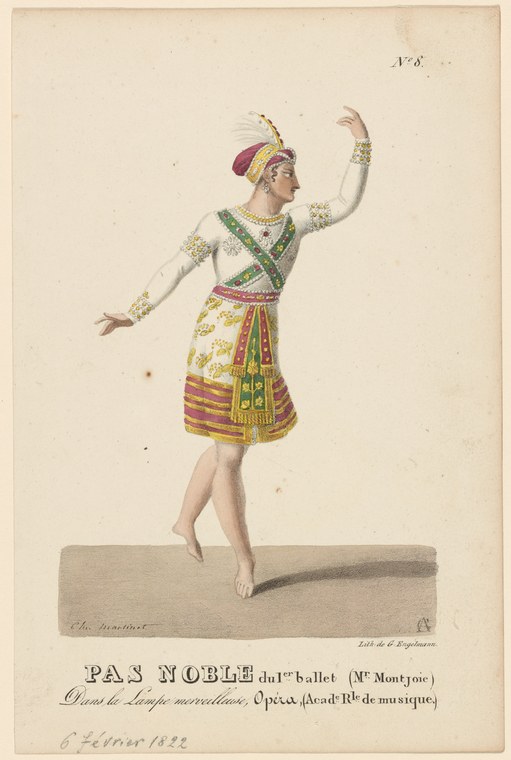
Pas noble du 1er ballet (Mr. Montjoie) dans La lampe merveilleuse, opéra
Unknown artist
- Collection:
- Prints depicting dance
- Source:
- New York Public Library
- Rights:
- Public domain — free to use, share and adapt.
- Recorded as:
- Public Domain
This print documents the performance of a specific operatic ballet role and preserves evidence of movement vocabulary, costume design, and the convention of the 'pas noble' in early theatrical dance. For dancers and historians, it illustrates how theatrical character dance was codified, presented, and circulated in popular print form—a glimpse into how dance was made visible and memorable to a public that could not always attend the theater. The exotic costume suggests how European ballet incorporated orientalist fantasy into its narratives, a practice fundamental to later Romantic ballet.
What you are looking at
A single dancer occupies the center of the composition, posed in a moment of stillness within movement. The figure stands barefoot on a shallow platform rendered in gray wash, weight distributed evenly but the body turned in profile toward the left. The dancer wears a striking costume: a close-fitting white bodice with gold embroidery and a broad green cross-band, and a knee-length skirt with an ornate pattern in gold and red horizontal stripes and green panels. The head is crowned with a turban in burgundy and gold, topped with an upright feathered ornament. Both arms are raised in an expressive gesture—the forward arm extended with fingers spread in a delicate position, the back arm curved with fingers also articulated—creating a sense of lyrical presentation rather than vigorous movement. The figure's posture suggests a moment of graceful display, with the torso held upright and the legs appearing nearly straight, the whole pose suggesting the kind of formal bearing expected in court or operatic contexts. The background is plain, allowing the costumed figure to stand in isolation against a soft cream ground.
The dancing
A single figure is depicted in a standing pose with an upright, extended carriage through the torso and neck. Both arms are raised and curved, with the forward arm extended further and the back arm bent, the hands articulated with splayed fingers in a manner suggesting controlled grace rather than vigorous execution. The stance appears to rest on straightened legs with minimal bend, and the weight is centered. There is no partner or group work visible; this is a solo presentation. The body's orientation and arm framing suggest a formal, presentational bearing typical of court dance or operatic dance performance rather than partnered ballroom technique.
The dance depicted
This is almost certainly the title role or a featured character solo from *La lampe merveilleuse* (The Wonderful Lamp), an opera-ballet that was performed in the 18th or early 19th century. The inscription identifies this as 'Pas noble du 1er ballet' (noble step from the first ballet), suggesting a formal, aristocratic style of movement performed within an operatic narrative. The costume—particularly the turban and the patterned skirt—points to an 'exotic' or orientalized character, consistent with operatic conventions of the period for representing foreign or fantastical elements. The dancer's posture and arm work are consistent with the elevated, courtly movement vocabulary of theatrical dance in this era: the arms are held aloft in a manner that suggests the formalized port de bras of baroque and early 19th-century ballet, and the stance conveys nobility and display. The 'pas noble' designation itself indicates a step form associated with dignified, courtly movement rather than comic or athletic display.
How it was made
This is a hand-colored engraving or etching, executed with fine line work in the figure, costume detail, and drapery, and finished with watercolor washes in muted tones—gray for the platform, flesh tone, and subtle color for the costume elements. The technique allowed for clear reproduction and distribution of images of famous dancers and roles in a form accessible to a theater-going public; such prints were likely sold as mementos of specific performances or as documentation of celebrated roles. The signature 'Ch. Henrici[?]' at the lower left appears to be the artist's mark. The inscription 'Larivé & Cie Imprimeurs' at the lower right suggests a commercial print house. The precision of line and the carefully controlled coloring indicate a professional production for circulation, not a unique work.
About this work
This engraved and hand-colored print documents a specific moment in theatrical dance history: a solo character role from an 18th or early 19th-century French opera-ballet. The work captures a single dancer in a formal, presentational pose, costume intact, in a manner intended to preserve the image of a famous role or performer for a public audience. The figure's bearing and movement vocabulary place it firmly within the aristocratic tradition of operatic dance, where movement was regulated, courtly, and subordinate to narrative and spectacle. As a print, it serves multiple functions: record of a performance tradition, advertisement of a celebrated dancer or role, and evidence of the relationship between operatic narrative costume and movement technique in this period.
How to look at it
Attend to the stillness within potential movement: the pose is frozen in a moment of presentation rather than transit, but the arm positions and the slight turn of the torso suggest a moment within a continuous phrase of movement. The raised arms in particular should be read as part of the formal vocabulary of the period—this is not vigorous or energetic, but rather controlled and courtly. The costume is integral to the meaning; the turban and patterned skirt signal a character role rather than a generic dancer, and the print's careful rendering of these details suggests they were considered essential to how audiences understood the role. Note too how the artist has positioned the figure in isolation on a bare platform—this is a portrait of a dancer and role, not a scene of social interaction or narrative action.
The artist
The artist is listed as 'Ch. Henrici' (or similar), about whom little is certain from the signature alone. The print was produced by 'Larivé & Cie', a commercial printing house, suggesting this was one of many such theatrical prints produced for public consumption in France during the late 18th and early 19th centuries. Such prints were often based on designs by theatrical artists or choreographers, or drawn from life at performances, but the specific relationship between Henrici and the original choreography or performance is not documented in the catalogue record.
The period
This work belongs to the period of French opera-ballet in the late 18th or early 19th century, when operatic spectacle and dance were integrated into longer narrative forms, often incorporating exotic settings and characters. The 'pas noble' was a foundational step vocabulary of theatrical dance in this era, the aristocratic counterpart to the 'pas d'action' or comic steps. Orientalism was a fashionable subject in French opera and ballet from the later 18th century forward, feeding European fascination with the Near East and providing a framework for costume spectacle. Print documentation of such roles was a commercial and cultural practice; theaters and choreographers understood the value of circulating images of famous dancers and roles to maintain public interest and sell tickets. The quality of this print suggests a professional theatrical establishment with resources to commission and distribute such promotional material.
Where it lives
This work is held in the New York Public Library's collection of prints depicting dance. The collection is a documentary assemblage of dance-related prints spanning several centuries, assembled to preserve visual records of dance performance and practice. The print appears to be a standard theatrical memento or advertisement print produced for public circulation in France.
Dance in this work
Questions about this work
What is 'La lampe merveilleuse'?
*La lampe merveilleuse* appears to be a French opera-ballet of the late 18th or early 19th century. The title suggests a narrative fantasy based on the theme of a magical lamp—possibly derived from or related to *Aladdin* tales then fashionable in European theater. The exact date, composer, and choreographer are not established by this print, but the work was significant enough to merit distribution of prints of its featured roles.
What does 'pas noble' mean?
A 'pas noble' (noble step or dance) was a formal, courtly dance or step phrase within the vocabulary of 18th and 19th-century theatrical ballet. It was distinct from comic or athletic steps, and signaled dignity, elevation, and aristocratic bearing. The 'pas noble' was typically performed by principal characters or in formal scenes, and required a controlled, refined execution of balletic vocabulary.
Why is the dancer wearing a turban?
The turban indicates an 'exotic' character role, part of the operatic and ballet tradition of orientalism. In 18th and 19th-century European theater, characters from the Near East, the Levant, or fantastical foreign lands were conventionally costumed with turbans, loose trousers, and other markers of 'otherness.' This served both narrative (establishing the character's origin or fantasy status) and visual purposes (creating spectacle and distinction on stage).
Is this a portrait of a specific dancer?
The print does not identify the dancer by name in the visible portions of the inscription. It is possible the name appeared on the original print in text now unclear in reproduction, or the print was intended to represent the role generically rather than a specific performer. Theatrical prints of this period often served both purposes—advertising a famous dancer in a famous role, or preserving the image of the role itself for future reference.
More dance artwork





