49 works in this view — arrow keys or swipe to move between them.
Dance in Art
L'Europe galante
Unknown artist
- Collection:
- Prints depicting dance
- Source:
- New York Public Library
- Rights:
- Public domain — free to use, share and adapt.
- Recorded as:
- Public Domain
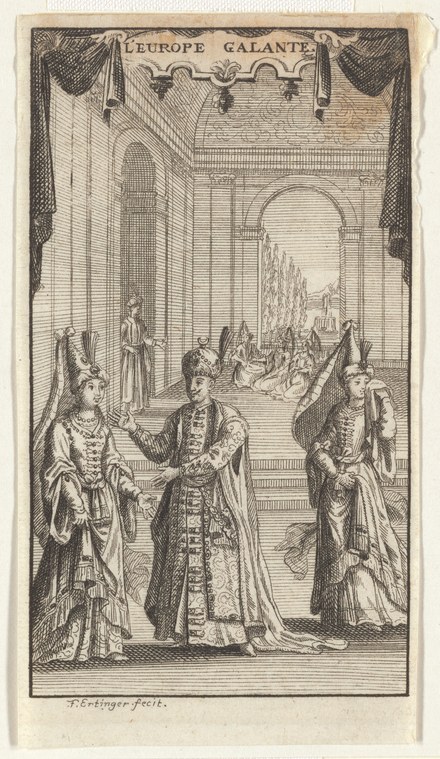
The print shows that baroque court dance was not primarily about virtuoso footwork or visible movement, but about posture, protocol, and the visual display of rank and refinement. The grandeur of the architectural frame and the formality of the pose tell us that dancing in this context was a form of courtly ceremony—a structured performance of deference, invitation, and social grace—rather than an autonomous choreographic event.
What you are looking at
This engraving depicts a formal court scene titled *L'Europe galante* (Gallant Europe), set within a vast classical interior with towering columns and a coffered ceiling. The architecture recedes dramatically toward a distant courtyard visible through a monumental arch. Three richly dressed figures occupy the foreground: two women in elaborate gowns with full skirts, long-sleeved jackets, and jeweled ornaments, and a man in embroidered court dress. The women stand facing the man in attitudes of greeting or conversation, their bodies angled toward one another. In the middle distance, a crowd of courtiers processes or assembles in the hall beyond, suggesting this is a formal court gathering. The composition is theatrical—the grand architecture frames the foreground action, and the congregation in the background establishes the social importance of the moment. Decorative swags and tassels hang from the ceiling, reinforcing the ceremonial grandeur.
The dancing
The three foreground figures are posed in an upright, formal stance typical of courtly interaction rather than active dancing. Their arms are held at a composed angle suited to conversation or the opening moment of a dance—not yet engaged in movement but in the dignified posture of aristocratic address. The two women flank the man slightly, their skirts spreading broadly across the floor, their bodies weight-bearing and still. The positioning suggests a moment of courtly protocol—a greeting, an invitation, or the beginning of a formal court dance—rather than a dynamic step sequence.
The dance depicted
The print most likely depicts a court dance or courtly dance scene from the late seventeenth or early eighteenth century, when such galant (gallant) subjects were popular in European court culture. The formal posed arrangement of the three figures—two women and a man in a moment of greeting or introduction—is consistent with the opening stance of courtly partner dances such as the minuet or other baroque social dances, which began with formal address and bowing before proceeding into steps. The title *L'Europe galante* suggests an allegorical or mythological subject, possibly dramatizing courtship or diplomatic exchange through the language of court dance. However, the figures are not actively stepping, so the image captures the moment of protocol or invitation rather than the dance proper.
How it was made
This is a copper engraving, identifiable by the fine parallel hatching used to build form and shadow, the crisp linear definition of architecture and costume, and the absence of color. Engraving was the dominant print medium for circulating sophisticated imagery in seventeenth- and eighteenth-century Europe, allowing multiple impressions from a single plate and reaching a broad educated audience. The signature at lower left reads 'T. Eitlinger fecit' (T. Eitlinger made this), indicating the artist-engraver. The high finish and grand subject matter suggest this was a commercial print intended for a cultured audience familiar with court culture and allegorical themes.
About this work
This engraving documents the visual culture of European court dance in the baroque or early rococo period. It preserves both the formal dress codes and the spatial protocols of aristocratic dance—the grand architectural setting, the hierarchical arrangement of figures, and the moment of courtly greeting that preceded the dance itself. The work belongs to a substantial tradition of prints depicting fashionable court life and galant subjects, which were collected and circulated among the European elite as records of contemporary manners and taste. For dance historians, it provides evidence of how court dances were framed, dressed, and ritualized as civic and erotic performance.
How to look at it
Attend to the architectural framing: the vast classical interior is not mere backdrop but essential to the meaning—it asserts the dancer's social rank and the public, ceremonial nature of the event. Notice the stillness of the figures: this is the moment before or outside the dance proper, when protocol and greeting were performed. The artist has chosen to depict not the kinetic excitement of the dance steps, but the formal poise and mutual address that structured such encounters. The symmetry of the composition, with the two women balanced on either side of the man, reinforces the hierarchical and ritualized nature of courtly interaction.
The artist
The engraver T. Eitlinger (signature reads 'T. Eitlinger fecit') is not recorded in standard references for this object. Eitlinger may be a northern European print-maker working in the seventeenth or early eighteenth century, though further research would be needed to establish a fuller biography. The competence of the engraving—the architectural perspective, the costume detail, the compositional balance—suggests a professional workshop artist of considerable skill.
The period
This print dates to the era when the minuet and other courtly partner dances dominated European aristocratic society, roughly the late 1600s to mid-1700s. During this period, court dance was the primary vehicle for displaying social rank, refinement, and erotic interest within the bounds of formal decorum. The allegorical or mythological framing of the subject—suggested by the title *L'Europe galante*—reflects the rococo taste for galant scenarios drawn from classical sources, which allowed artists and patrons to explore themes of courtship and seduction within a respectable literary framework. Prints depicting court life and fashionable conduct were major commodities in the European art market, circulated among nobility and an aspirant urban gentry eager to learn and imitate courtly manners.
Where it lives
The work is held in the New York Public Library's collection of prints depicting dance. It is catalogued by title and subject rather than by artist attribution, reflecting the historical practice of collecting such prints as documents of manners and dress rather than as works of individual artistic genius.
Dance in this work
Questions about this work
Is this actually a dance scene?
Yes, but it depicts the formal moment of greeting and invitation that preceded the dance, not the dance steps themselves. In baroque court culture, the ritual of courtship and deference—the bowing, the offer of the hand, the moment of address—were as important as the steps that followed. This print preserves that ceremonial dimension.
What does the title *L'Europe galante* mean?
*Galante* means gallant or amorous in a courtly, refined sense. The title suggests the scene depicts a moment of courtly flirtation or seduction framed through a classical or mythological allegory. *Europe* may refer to the mythological figure of Europa or to the continent as an allegorical character.
How do we know this is a court dance and not a theatrical performance?
The architectural setting—a palace interior with classical colonnades—and the formal dress and pose of the figures suggest a court gathering rather than a staged performance. The crowd in the background appears to be assembled courtiers, not an audience seated in a theatre. Court dances were social rituals performed in the actual spaces of aristocratic life, not in dedicated performance venues.
More dance artwork





