49 works in this view — arrow keys or swipe to move between them.
Dance in Art
Isadora Duncan
Unknown artist
- Collection:
- Prints depicting dance
- Source:
- New York Public Library
- Rights:
- Public domain — free to use, share and adapt.
- Recorded as:
- Public Domain
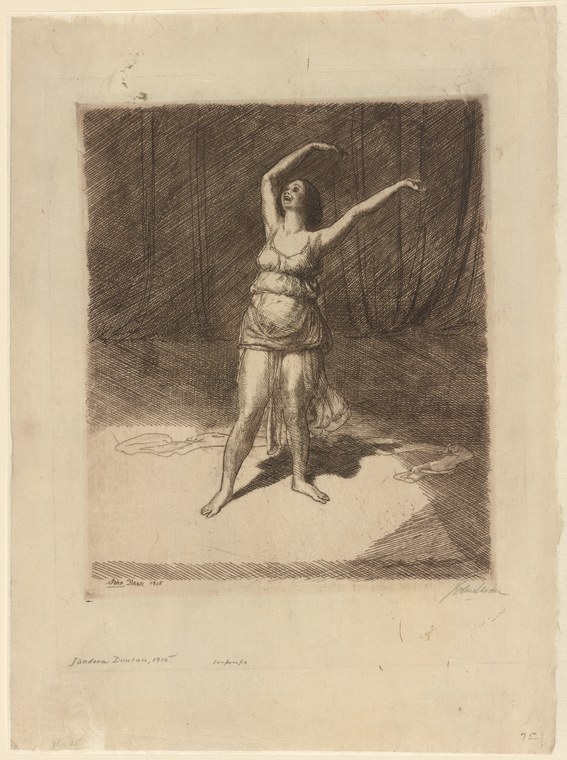
Isadora Duncan transformed how modern bodies could move on stage and how that movement could be represented. This etching—a fine art print rather than a photograph—shows how Duncan's revolutionary practice was absorbed into the visual culture of the early twentieth century and made legible to educated audiences through classical references and museum-quality technique. For dancers and historians, it documents not Duncan's actual movement but the aesthetic mythology surrounding her—how she was seen, celebrated, and translated into the high art forms of printmaking.
What you are looking at
A female dancer stands alone in an austere interior, spotlit against heavy draped curtains that fill the background. She wears a simple draped tunic or chiton bound at the waist and hips, in the manner of ancient Greek dress, with her feet bare. Her body is caught mid-movement in a classical contrapposto stance, her left arm extended outward and slightly upward while her right arm reaches diagonally across her body. Her weight rests primarily on her left leg, the right leg slightly bent. The composition is intimate and focused: the dancer occupies the center of a shallow stage space defined by receding vertical drapery lines, creating geometric depth. The etching technique renders the scene in warm sepia tones with delicate cross-hatching in the drapery and subtle modeling on the figure's musculature. The lighting emphasizes the dancer's body while leaving her face in partial shadow.
The dancing
A single female dancer in profile-frontal view, her body aligned in a classical contrapposto with one leg supporting and the other bent. Her arms are arranged asymmetrically—the left extended to shoulder height or above, the right drawn inward—creating an open, expansive upper body despite a grounded lower half. The pose suggests a moment of lift or suspension rather than weight in motion. Her costume, a simple chiton, leaves the arms, legs, and torso exposed, allowing the viewer to read every articulation of the body. The musculature is rendered with anatomical attention, suggesting the dancer's training and control.
The dance depicted
This is most likely a representation of Isadora Duncan or her style of dance—the title supports this identification. The costume, bare feet, and pose align with Duncan's revolutionary modern dance aesthetic of the early twentieth century, which rejected ballet's pointed shoes and rigid technique in favor of natural movement based on classical Greek forms. The contrapposto stance and raised arm evoke both ancient Greek statuary and the languid, flowing gestures that characterized Duncan's choreography. The image captures not an explosive moment of motion but a pose of repose or transition—the kind of contained, aesthetically composed moment that Duncan's photographs and contemporary engravings often emphasized. Duncan's dance was theatrical and deliberate, meant to be viewed as art, and this etching reflects that status.
How it was made
This is an etching, identifiable from the fine linear hatching, the characteristic plate marks, and the warm brown ink typical of nineteenth and early twentieth century printmaking. Etching allowed for intimate, detailed work suitable to gallery exhibition and art collecting—a medium more prestigious and longer-lived than theatrical programs or newspaper illustrations. The technique's capacity for delicate modeling of the human form, visible here in the figure's musculature and the volumetric rendering of the drapery, made it ideal for anatomical studies of the dancing body. The work circulated as a fine print, not as popular entertainment, suggesting an audience of artists, collectors, and dance enthusiasts familiar with both classical art and contemporary modern dance.
About this work
This etching depicts a female dancer in a classical Greek-inspired costume—bare feet, draped tunic, simple binding—posed in a moment of aesthetic suspension against a background of heavy studio drapery. The title indicates this is Isadora Duncan, the American modern dancer who revolutionized early twentieth-century dance by rejecting ballet convention and instead drawing on ancient Greek movement and natural gesture. The work captures her aesthetic through the stillness and formal composition the era favored: the dancer is not caught in action but posed as sculpture, her body a legible object of art. The etching medium positions it as a fine art print for collectors and artists rather than a commercial theatrical record, reflecting the high cultural status Duncan's work had achieved by the time this print was made.
How to look at it
Attend to the stillness of the pose: this is not a capture of motion but a composed, sculptural moment. The artist has chosen to emphasize the classical proportions and the geometric relationships of the body—how the extended arm balances the slight S-curve of the torso, how the contrapposto grounds the figure while the upper body opens outward. The drapery behind is not incidental scenery but an active formal element, its vertical lines emphasizing the figure's verticality and its shadows modeling the space. Notice too the bare feet: they are rendered with anatomical precision and are fully integrated into the pose, a radical statement in an era when ballet's pointe shoe was the standard marker of trained dance. The lighting and the gentle modeling of the body invite you to see the dancer as a subject of serious artistic attention, as worthy of the fine art print as any classical sculpture.
The artist
The artist is not recorded in the catalogue. The etching bears a signature (partially visible in the lower right) and a date inscription (noted as "Isadora Duncan, 1917" or similar in the lower left), but neither is fully legible in the image. The work was executed during Duncan's active performing years and distributed through art channels—it is held in a major public collection dedicated to dance iconography. The technique and quality suggest a professional printmaker of some standing, possibly someone working in artistic circles in Paris or another European capital where Duncan was celebrated.
The period
This work emerges from the early twentieth-century intersection of modern dance, classical revival, and fine art printmaking. Duncan's work (1877–1927) coincided with Art Nouveau, Symbolism, and early Modernism—aesthetic movements that prized the expressive human figure and drew on classical sources. The 1917 date places it during World War I, a period when Duncan's reputation in Europe was already secure despite the traumas of the war; by this date she had been performing for nearly thirty years and had established schools and a methodology. The etching format reflects the period's confidence in the fine print as a vehicle for artistic expression and historical documentation. Simultaneously, photography was becoming the dominant medium for capturing dance, making a hand-pulled print a choice with artistic rather than purely documentary intent.
Where it lives
The work is part of the New York Public Library's 'Prints depicting dance' collection, held in the performing arts division. It is catalogued by subject (Isadora Duncan) rather than by artist name, indicating that the dancer's identity was the primary reason for its collection and preservation. As a fine art print in a public institution, it circulated as a documented artifact of modern dance history rather than as a commercial theatrical souvenir.
Dance in this work
Questions about this work
Is this a photograph of Isadora Duncan?
No, it is an etching—a hand-pulled fine art print. Etchings are made by incising a design into a copper plate, inking it, and pressing paper onto it. This technique allows for fine detail and a warm, delicate image, but it is fundamentally different from photography. The etching was likely made after a photograph or a live performance, or from the artist's memory and knowledge of Duncan's work and aesthetic.
Why are her feet bare?
Bare feet were central to Isadora Duncan's revolution in modern dance. She rejected the pointe shoes of classical ballet as artificial and constraining, arguing that the human foot in its natural state was more expressive and more honest. Bare feet became a signature element of her technique and her visual identity, immediately recognizable to her audiences and to artists who represented her.
What is she wearing?
A simple draped tunic or chiton, in the manner of ancient Greek dress. Duncan drew heavily on Greek and Roman sources for her aesthetic—she saw ancient Greece as a model of natural, uninhibited human movement. This costume, minimal and ungathered at the waist, allowed her body to be fully visible to the audience, a stark contrast to the heavily constructed tutus and bodices of classical ballet.
When was Isadora Duncan at her peak?
Duncan performed professionally from the 1890s onward and was at the height of her international fame from roughly 1905 to 1920. This etching dates to 1917, near the end of her performing career. She continued to teach and create until her death in 1927. Her influence on modern dance was immense and enduring, establishing the foundation for twentieth-century contemporary dance.
More dance artwork





