49 works in this view — arrow keys or swipe to move between them.
Dance in Art
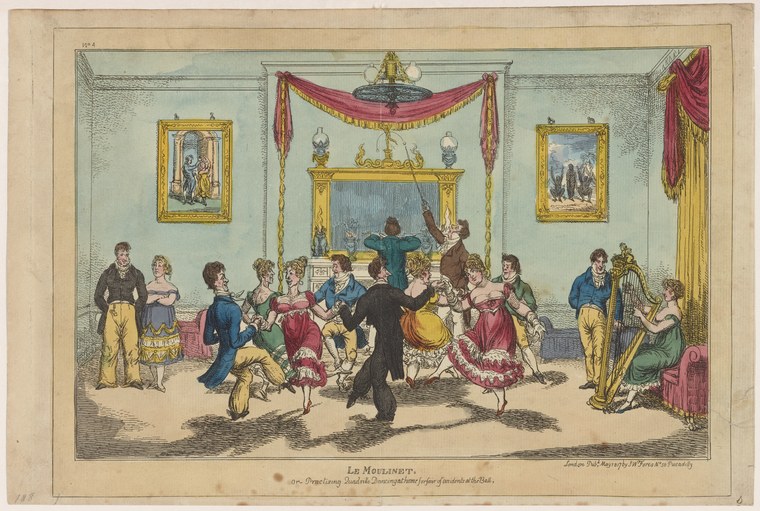
Le Moulinet, or practising quadrille dancing at home for fear of accidents at the ball
Unknown artist
- Collection:
- Prints depicting dance
- Source:
- New York Public Library
- Rights:
- Public domain — free to use, share and adapt.
- Recorded as:
- Public Domain
For historians of dance, this image is invaluable evidence of how the quadrille was actually taught and practiced—not in a studio but in a private room, with a conductor-like master and live music. For art historians, it exemplifies the genre print tradition of documenting fashionable life and the visual conventions used to convey instruction, hierarchy, and the aspirations of the middle classes. The print's explicit concern with preventing "accidents"—social failure—reveals the anxiety beneath the apparent ease of Regency ballroom culture.
What you are looking at
A hand-colored engraving depicting an indoor dance instruction or practice scene, likely from the early 19th century. The setting is an elegant room with pale green-blue walls, gold-framed paintings hung symmetrically, and heavy crimson drapes swagged across the top. A large mirror with a gold frame dominates the back wall, reflecting the scene. At the room's center, a small group of dancers moves in formation under the direction of a man in black (likely a dance master), while musicians play at the right: a man with a harp and another figure. Around the perimeter stand onlookers in fashionable dress—men in breeches and dark coats, women in high-waisted muslin gowns and bonnets typical of the Regency period. The dancers themselves wear similar period dress, with the women in pale silk skirts and the men in knee breeches. A small child sits or crouches in the foreground, and the overall mood is one of genteel domestic instruction rather than a public ball.
The dancing
The dancers move in a square or rectangular formation characteristic of quadrille, with couples positioned at cardinal points. Their posture is upright and formal, with arms held at the sides or lightly positioned for the prescribed figures of the dance. The dance master in the center gestures with authority, conducting the movement; his dark silhouette creates a visual focal point. The surrounding figures stand at ease, watching intently. The composition emphasizes the instructional nature of the scene—this is a rehearsal under supervision, not spontaneous social dancing.
The dance depicted
This is a quadrille, one of the most popular social dances of the Regency and early Victorian periods. The title references the feared "accidents at the ball"—social missteps and collisions—that might occur without proper domestic rehearsal. Quadrilles were square dances performed by two or four couples in a set, composed of five distinct figures with prescribed steps and formations. They required coordination, memory, and precision, making home practice sessions valuable for ensuring competent social performance. The image documents the pedagogy of ballroom dance: the role of the dance master as authoritative instructor, the importance of domestic practice space (often the parlor or drawing room), and the involvement of musicians (harp and a second instrumentalist, likely violin or flute) in maintaining the tempo and structure.
How it was made
This is a hand-colored engraving, likely etched and then aquatinted for the tonal areas (walls, shadows, drapery). The technique allowed for fine detail in the figures' dress and faces while creating convincing spatial recession through the parallel lines of the wall paneling and the careful placement of the mirror. The hand-coloring, applied after printing, varies slightly in consistency and coverage, which is typical of commercial color work of the period. The relatively small size and portable nature of such prints made them affordable and collectable among the middle classes—this was popular entertainment and instruction combined.
About this work
Le Moulinet (literally "the little mill" or spinning motion, a figure in the quadrille) is a genre scene capturing the domestic practice of ballroom dancing in early 19th-century Britain or France. It documents both the dance itself—the quadrille, the defining social dance of the era—and the culture surrounding it: the professionalization of dance instruction, the involvement of hired musicians, the physical arrangement of the drawing room, and the social anxieties that prompted even affluent families to hire masters and rehearse privately before attending public balls. The print belongs to a substantial tradition of dance instruction imagery and social satire that flourished in the late 18th and early 19th centuries, making it both a technical record and a social document.
How to look at it
Pay attention to the spatial arrangement: the dance master in the center, the musicians on the right edge, the mirror reflecting the scene, and the spectators lining the walls. This composition tells you how the room functioned—the mirror allowed dancers to observe themselves, the master's central position shows his authority and visibility, and the spectators' positions (some standing, one seated, the child in the foreground) establish a hierarchy of attention and interest. The careful rendering of dress—the high waistlines, the long skirts, the breeches and coats—anchors this in a specific historical moment. Look also at the hands and feet: notice how the artist conveys the prescribed, formal nature of the quadrille through controlled posture and symmetrical arm positions, quite different from the abandon of later social dances.
The period
The quadrille emerged in France in the 1780s and became the dominant figure dance in Britain and Europe by the 1810s–1840s, displacing older country dances and cotillions. It was considered sophisticated, French, and modern—precisely the kind of accomplishment that marked a well-educated young person. The early 19th century saw an explosion of dance instruction books, printed dance cards, and satirical prints depicting dance lessons and balls, reflecting both the commercialization of dance and middle-class anxiety about social propriety. The Regency period (1811–1820) in Britain was marked by fashionable living centered on the drawing room, where parlor accomplishments—music, dancing, drawing, needlework—were cultivated and displayed. This print sits within that visual culture of domestic improvement and social aspiration.
Where it lives
The print is held in the New York Public Library's collection of prints depicting dance. The inscription at the bottom is partially legible; the format, size, and technique are consistent with early 19th-century commercial reproductive prints sold in London and Paris, likely hand-colored at the publisher's workshop or by independent colorists and sold singly or in bound collections.
Dance in this work
Questions about this work
What is a quadrille?
A quadrille is a square dance for four couples (eight dancers) arranged in two lines facing each other, or for two couples facing across. It consists of five set figures—typically Pantalon, Été, Poule, Trenis, and Finale—each with prescribed steps and formations. Dancers follow the figures in sequence, with a caller or music providing the cues. It was the dominant ballroom dance of the early 19th century and required rehearsal to perform smoothly in social settings.
Why would people practice quadrilles at home?
Quadrilles were complex dances with prescribed figures that had to be executed in synchrony with other dancers. Public balls and assemblies were occasions for showing off accomplishment and social standing, so practicing privately with a hired master and musicians reduced the risk of visible mistakes—the "accidents" mentioned in the print's title. Rehearsal was also an entertainment and a marker of gentility and education.
Who is the figure in black at the center?
This is the dancing master, a hired professional responsible for teaching the quadrille and conducting the dancers through its figures. His central position and the way the dancers orient toward him show his authority. Dancing masters were common in genteel households of the period and often traveled between families, teaching seasonal classes before the winter ball season.
What era is this from?
The style of dress, the fashionable drawing room, and the popularity of the quadrille all point to the early 19th century, most likely between 1810 and 1840. The engraving technique and hand-coloring are consistent with commercial prints of this period. The specific date of this print is unknown, but it was made during the height of the quadrille's dominance in European ballroom culture.
More dance artwork





