49 works in this view — arrow keys or swipe to move between them.
Dance in Art
Dance on music covers
Unknown artist
- Collection:
- Prints depicting dance
- Source:
- New York Public Library
- Rights:
- Public domain — free to use, share and adapt.
- Recorded as:
- Public Domain
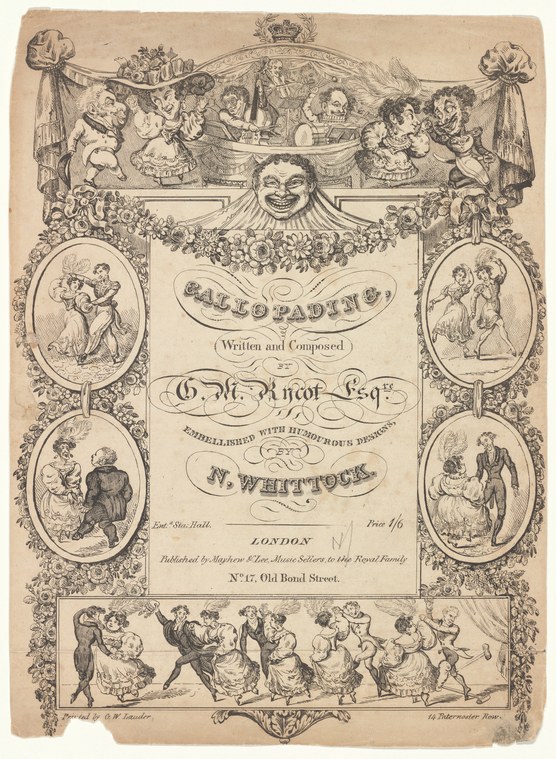
The four ovals and the frieze provide rare visual documentation of early-19th-century English waltz, quadrille, and cotillion technique—the actual height and frame of the dance, the hold, and the social context in which it was performed. This level of specific detail about how bodies related to one another in partnered dance is scarce in the visual record. The work also shows how music publishers marketed dance to the fashionable public, using the appeal of social dancing to sell compositions.
What you are looking at
This is a title page for a musical work called "Allodium," engraved and published in London by Longman & Broderip around the early 19th century. The page is framed by an elaborate Regency-era decorative border featuring acanthus scrolls, garlands, and cherubs. At the top center sits a jovial male mask or head with a wide grin, flanked by two cherubs holding swags of drapery. Below this are four oval vignettes arranged in a diamond pattern, each depicting dancing figures in period dress: couples and groups performing social dances of the era, their movements animated and their clothing (high-waisted gowns, breeches, tailcoats) typical of the Regency period. The central space contains the title and composer credit to "G. M. Ancot Esq." with music "Engraved with his Directions." At the bottom runs a continuous frieze of small figures dancing, conversing, and socializing—a lively ballroom scene compressed into a single horizontal band. The overall effect is theatrical and celebratory, designed to advertise both the music and the fashionable dance culture of the day.
The dancing
The four oval vignettes show pairs and small groups in closed and open holds characteristic of Regency-era ballroom dancing. In the upper left, a couple faces each other in what appears to be a waltz or similar embrace. The women wear high-waisted, empire-silhouette gowns with long skirts; the men wear tailcoats, breeches, and stockings. Bodies are upright and formal, with women's arms raised and men's posture erect—the deportment of trained social dancers. The lower frieze shows more varied poses: some figures stand in conversation, others move through the steps of a dance, and the composition suggests the sequential movement of a group dance or cotillion. Arms and legs are depicted with enough specificity to suggest actual dance steps, not merely generic movement.
The dance depicted
The image documents English Regency-era social ballroom dancing, most likely the waltz, cotillion, and quadrille—the fashionable dances of London drawing rooms and assembly rooms circa 1800–1820. The four ovals suggest different dances or phases of a dance event, while the frieze at the bottom captures the social choreography of an entire ball. The closed hold in the upper left vignette is consistent with the waltz, which was becoming fashionable in England during this period, though still considered somewhat daring for its intimacy. The formality of posture and the presence of multiple couples suggest cotillion or quadrille variations as well. This is documentary evidence of how educated, fashionable dancers held themselves and partnered during the Regency period.
How it was made
This is a hand-colored engraving, as evidenced by the fine linear detail, the hatching technique, and the application of watercolor or gouache tint (visible in the background wash and the delicate coloring of the dress and decorative elements). The engraving would have been printed from a copperplate and then hand-colored by workshop assistants, a standard practice for commercial music covers and popular prints of the period. This technique allowed for broad circulation and relatively affordable production, making the work accessible to amateur musicians and dancers who would purchase the sheet music. The elaborate decorative border suggests this was a commercial title page meant to appeal to the genteel market of London music publishers, and the quality of engraving indicates a respectable publisher's investment.
About this work
This is a music-cover engraving documenting Regency-era social dance through four narrative vignettes and a ballroom frieze. It presents dance not as abstract movement but as a fashionable social ritual, capturing the posture, partnerships, and costume conventions of the English drawing room and assembly room circa 1800–1820. The work sits at the intersection of music publishing, social history, and dance representation—it is simultaneously a commercial product (a title page for sheet music), a fashion plate (showcasing current dress), and a choreographic document (showing how men and women actually partnered and moved). For dance historians, it is invaluable evidence of early-19th-century English ballroom technique, partnering conventions, and the social choreography of the ball; for art historians, it exemplifies the commercial print culture of Regency London.
How to look at it
Attend first to the holds and frames in the four ovals: notice how the couples relate to one another spatially and physically. The upper left vignette shows the closest, most formal embrace—likely the waltz. The other ovals show more open or group-based formations. Look at the women's arms: are they raised, lowered, extended to the side? In the frieze, follow the sequence from left to right and notice how the figures progress through what may be a single dance or multiple moments in a ball. The cherub mask at the top and the swags of drapery are celebratory ornament, signaling that this is a joyous, fashionable subject. The precision of the engraving means every line conveys information about costume, posture, and movement.
The artist
The engraver and designer are not identified on the page. The work is credited to the composer G. M. Ancot, about whom little is known; it was published by Longman & Broderip, the major London music publisher of the period. The print shows the hand of a skilled commercial engraver versed in the Regency decorative vocabulary—the scrollwork, cherubs, and framing devices are all standard to the period's design language. The quality suggests a London workshop of some standing, though without a signature or inscription the individual artist remains anonymous.
The period
This engraving dates to the era when the waltz was being introduced and adopted in English high society, a process that generated considerable cultural debate and moral concern about the closeness of the hold. At the same time, the quadrille and cotillion remained the dominant group dances, and the cotillion in particular was undergoing rapid stylistic change and elaboration. The Regency period (1811–1820) saw an explosion of dance instruction manuals, music publications, and fashion plates documenting the social dances of the era. This print participates in that visual and commercial apparatus, marketing fashionable dance to the leisure class. In art, the period saw an appetite for narrative, genre scenes that celebrated fashionable leisure; the ovals framing social dances fit squarely within this aesthetic.
Where it lives
Held by the New York Public Library as part of its Prints collection documenting dance. The work is a commercial music cover, likely one of many impressions printed and distributed for sale to amateur musicians and dancers in early-19th-century England. Its presence in an American institutional collection reflects 19th- and 20th-century collecting practices that valued Regency-era material as historical evidence of manners and taste.
Dance in this work
Questions about this work
Can you identify the dances shown in the four ovals?
The upper-left vignette most likely shows a waltz, based on the closed hold and formal embrace. The others are harder to specify from the image alone but likely represent variations of the cotillion or quadrille, which were the dominant group dances of the Regency period. All four ovals together may document different phases of a single dance event or different dances danced in sequence at a ball.
Why does the sheet music show so many dancing figures instead of just the title?
This was a standard marketing practice for music publishers of the period. The image of fashionable dancers in elegant dress appealed to the leisure class who bought sheet music for drawing-room performance. The image sold the aspiration as much as the music—it promised not just the notes but entry into fashionable society and the chance to perform the latest dances.
What can this engraving tell us about dance history?
It documents the posture, hold, and social formation of English Regency ballroom dancing with unusual specificity. The upright frame, the formality of the dancers' bodies, and the careful depiction of costume and partnering conventions make it a valuable historical source for understanding how men and women actually danced together in the early 19th century. It also shows the centrality of dance to fashionable leisure and courtship.
More dance artwork





