49 works in this view — arrow keys or swipe to move between them.
Dance in Art
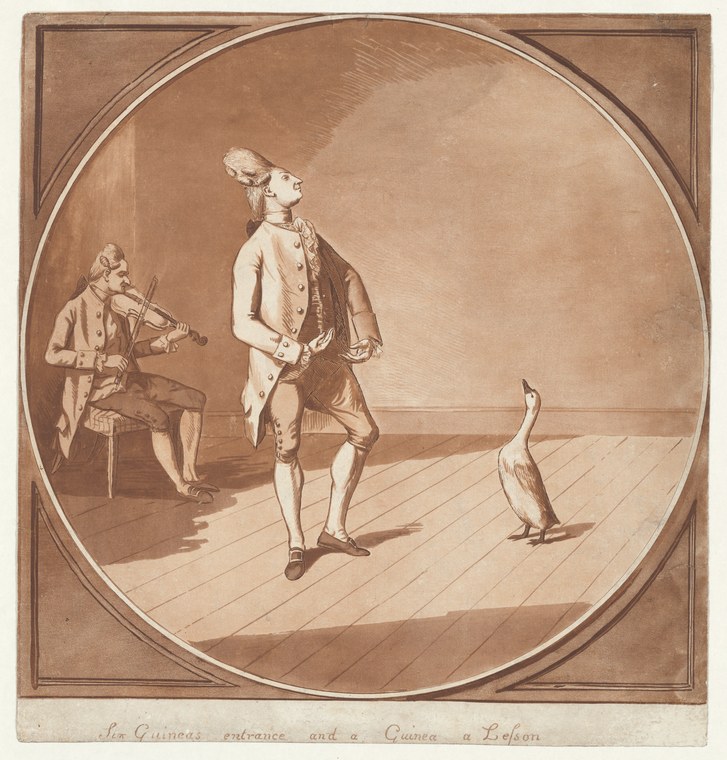
Six guineas entrance and a guinea a lesson
Unknown artist
- Collection:
- Prints depicting dance
- Source:
- New York Public Library
- Rights:
- Public domain — free to use, share and adapt.
- Recorded as:
- Public Domain
This image is rare documentary evidence of how dance instruction was actually marketed and conducted in the 18th century, capturing the teacher-student relationship, the role of live music, and the commercial pricing of an accomplishment that was essential to genteel social participation. The duck's presence, whether pedagogical or satirical, hints at the performative and sometimes absurd dimensions of fashionable dance practice in the period.
What you are looking at
A gentleman in 18th-century dress stands at the center of a wooden stage, his body angled three-quarter view, watching intently. To his left sits a violinist on a chair, bow raised, providing accompaniment. To his right, a duck waddles across the stage floor, its neck extended and wings slightly raised. The stage is set within a circular frame, the background rendered in warm brown washes suggesting interior theatrical lighting. The floor is drawn with clear perspective lines receding toward the back. The gentleman wears a light-colored coat with buttons, dark breeches, shoes with buckles, and a tricorn hat; his posture is alert and amused, his gaze fixed on the bird. The violin music and the duck's presence suggest a moment of entertainment or instruction.
The dancing
The gentleman's stance is upright but relaxed, weight distributed on both feet in a position ready to move—neither frozen nor actively dancing. His arms hang loosely at his sides, and his head tilts slightly forward in observation. The violinist is seated in profile, arm raised in active playing position. The duck is rendered as a living creature in motion, not as a prop, with its body suggesting active movement across the stage. The spatial relationship between the three figures forms a triangle, with the gentleman as the focal point.
The dance depicted
This image most likely documents an 18th-century dancing master's lesson or advertisement. The title 'Six guineas entrance and a guinea a lesson' indicates a commercial dance instruction scenario. The gentleman appears to be a student or dancing master demonstrating or learning movement, possibly with the duck present as a whimsical prop or test of balance and coordination—a known pedagogical device in early modern dance instruction. The violin provides live accompaniment, standard for any formal dance lesson of the period. Without clear evidence of a specific dance step being executed, the image appears to document the commercial and social context of dance instruction rather than a particular style.
How it was made
This is a hand-colored etching or engraving, identifiable by its line-based construction, the formal circular frame, and the uniform brown wash coloring characteristic of 18th-century satirical or documentary prints. The technique allowed for mass production and distribution, making it likely a broadside or advertisement that could be posted or sold cheaply. The warm monochromatic treatment and careful cross-hatching suggest a professional print shop production. This was a common medium for advertising services or satirizing social practices in the Georgian era.
About this work
This print documents the commercial reality of 18th-century dance instruction in England, capturing a dancing master's studio advertisement through the figure of a gentleman taking lessons with live violin accompaniment. The playful inclusion of a duck suggests either the eccentricity of the instructor or a comic representation of a teaching method designed to test the student's focus and balance. The work sits at the intersection of dance history, social satire, and commercial advertising—revealing what a lesson cost, how it was taught, and how it was publicly marketed to potential students.
How to look at it
Focus on the gentleman's posture and the spatial arrangement: he is not mid-step but rather in an attitude of attention and instruction, watching both the violinist and the duck. The duck's position and movement give the scene its compositional balance and its humor. The circular frame was a common compositional device for theatrical or performance scenes, suggesting this is a formally documented moment rather than a casual sketch. The precision of the floor's perspective lines and the careful rendering of the stage setting indicate this is not generic but attempts to document a specific type of commercial space.
The period
In the 18th century, dancing was a core requirement of genteel education for both men and women in Britain. Professional dancing masters operated studios in major cities and advertised their services to aspiring members of the gentry and merchant classes. The guinea was a significant fee—roughly equivalent to a week's wages for a tradesman—making dance instruction a commodity for the relatively wealthy. The period saw the standardization of French court dances (minuet, cotillion, country dances) as the models for polite society. Satirical prints documenting social practice were a popular and profitable genre, and advertisements for professional services often appeared in this visual form.
Where it lives
This print is held in the New York Public Library's collection of prints depicting dance. It appears to be an 18th-century British satirical or documentary print, likely produced for commercial distribution as either an advertisement, a satirical comment on dance instruction, or both.
Dance in this work
Questions about this work
What was a guinea in 18th-century money?
A guinea was a gold coin worth £1 and one shilling (21 shillings total). The 'six guineas entrance' mentioned in the title would have been a substantial initial fee to join a dancing master's academy, and 'a guinea a lesson' a per-session charge—comparable to a skilled worker's weekly wages. Dance instruction was thus a luxury service for the gentry and aspiring middle classes.
Why is there a duck on the stage?
The duck's purpose is unclear but plausible explanations exist: it may be a test of the student's balance, focus, and ability to ignore distraction—a real pedagogical practice; or it may be satirical commentary on the pretensions or eccentricities of fashionable dance instruction. Either way, it would have made the image memorable and amusing to a viewing public.
What dances were taught in 18th-century London studios?
The standard repertoire included the minuet (the most prestigious), cotillion, country dances, and the allemande. All were French in origin and marked the dancer as refined and educated. These were social dances, not theatrical performances, though many dancing masters were also choreographers for the London theaters.
More dance artwork





