49 works in this view — arrow keys or swipe to move between them.
Dance in Art
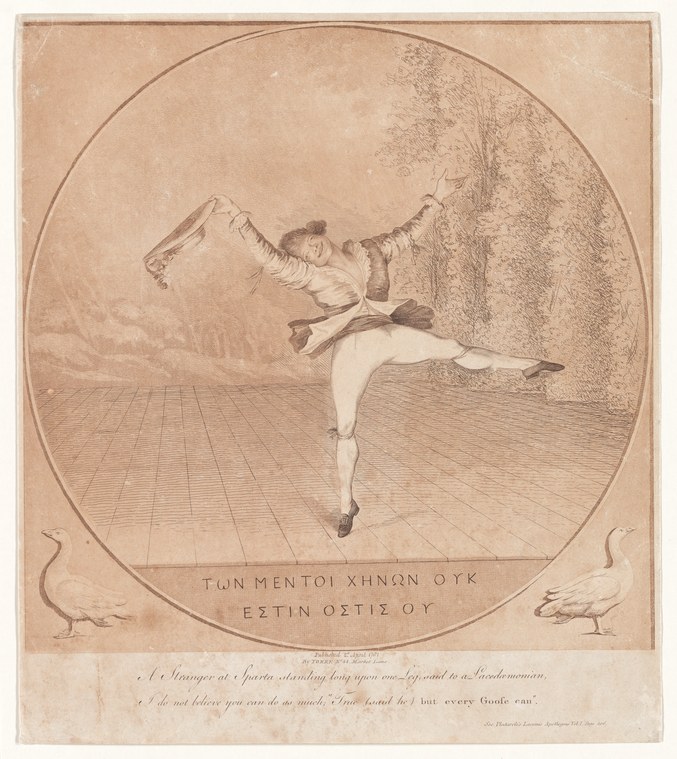
A stranger at Sparta standing long upon one leg,: said to a Lacedoemonian, I do not believe you can do as much; "True (said he) but every goose can"
Unknown artist
- Collection:
- Prints depicting dance
- Source:
- New York Public Library
- Rights:
- Public domain — free to use, share and adapt.
- Recorded as:
- Public Domain
This engraving documents an early phase of ballet pedagogy and the neoclassical framing of dance as a classical art form rooted in Greek and Roman precedent. It shows how late 18th-century artists and dance makers were beginning to isolate and study specific positions and movements, creating a visual record of technique that was not yet fully codified in the written vocabulary that would emerge in the 19th century.
What you are looking at
A solitary female dancer stands in profile within a circular composition, balanced on one extended leg in an arabesque or attitude position. Her supporting leg is straight and strong; her free leg extends behind or to the side with pointed foot. She wears a simple muslin or linen tunic with short sleeves and a dark belt at the waist, with her hair arranged in a classical style. The floor is rendered in linear perspective, receding toward a distant colonnade or architectural feature on the right. The setting suggests an interior space—perhaps a studio or gymnasium—with classical proportions. Two serpentine ornaments frame the bottom of the circular frame. Below the image, Greek text appears, followed by an English verse describing a Lacedaemonian who can stand longer on one leg than a stranger, with the goose's retort.
The dancing
A single female dancer in an extended balancing pose. Her weight is fully supported on one straight leg; the other leg is fully extended behind or to the side with a pointed foot, in the position known as arabesque or attitude. Her arms are raised and extended, one forward and one back or raised to the side, creating an elongated line from fingertip through the supporting leg. Her torso is upright and controlled. The pose demands extreme balance, ankle strength, and sustained extension—qualities central to classical training.
The dance depicted
This appears to depict a classical or neoclassical exercise or demonstration, not a narrative dance or social dance. The subject is a single dancer performing a technical feat of balance and extension—likely associated with the emerging academic ballet training system of the late 18th century. The Greek epigram and English verse frame this as a test of human endurance and skill, comparable to a goose's ability to stand on one leg. The costume is generic classical-revival dress rather than specific to any tradition, and the architectural setting evokes Greco-Roman precedent. This is closer to gymnastic display or pedagogical demonstration than theatrical performance.
How it was made
This is an engraving, executed in line with fine cross-hatching to model form and suggest three-dimensional space. The circular frame was a common format for neoclassical subjects. The technique of engraving allowed precise rendering of anatomical form and fine detail in the dancer's musculature and pose; it also made the work reproducible and widely circulatable. The classical subject matter and formal composition suggest this was intended as both a work of artistic merit and a teaching or reference document.
About this work
This is a late 18th-century engraved study of a female dancer in an extended balancing pose, inscribed with a Greek epigram and English verse about standing on one leg. The work sits at the intersection of classical revival aesthetics, emerging academic ballet training, and the graphic arts tradition of anatomical and movement study. It represents both the neoclassical taste for Greco-Roman subjects and an early interest in codifying and visualizing dance technique through print. The image is neither a theatrical scene nor a social dance, but rather a technical and philosophical demonstration—a visual argument about human capability and control.
How to look at it
Attend to the absolute stillness and control implied by the pose—this is not a passing moment in movement, but a held position demonstrating mastery of balance and strength. The extended leg, pointed foot, and upright carriage show the discipline of classical training. The circular frame isolates the figure and emphasizes the geometry of the pose, inviting comparison to classical sculpture. The accompanying epigram transforms the image from mere technical study into a philosophical statement about human excellence and the animal world.
The period
This engraving dates to the late 18th century, when neoclassicism dominated European art and culture following the excavations at Pompeii and Herculaneum. In dance, this was the era of the ballet d'action—ballets that told stories rather than serving merely as courtly ornament—and of increasing formalization of training methods. The classical body, studied through anatomy and modeled in sculpture, was becoming the ideal form for dance. The integration of Greek text with English verse suggests a work intended for an educated, anglophone audience with classical learning.
Where it lives
This engraving is held in the New York Public Library's Prints collection, which documents dance in visual culture through prints, drawings, and other works on paper. The collection emphasizes the role of graphic media in circulating ideas about dance to a broad public.
Dance in this work
Questions about this work
Is this a ballet?
It depicts a ballet position or exercise rather than a narrative ballet scene. The pose—an extended balancing position—would become fundamental to classical ballet training, but here it is presented as an isolated technical and philosophical demonstration, not part of a theatrical performance.
What is the Greek text?
The inscription references an Aesopian fable about a Lacedaemonian (Spartan) who, challenged by a stranger to prove he could stand longer on one leg, replied that while he could not, any goose could—a witty deflation of human boasting. The engraving visually enacts this test of endurance and balance.
When was this made?
The record lists the date as unknown, but the style—neoclassical aesthetic, fine line engraving, classical costume, and Greek epigraph—places it in the late 18th century, during the height of neoclassicism in European art and the emergence of academic ballet training.
Who is the dancer?
The dancer is not identified. The figure appears to be a generic classical ideal rather than a portrait, serving as a vehicle for demonstrating a position and illustrating an idea about human skill and animal nature.
More dance artwork





