49 works in this view — arrow keys or swipe to move between them.
Dance in Art
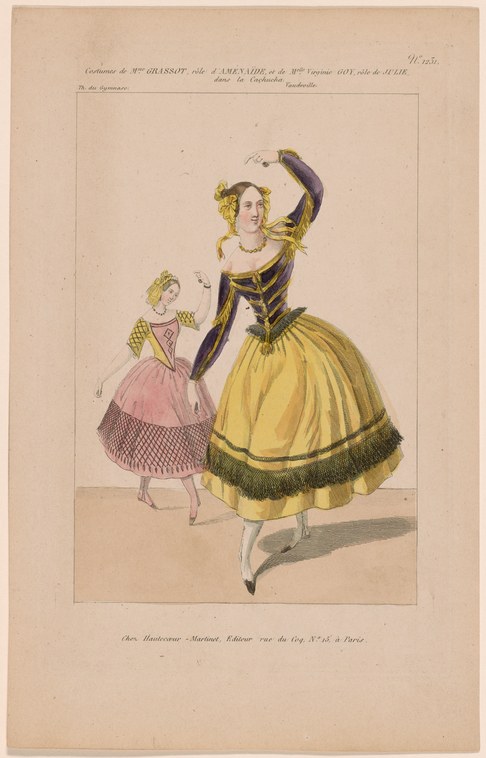
Costumes de Mme. Grassot, rôle de Aménaïde, et de Melle. Virginie Goy, rôle de Julie, dans la Cachucha. Vaudeville, Th. du Gymnase
Unknown artist
- Collection:
- Prints depicting dance
- Source:
- New York Public Library
- Rights:
- Public domain — free to use, share and adapt.
- Recorded as:
- Public Domain
This image captures the cachucha at its peak of fashion in Parisian theater, when Spanish-influenced dance was being actively integrated into the ballet vocabulary. For dance historians, it is direct visual evidence of how technique, costume, and theatrical convention combined to produce one of the era's most commercially successful dance forms. The print also documents the role of female virtuosos in driving theatrical innovation and the economics of 19th-century dance celebrity.
What you are looking at
This is a hand-colored theatrical print showing two female dancers in costume against a plain background, characteristic of 19th-century stage design documentation. The foreground figure, identified as Mlle. Virginie Goy in the role of Julie, wears a voluminous yellow skirt with black trim and a dark bodice, her left arm raised expressively overhead while her body twists in a dynamic pose. Behind her stands a smaller figure in a pink dress, identified as Mme. Grassot in the role of Aménaïde, creating a compositional depth through scale and positioning. Both dancers wear pale stockings and heeled shoes; their hair is styled up in the fashionable mode of the period. The print documents costumes from a production of *La Cachucha* at the Théâtre du Gymnase, a Parisian vaudeville house. The composition freezes a moment of energetic movement, with Goy's pose suggesting rapid rotation or a turning step characteristic of the Spanish-influenced dances then fashionable in Parisian theater.
The dancing
The principal dancer, Goy, is captured mid-turn with her torso twisted and her raised arm creating a strong vertical line that carries the viewer's eye upward. Her weight appears to be on one supporting leg, with the other leg extended or in transition, a pose suggesting either the traveling turns or characteristic hip-led movements of cachucha technique. The smaller figure behind functions almost as a duet partner or secondary character, her more modest pose and positioning creating narrative hierarchy. The dancers' arm positions—particularly Goy's elevated arm and the general openness of the frame—suggest the theatrical vocabulary of Romantic-era movement rather than the controlled, enclosed lines of classical ballet.
The dance depicted
This is a cachucha, a Spanish dance that became a Parisian theatrical sensation in the 1830s–1840s. The cachucha combined Spanish folk elements—rapid hip motion, castanets, and turned-out hip action—with the technical vocabulary of ballet, and was typically performed as a solo showpiece by prima donnas. The costume, the energetic twisted pose, and the theatrical framing all point to this hybrid form. The print documents a specific performance at the Théâtre du Gymnase, capturing how this once-exotic Spanish dance had been fully absorbed into Parisian vaudeville entertainment. The raised arm and rotational energy visible in Goy's posture align with contemporary descriptions of cachucha technique as involving rapid spins and sharp hip articulation.
How it was made
This is a hand-colored lithograph or engraving, a medium standard for theatrical costume documentation in 19th-century Paris. The delicate line work, fine hatching for shadow, and the careful application of watercolor or gouache over the print surface are characteristic of the luxury theatrical prints produced for collectors and patrons. The technique allowed theaters to distribute images of their stars and costumes widely, serving both as publicity and as a record of specific productions. The print's format and style place it within a large body of such documentation from the Parisian stage, a form of marketing and visual archive that was central to theater culture of the period.
About this work
This print documents a moment in the theatrical life of a specific Paris production: two dancers in character costumes from *La Cachucha*, a dance-centered vaudeville staged at the Théâtre du Gymnase. The work sits at the intersection of three strands of 19th-century culture: the Romantic-era obsession with Spanish exoticism (which manifested in the cachucha craze), the rise of the prima donna as theatrical commodity, and the lithographic print industry that made theatrical ephemera collectible. It is not a record of a historical dance as such, but rather a theatrical artifact—a snapshot of how a Spanish folk form was domesticated, glamorized, and circulated through Paris's commercial theaters. The print belongs in a dance gallery because it documents actual choreography and technique as they were performed and understood by audiences of the 1830s–1840s.
How to look at it
Attend to the pose itself: the raised arm, the twisted torso, and the implied rapid rotation are not accidental. This is the moment a choreographer or artist chose to represent the cachucha—energetic, asymmetrical, and weight-shifted rather than balanced. Notice how the smaller figure in pink is scaled and positioned not as an equal but as a secondary character, reinforcing the print's function as a record of a specific star performance. The yellow skirt's volume and its black decorative trim are not merely costume detail; they were essential to the visual and kinetic effect of the dance, and the print's careful rendering of both figures' legs and feet indicates that footwork mattered to how this dance was understood and admired.
The period
The cachucha emerged in Spanish folk tradition but became a European sensation through the 1830s and 1840s, when it was adopted and refined by Parisian ballet dancers. The Spanish dance's rapid hip motion, rhythmic precision, and exoticism fitted the Romantic era's appetite for colorful character dances and foreign spectacle. By the time this print was made, the cachucha had moved from the ballet stage (where it appeared in mixed programs) into popular theater and vaudeville, as this print's attribution to the Théâtre du Gymnase demonstrates. The period saw a deliberate traffic between 'folk' and 'theatrical' forms: Spanish, Polish, and Oriental dances were codified, costumed, and presented to urban audiences as both authentic and elegant. Lithographic prints like this one were central to promoting dancers as celebrities and making their costumes and moves recognizable and collectible.
Where it lives
This print is held in the New York Public Library's collection of prints depicting dance. It is a typical example of the theatrical costume prints produced in quantity during the 19th century to document and publicize specific Parisian stage productions.
Dance in this work
Questions about this work
What is the cachucha?
The cachucha is a Spanish dance that became a major attraction in European theaters during the 1830s and 1840s. It combined Spanish folk rhythms and hip motion with ballet technique, typically performed as a virtuosic solo or duet. The dance was known for rapid turns, sharp hip articulation, and energetic footwork, and was often accompanied by castanets.
Who were these dancers?
The print identifies them as Mme. Grassot and Mlle. Virginie Goy, performers in this production of *La Cachucha* at the Théâtre du Gymnase in Paris. Beyond the information in the print's caption, their individual histories are not yet established in this record.
Why is this a lithograph?
Lithography was the dominant print technology for theatrical publicity and documentation in 19th-century Paris. It allowed for fine detail, hand-coloring, and relatively rapid reproduction, making it ideal for distributing images of stars and costumes to collectors and the theater-going public.
What does the pose tell us about how cachucha was danced?
The twisted torso, raised arm, and implied rotation show that cachucha was a dynamic, weight-shifted dance rather than a balanced, upright form. This pose suggests the rapid traveling turns and hip-led movement that characterized the style and made it distinct from classical ballet technique.
More dance artwork





