49 works in this view — arrow keys or swipe to move between them.
Dance in Art
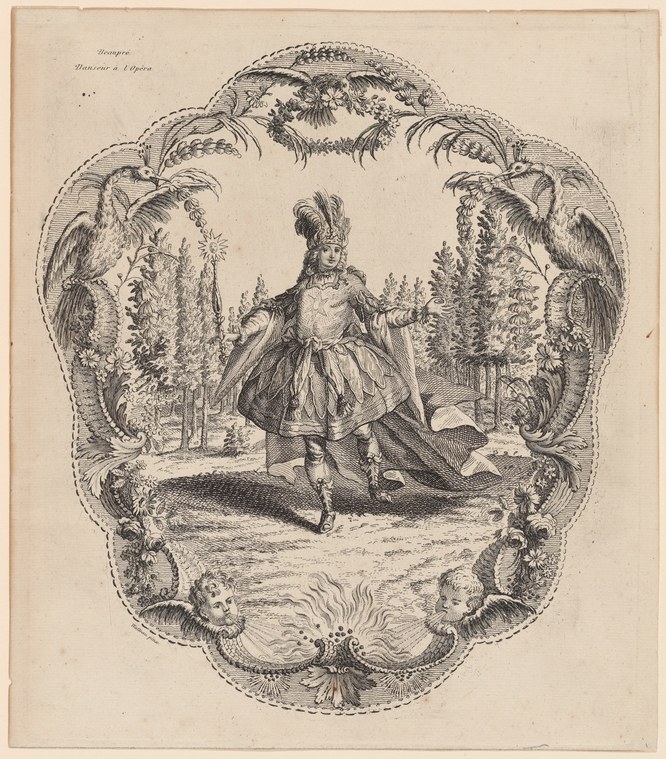
Beaupré danseur à l'Opéra.
Unknown artist
- Collection:
- Prints depicting dance
- Source:
- New York Public Library
- Rights:
- Public domain — free to use, share and adapt.
- Recorded as:
- Public Domain
Named documentary evidence of a professional male dancer's existence and costume from the early French Opéra is rare and invaluable. The work demonstrates that individual dancers, not only choreographers or composers, were considered notable enough to be commemorated in expensive prints, suggesting a developed culture of dance celebrity and professional performance in Paris by this period.
What you are looking at
A male dancer in elaborate court costume stands center stage in a forest clearing, arms spread in an open, welcoming gesture. He wears a plumed headdress, richly decorated jacket, and knee breeches with what appears to be heeled shoes—the full ornament of a court dancer of the late seventeenth or early eighteenth century. Tall evergreen trees frame him on both sides and recede into the background, creating a theatrical woodland setting. The entire composition is enclosed within an ornamental border of scrollwork, acanthus leaves, and two cherub heads at the base, suggesting this is a title page or frontispiece rather than a documentary image. The engraving's fine lines and formal framing indicate this was a prestigious publication, likely celebrating the dancer Beaupré and his role at the Paris Opéra.
The dancing
The dancer's weight appears equally distributed and grounded, his torso upright with both arms raised to roughly shoulder height in an open, expansive position. His legs are straight but not rigid, with one foot slightly advanced—a pose suggesting either a moment of stillness before movement or the held completion of a phrase. The stance has the courtly formality of someone trained to move within strict protocols of deportment and decorum. There is no partner visible, making this a solo male dancer or a moment plucked from a larger ensemble piece where he stands alone.
The dance depicted
This is almost certainly Baroque court dance of the French school, the dominant style of aristocratic and professional dance in the period when the Paris Opéra was establishing itself as Europe's premier dance institution. Beaupré is documented as a dancer of the Opéra in the early eighteenth century, though the exact dates of his performance are unknown. The open arms, upright carriage, and emphasis on graceful presence over technical display are consistent with the menuet and other courtly dances that formed the core of the Opéra's repertoire. The forest setting, while theatrical, does not necessarily indicate a specific mythological or narrative role; the image is primarily a portrait of the dancer in his professional costume, made to commemorate or advertise his status.
How it was made
This is a line engraving, executed with the fine, regular hatching and precise detail characteristic of mid-to-late seventeenth-century Parisian printmaking. The ornamental border and the centered, formal composition mark it as a frontispiece or independent portrait print, likely intended for circulation among the nobility and the increasingly literate urban audience interested in theatre and dance. Engraving of this quality was expensive and would have required both a skilled engraver and a patron—in this case, probably the Opéra itself or a noble patron of Beaupré—indicating that the dancer held significant enough status to merit this form of commemoration.
About this work
This engraving commemorates a named dancer, Beaupré of the Paris Opéra, in the costume and carriage of high Baroque court dance. The work sits at the intersection of dance documentation and theatrical portraiture: it is neither a staged scene from a ballet nor a genre study of common people dancing, but rather a formal image of a professional male dancer in his working dress, posed to display the bearing and elegance that defined courtly movement. The ornate border and careful execution suggest this was a prestigious object, circulated to affirm both the dancer's status and the cultural importance of the Opéra in early eighteenth-century France.
What makes this image valuable today is precisely that it names an individual dancer and records his costume and professional identity at a moment when dance notation was still inadequate to preserve movement and when most dancers' names and careers vanished within a generation. The image testifies to the existence of a male dancer of enough standing to be engraved and circulated, and to the audience's hunger for images of the stage.
How to look at it
Note the dancer's stillness and symmetry—this is not a captured moment of rapid motion, but a posed presentation of the dancer's carriage and professional identity. Observe how the artist has captured the formality of court dress: the headdress, the decorated coat, the positioning of the legs, the placement of the arms—all of which communicate rank, training, and decorum. The forest setting, though theatrical, is secondary to the figure; the trees frame and isolate the dancer rather than telling a story. This is a portrait first, a dance record second.
The period
This engraving dates almost certainly to the early eighteenth century, a moment when the Académie Royale de Danse (founded 1661) had established the codified vocabulary of courtly movement that became Baroque ballet, and the Paris Opéra (founded 1669) had become the dominant stage for dance spectacle. By the 1680s–1720s, the Opéra had shifted from a court institution to a commercial public theatre, and dancers were beginning to be named performers whose roles and talents were discussed and celebrated. This was the period when dance was transitioning from an amateur accomplishment of the nobility to a professional art form requiring specialized training and generating public interest. The emphasis on the solo male dancer in formal court dress reflects the importance of the baladin (male dancer) to the French theatrical tradition, a role quite different from the later ballet star.
Where it lives
The work is held in the New York Public Library's Prints division, which specializes in historical engravings and theatrical ephemera from Europe. It is catalogued as a work depicting dance but lacks detailed dating and attribution, suggesting it entered the collection as part of a larger acquisition of dance-related prints.
Dance in this work
Questions about this work
Who was Beaupré?
Beaupré was a male dancer at the Paris Opéra in the early eighteenth century. Beyond the information in this print, little is documented about his career, roles, or dates of performance. The fact that he merited an engraved portrait suggests he held some prominence, but the historical record of individual dancers from this period is sparse. This print is itself primary evidence of his existence and professional status.
Is this a scene from a specific ballet?
Probably not. The image is a formal portrait of the dancer in professional costume, posed to display courtly bearing, rather than a scene depicting a narrative or choreographed sequence. The forest setting is theatrical convention but does not indicate a specific work. The title simply names the dancer and his affiliation.
What can we learn about Baroque dance from this image?
The dancer's costume, carriage, and pose reveal the centrality of formal, upright bearing; the importance of elegant arm and hand placement; and the courtly aesthetic that governed movement. The male dancer's prominence on stage and the professional status enough to merit an engraving show that men were not secondary performers but central to the Opéra's prestige. The absence of pointe shoes, turned-out positions, and the overall emphasis on courtly deportment over acrobatic display distinguish this from later Romantic and modern ballet.
More dance artwork





