49 works in this view — arrow keys or swipe to move between them.
Dance in Art
Ballroom dancing on British and American 19th-century music covers
Unknown artist
- Collection:
- Prints depicting dance
- Source:
- New York Public Library
- Rights:
- Public domain — free to use, share and adapt.
- Recorded as:
- Public Domain
The quadrille was the governing social dance of the mid-19th century, and this image preserves its formal vocabulary and ceremonial function in vivid detail. The military context adds historical specificity: it shows how ballroom dancing was integrated into military culture and officers' social ritual, a practice now largely forgotten. For dancers and social historians, this print is documentary evidence of how the quadrille was actually positioned, dressed, and performed in America on the eve of the Civil War.
What you are looking at
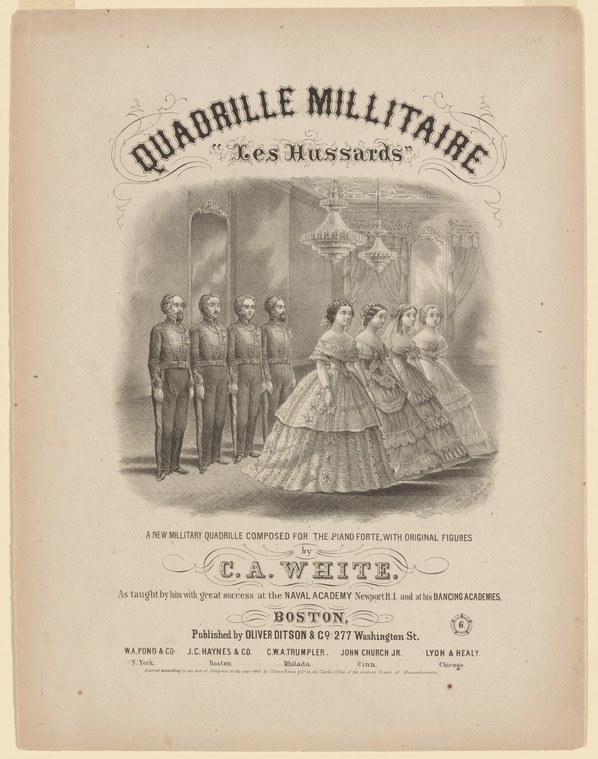
A military quadrille unfolds in a grand interior with tall columns and a distant chandelier. On the left stand four military officers in dress uniforms, their posture formal and at attention. On the right, four women in elaborate mid-19th-century ball gowns with full skirts stand in a complementary formation. The women's dresses feature the characteristic voluminous skirts and fitted bodices of the 1850s, with what appears to be pale fabrics—likely white or cream silk with deep flounces. The officers and women face one another across a clear space, positioned as if beginning or pausing in the dance. The composition is symmetrical and ceremonial, with careful attention to the parallel ranks of male and female dancers. The setting suggests an officers' ball or formal military social event, with the neoclassical architecture emphasizing the occasion's importance.
The dancing
The officers maintain upright, military bearing with arms at their sides or in formal position—no physical contact between couples is evident. The women stand poised with their arms held gracefully, their bodies erect within the confines of their corseted gowns. All eight figures are arranged in two parallel lines, evenly spaced, suggesting the geometric precision of a quadrille formation. The artists has rendered the bodies as relatively stiff and formal rather than captured mid-movement, emphasizing the structured, processional nature of the dance rather than fluid motion.
The dance depicted
This is a military quadrille, a formal ballroom dance in four couples performing a set sequence of figures. The quadrille was the dominant social dance of the mid-19th century, performed at balls and formal military occasions. The title 'Les Hussards' (The Hussards) identifies the military context—likely a cavalry regiment's ball. The composition shows the opening stance typical of quadrille dancing: couples positioned opposite one another before the first figure begins. The rigid posture and formal spacing reflect the dance's highly codified nature, where specific steps and arm positions were prescribed and executed with military precision. This engraving captures the social function of the quadrille as a display of order, rank, and courtly refinement.
How it was made
This is a lithographic print, a medium well-suited to the rapid reproduction and wide circulation of popular music covers and entertainment ephemera in the mid-19th century. The artist employed fine linear work and careful stippling to create tonal gradation in the figures and architectural elements, achieving a sense of depth and substance. Lithography allowed for both artistic sophistication and affordable mass production, making this image accessible to the middle-class piano-playing public who would purchase such sheet music. The print's size and format—a cover for piano music—indicates it was made for domestic consumption, not gallery display.
About this work
This is a lithographic cover for a military quadrille titled 'Les Hussards,' published by Oliver Ditson & Co. in Boston. The print depicts the formal opening of a set quadrille as performed at a military officers' ball, with four male officers in dress uniforms arranged opposite four women in ball gowns of the 1850s. The work belongs to a vast body of 19th-century music-cover imagery that documented ballroom dancing as a central practice of genteel social life and military ceremony.
Music covers of this type are invaluable documents of dance history: they record the dances that were performed, the social contexts in which they took place, the gender dynamics of ballroom etiquette, and the fashions worn by dancers. This particular image captures the quadrille at its moment of greatest social prominence in America, before it began to decline in popularity after the American Civil War. The military subject matter reflects the strong association between ballroom dancing and officers' society in the 19th century.
How to look at it
Look at the symmetrical arrangement of the figures and the careful spacing: the quadrille was a geometrically precise dance, and the engraver has emphasized this by placing the couples in perfect opposition. Notice the rigidity of the bodies and the absence of physical contact—the quadrille was not an intimate dance, but a formal display of decorum and coordination. The women's skirts dominate the composition visually, reflecting both the fashions of the era and the fact that ballroom dancing was, for women, a central arena for displaying wealth, beauty, and marriageability. The military uniforms serve a similar function for the men, signaling rank and status. This is a dance of social display, and every detail of costume and posture has been carefully composed to convey respectability and order.
The artist
The cover credits the composition to C. A. White, described as 'taught by him with great success at the Naval Academy Newport R.I. and at the Dancing Academies' in Boston. White was a dancing master operating in the Boston area, a profession that flourished in the 19th century. Dancing masters composed, taught, and promoted social dances, and the publication of sheet music under their names was a standard way of establishing professional authority and advertising their services. The engraving itself was executed by a specialist print shop—the publisher Oliver Ditson & Co. employed skilled lithographers—but White's name signifies his role as choreographer and pedagogue.
The period
The 1850s-1860s were the high point of the quadrille in America. The dance had arrived from France in the early 1800s and by mid-century had become nearly universal in ballrooms and at military balls. It was the dominant dance form taught in dancing schools, and music for quadrilles flooded the market. The Civil War disrupted this culture significantly; after 1865, the quadrille gradually lost its central position to waltzes and later to the new dances of the early 20th century. This print captures the quadrille at its cultural zenith, at a moment when it was considered the acme of refined, orderly, and genteel social performance. The military theme also reflects the prominent role of officers' balls in urban social life before the war.
Where it lives
This lithograph is held in the New York Public Library's collection of prints depicting dance. It is a sheet-music cover, part of the vast body of 19th-century commercial music publishing that documented American ballroom culture. Such items were mass-produced for sale to amateur musicians and dancers, making them common but now historically precious evidence of the dances people performed and the contexts in which they danced.
Dance in this work
Questions about this work
What is a quadrille?
A quadrille is a set dance for four couples arranged in a square, with all couples performing a series of prescribed figures in unison. It was the most popular ballroom dance of the 19th century, performed at balls, private dances, and military events. Each quadrille consisted of five or six figures, each lasting about a minute, and was accompanied by orchestral music or piano.
Why is this a 'military' quadrille?
The title 'Les Hussards' (The Hussards) identifies it as a quadrille performed by cavalry officers (hussars wear distinctive military uniforms) at a military ball. Military quadrilles were common in the 19th century; they often incorporated military themes or were composed for specific regiments. Officers' balls were major social occasions, and the quadrille was a centerpiece of such events.
Who was C. A. White?
C. A. White was a Boston-based dancing master—a professional teacher and choreographer of social dances. Dancing masters were prominent figures in 19th-century urban society; they ran schools, taught private lessons, choreographed dances for public balls, and often published sheet music for the dances they taught. Publishing a quadrille under your name was a way of establishing your professional reputation and marketing your services.
What does this image tell us about 1850s ballroom fashion?
The women's gowns show the characteristic silhouette of the 1850s: a very small, corseted waist, a full skirt supported by a crinoline or hoopskirt, and multiple flounces or layers of fabric at the hem. The men wear military dress uniforms appropriate to a formal evening occasion. These fashions were central to the ballroom experience: dancers were dressed to display wealth and status, and the voluminous skirts of the women created a striking visual effect during the dance.
More dance artwork





