49 works in this view — arrow keys or swipe to move between them.
Dance in Art
Ballroom dancing on British and American 19th-century music covers
Unknown artist
- Collection:
- Prints depicting dance
- Source:
- New York Public Library
- Rights:
- Public domain — free to use, share and adapt.
- Recorded as:
- Public Domain
For dance historians, this image is valuable as a record of ballroom posture, frame, and costume in the 1840s–50s—a period for which written dance manuals are plentiful but visual evidence of actual practice is rare. For historians of print culture and commerce, it exemplifies how dance was packaged, sold, and circulated to middle-class consumers as a form of social instruction and entertainment. The association with Queen Victoria also marks the moment when ballroom dance became a defining feature of British national culture and imperial identity.
What you are looking at
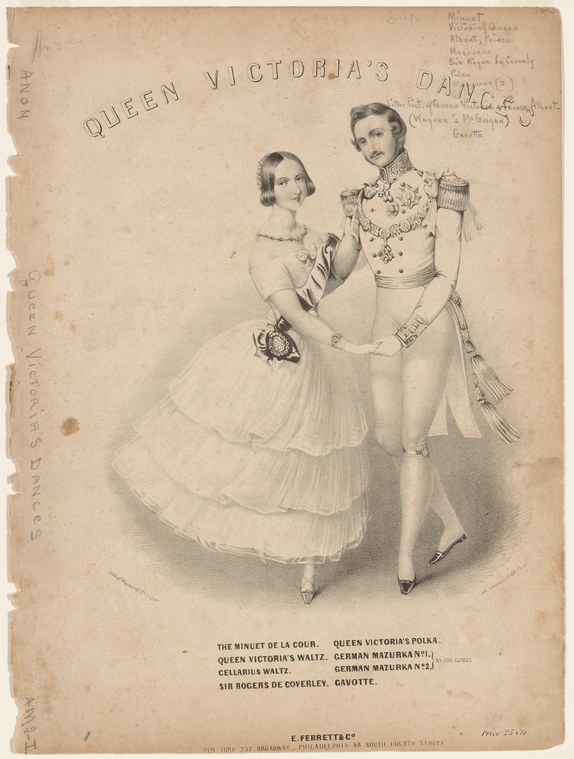
A young woman in a voluminous white ball gown with a fitted bodice and gathered skirt stands with a military officer in dress uniform, the two posed as if mid-waltz or similar ballroom dance. The woman, positioned slightly to the left, holds a small bouquet and wears her dark hair parted and smoothed close to her head in the fashion of the 1840s. The officer, in white breeches and an ornate jacket with epaulettes and heavy braiding across the chest, stands upright with his left hand at her waist. Their relative scale and formal presentation suggest this is a published music cover or theatrical illustration rather than a candid moment—the figures are idealized and the composition highly staged. The background is plain, allowing the figures and their elaborate dress to dominate. The title arc above reads 'QUEEN VICTORIA'S DANCE' in large letters, with musical selections and composers' names printed below the image, including reference to a 'Gavotte' and other named pieces.
The dancing
The couple holds a formal closed ballroom position appropriate to early Victorian court dance: the woman's right hand rests in the officer's left, his right hand positioned at her waist, both bodies upright and slightly angled toward one another. The woman's posture is demure, with her weight settled in the weighted hip characteristic of the period's deportment; the officer's military bearing—shoulders back, chin raised—emphasizes rank and formality. There is no action captured mid-step; instead, the two are frozen in a posed attitude of readiness or greeting, the moment before or after a figure rather than within it. The woman's full skirt is arranged to display its volume and construction, a priority of the image that also signals the ballroom context.
The dance depicted
This is a waltz or similar couple dance of the early-to-mid-Victorian era, depicted on a commercial music cover. The identification rests on the closed position, the formal dress, the explicit title reference to 'Queen Victoria's Dance,' and the printed musical selections below, which include a 'Gavotte' and other social-ballroom forms. The image serves a commercial function—marketing sheet music and theatrical performance—rather than documenting actual practice, so it idealizes the participants and the moment. The couple represents not a historical dance between specific individuals but a type: the gentleman partner and the lady in her prime ballroom display costume. No footwork is visible, and the posture suggests a moment of presentation rather than active stepping.
How it was made
This is a lithograph or engraving, established by the fine linear hatching, the tonal gradations achieved through parallel lines, and the printing conventions visible in the paper's color and surface. The technique is characteristic of mid-nineteenth-century commercial music-cover production: the image was designed to be mass-produced and affordable, allowing wide circulation of dance imagery to the aspiring ballroom-dancing middle classes. The precision of line and the classical engraving style (with no photographic softness or painterly brushwork) indicate professional production by a skilled printmaker, likely working from a designer's drawing. The imprint 'E. FERRETTA & Co.' at the base confirms commercial manufacture. This medium—cheap, repeatable, and distributed through music vendors—made the image a form of social instruction and aspiration rather than fine art.
About this work
This is a lithographed music cover from the mid-nineteenth century depicting a fashionable couple in ballroom dress, posed in the formal closed position of a waltz or similar Victorian social dance. The image is tied to Queen Victoria and branded with titles of actual musical compositions ('Gavotte,' 'Polka,' 'Waltz'), suggesting it was sold as sheet music or theatrical publicity. The work belongs in a gallery of dance imagery because it documents both the physical form of early-Victorian ballroom dance—the hold, the frame, the costume—and the commercial and aspirational machinery through which that dance was circulated and taught. It is not a record of a specific performance but a standardized representation designed to sell music and to model behavior to a broad audience.
The image reveals the gendered and hierarchical nature of Victorian ballroom culture: the woman is ornament and follower, displayed in her expensive white gown; the man is uniformed authority and leader. The ballroom was a crucial site of courtship and social mobility for the period's middle classes, and images like this one were instruments of that social work. It sits at the intersection of dance practice, commercial culture, and gender ideology in the nineteenth century.
How to look at it
The viewer should attend to the precision and formality of the pose: this is not a snapshot of movement but a carefully composed image designed to model correct ballroom behavior. Notice the woman's posture—the slight forward tilt, the weight distributed through her hips, the demure angle of her head—and the officer's upright military carriage; the contrast is deliberate and gendered. The printing technique, with its delicate parallel lines and even tonality, was state-of-the-art for commercial reproduction and allowed the image to reach a wide market. Finally, look at the costume: the woman's white ball gown, with its fitted bodice and voluminous skirt, is as much a subject of the image as the dance itself; the dress is her primary ornament and the marker of her eligibility and status.
The artist
The maker is not recorded. The print bears the imprint 'E. FERRETTA & Co.' at the base, likely a London music publisher or lithographic printer of the mid-nineteenth century. The professional quality of the line work and the standardized format suggest a specialist commercial workshop rather than an artist working independently. Such images were typically produced by teams: a designer or illustrator would create the original drawing, a lithographer would transfer it to stone or plate, and printers would run multiple impressions for sale.
The period
The 1840s–50s were the zenith of the waltz's dominance in European ballroom culture. The waltz, imported from Vienna and popularized in Britain in the 1810s, had become the defining dance of respectability and social aspiration by mid-century. Simultaneously, other structured social dances—the polka (newly fashionable in the 1840s), the gavotte (a Baroque form revived for nostalgic and theatrical purposes), and the quadrille—were performed in the same spaces. The image dates from this moment of co-existence and experimentation. In the visual arts, the waltz was a favorite subject for painters and printmakers; the couple in motion or in posed readiness appeared constantly on music covers, in periodicals, and in theatrical scenes. This reflected both the reality of ballroom dancing as a central leisure activity for the urban middle class and its role as a marker of civilization, propriety, and national culture.
Where it lives
The object is part of the New York Public Library's collection of printed dance imagery, classified as a music cover or theatrical print. The holding reflects the NYPL's long practice of collecting commercial and popular visual culture related to performance and music—materials that document not fine art but the material culture of public entertainment. Such music covers were sold by the thousands in the nineteenth century and were discarded and lost at far higher rates than fine-art prints, making surviving examples valuable for their documentary evidence.
Dance in this work
Questions about this work
Is this a portrait of a real couple dancing together?
No. This is a commercial music-cover design using idealized generic figures—a fashionable young woman and a uniformed officer—to represent the ballroom couple. The 'Queen Victoria's Dance' title is a marketing device; the image does not depict Victoria or a specific historical event. The couple is a type, not individuals.
What was the waltz and why was it controversial?
The waltz was a turning dance for couples in closed position, originating in Austria and Vienna in the late eighteenth century. In Britain, it was initially criticized as improper because the couple held each other closely throughout, unlike the more distant positioning of earlier court dances. By the 1840s, it had become respectable and fashionable, and it dominates ballroom imagery from this period onward.
What do the other dance titles on this cover mean?
The cover lists several musical compositions: a Gavotte (a Baroque court dance revived in the nineteenth century), a Polka (a newer, trendy dance from Central Europe that swept Europe in the 1840s), a Waltz (the dominant dance of the period), and a Quadrille (a formation dance for groups of couples). All of these would have been performed at the same ballroom events, often in sequence during an evening.
How do I know this is a lithograph or engraving?
The fine parallel hatching lines that create tone and shadow, the precision of the line work, and the uniform printed surface are characteristic of lithography or engraving—printing techniques that dominated commercial music-cover production in the nineteenth century. The image was not photographed or hand-painted but was created as a design for mass printing.
More dance artwork





