49 works in this view — arrow keys or swipe to move between them.
Dance in Art
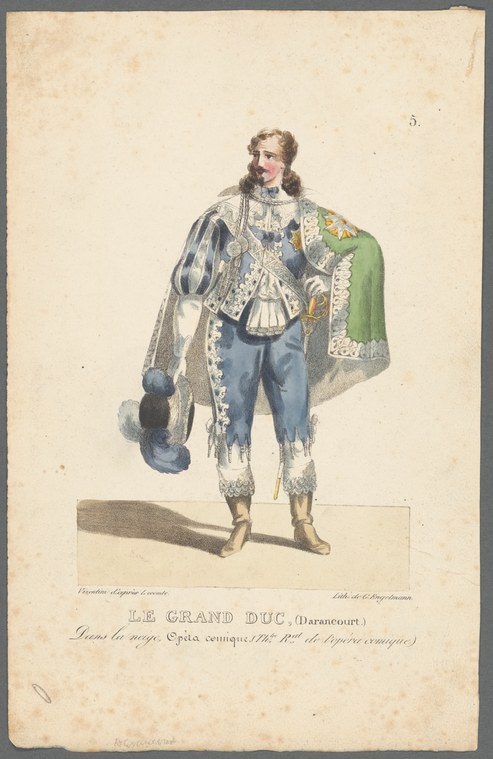
Le Grand Duc, (Darancourt.) Dans la neige, Opéra comique, (Th[éâ]tre R[oy]al de opéra comique)
Unknown artist
- Collection:
- Prints depicting dance
- Source:
- New York Public Library
- Rights:
- Public domain — free to use, share and adapt.
- Recorded as:
- Public Domain
This work documents the male dancer as a theatrical professional in an opera-dance context where he remains understudied in dance history, which has often concentrated on the female ballet dancer of the Romantic period. The costume evidence, the formal pose, and the theatrical archive context all matter for understanding the full ecology of early 19th-century professional dance.
What you are looking at
A single male figure in aristocratic dress stands in a three-quarter pose against a plain cream background, his body weight shifted forward onto his left leg in a characteristic stance of theatrical performance. He wears a richly decorated blue silk coat with elaborate white lace ruffles at the neck and wrists, and fitted breeches that extend to the calf. Over one shoulder hangs a green cape or mantle lined with white, which falls dramatically down his back and across his left arm. A fur muff or tippet hangs from his right hand. His left foot is extended forward with the toes pointed, a deliberate and graceful extension typical of formal dance training. His posture is upright and dignified, his gaze directed upward and to the side in a theatrical manner. The hand positions are carefully arranged—his right arm hangs at his side while his left is slightly raised. A faint shadow beneath his feet grounds the figure. The overall composition suggests a moment of arrested movement, as if frozen mid-gesture in a formal dance or theatrical scene.
The dancing
The figure demonstrates a trained dancer's bearing: the extended left leg with pointed foot, the upright spine, and the composed arm positions all indicate classical dance training. The weight is carried forward and to the left, creating a diagonal line through the body that suggests forward momentum arrested in a formal pose. The arm positions are modest and restrained—characteristic of early 19th-century male courtly or theatrical dance—rather than the broader gestures of later balletic vocabulary. The elaborate dress does not appear to impede movement; instead, the figure's positioning suggests ease within such costume.
The dance depicted
The inscription identifies this as the Grand Duke in a scene titled "Dans la neige" (In the Snow) from *Opéra comique* performed at the Théâtre Royal de l'Opéra comique. This appears to be a costume figure study for a specific theatrical character rather than a naturalistic representation of social dance. The formal pose and theatrical dress suggest this is a male dancer performing a composed role, likely from a comic opera. The extended leg and composed posture indicate classical ballet vocabulary of the early-to-mid 19th century, though the full staging context and the specific choreography are not recoverable from this image alone. The work documents a particular performer or character type in theatrical dance at a specific moment.
How it was made
This is a hand-colored engraving or etching on paper, characteristic of theatrical costume documentation of the early 19th century. The linear precision of the engraved line (particularly visible in the outline of the figure and the delineation of the coat's embroidery) contrasts with the translucent watercolor washes applied to represent the silks, furs, and fabrics. This combination allowed for both fine detail and atmospheric effect. Such prints were made for theatrical archives, for circulation among performers, and for collectors interested in dance and costume history. The technique itself indicates this was a work of some expense and care, intended for distribution among people with professional interest in opera and dance.
About this work
This engraved and hand-colored costume study documents a male performer in a specific role—the Grand Duke—in a comic opera performed in Paris in the early 19th century. The work is neither a snapshot of social dance nor a character study in the modern sense, but rather a formal document of a theatrical costume and the bearing expected of a dancer or actor in that role. The image preserves evidence of how male dancers of this period inhabited formal dress and composed themselves in theatrical space: with trained posture, extended legs, and an upright dignity that reads as both natural and carefully constructed.
As a record of theatrical dance culture in the Romantic era, this print reveals how comic opera dancers occupied a different register from the ethereal female figures celebrated in contemporary ballet imagery. The male dancer here is dignified, formally costumed, and posed with careful attention to line and proportion—not in flight or supernatural reverie, but grounded and present.
How to look at it
Attend first to the feet and legs: the pointed left foot extended in a deliberate, trained position tells you this is a dancer or a performer trained in dance. Then follow the line of the torso—the upright spine and squared shoulders, the way the weight sits forward and to the left—which together create a composed, formal bearing that reads as both natural and artificially constructed. The costume is lavish and specific: the blue silk coat and white lace are not generic but carefully rendered, indicating a particular historical moment and a particular character. The expression—the gaze directed away and upward—adds a theatrical dimension: this is not a portrait but a performance pose, a moment of composed action frozen for documentation.
The artist
The artist is not recorded in the catalogue. The credit line indicates the work was engraved by Lith. de S. Pourthebaum (likely a commercial lithographic or engraving workshop), a common arrangement for theatrical costume prints of this period, where prints were often made after drawings by unattributed or uncredited artists and then commercially printed and colored for sale or distribution.
The period
This work dates to the heyday of comic opera in Paris, a form that blended sung and danced performance in ways distinct from the more elaborate spectacles of grand opera or the ethereal aesthetics of Romantic ballet. The early 19th century saw male dancers occupying various roles in theatrical genres—comic, heroic, supporting—each with its own costume and choreographic vocabulary. This same period saw the emergence of the female ballet dancer as the primary focus of artistic and critical attention, which has made male dancers of this era less visible to later historiography. The print medium itself was a primary vehicle for circulating images of costume and performance to a professional and amateur audience.
Where it lives
The work is held in the New York Public Library's prints collection devoted to dance imagery. The print was made for theatrical distribution or archive purposes, allowing performers and interested parties to access visual documentation of specific roles and costumes.
Dance in this work
Questions about this work
Who was the dancer who performed this role?
The print does not identify the performer, only the character—the Grand Duke. Many such costume prints were made without naming the dancer who originated or performed the role. The character attribution alone was often considered sufficient documentation for theatrical purposes.
What was *Opéra comique* and how is it different from ballet?
*Opéra comique* was a French theatrical form that combined sung dialogue, dance, and comedy, typically lighter in tone than grand opera. It was distinct from ballet proper, though dancers performed in opéra comique productions. Male dancers in this context often took narrative or comedic roles rather than the supernatural or ethereal roles emphasized in contemporary ballet imagery.
Why does the figure have a pointed foot if this is not ballet?
Pointed feet were part of formal dance vocabulary across theatrical genres in this period—ballet, opera-ballet, and comic opera—not exclusive to ballet proper. This figure's training is evident in the extended leg and composed bearing, which indicate classical dance instruction regardless of the specific performance context.
What can the costume tell us about the choreography?
The costume is relatively structured and formal, which would have allowed certain movements (extended legs, turns, formal carriage) while potentially restricting others (large jumps, rapid changes of level). The fitting breeches and formal coat suggest a performer who moved with precision and control rather than abandon—consistent with early 19th-century comic opera characterization.
More dance artwork





