49 works in this view — arrow keys or swipe to move between them.
Dance in Art
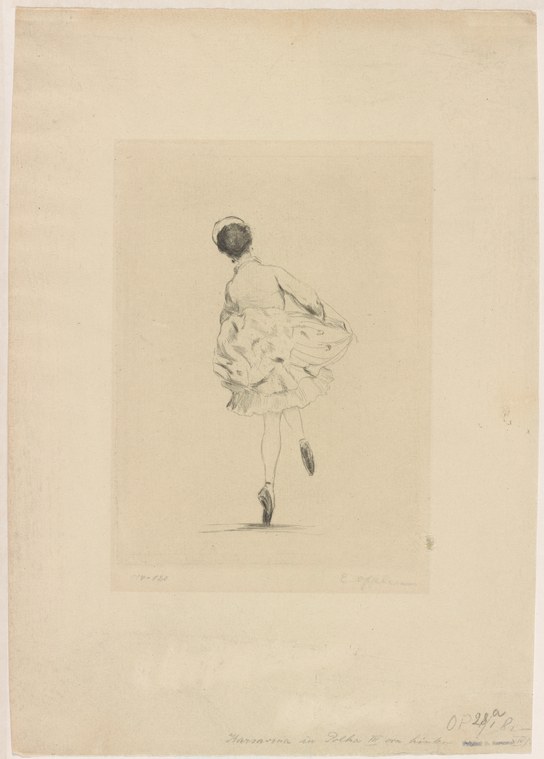
Karsavina in Polka III von hinten
Unknown artist
- Collection:
- Prints depicting dance
- Source:
- New York Public Library
- Rights:
- Public domain — free to use, share and adapt.
- Recorded as:
- Public Domain
Karsavina was a founding artist of the Ballets Russes and one of the most influential ballet dancers of the early 20th century. Any study of her in a specific role is a rare documentary record of how a canonical role was performed and embodied at the time. The Polka is a character dance—a category often overlooked in ballet history in favour of classical roles—and this sketch is evidence that such dances were studied with the same anatomical care and artistic attention as the grandes danses.
What you are looking at
A single female dancer is depicted in three-quarter rear view, captured mid-movement in what appears to be a moment of balletic poise or preparation. She wears a short, ruffled skirt—consistent with late 19th-century theatrical costume—and her upper body is bare or minimally draped. Her head is turned slightly, dark and rendered with firm shading. Her weight appears to rest on one leg while the other extends or lifts; the positioning suggests either a développé, an attitude derrière, or a moment of suspension. The figure is rendered against a plain, neutral ground with minimal spatial context—the focus is entirely on the dancer's form and the play of light across her body. The composition is intimate and studies the figure from a viewpoint that emphasises the line of the back and the extension of the working leg.
The dancing
A single dancer stands in a pose that isolates the line of her back and one extended leg. The supporting leg is nearly straight, the working leg lifted or extended behind; the torso leans slightly forward or sustains a balletic curve. The arm position is ambiguous in the sketch but appears to be held away from the body—possibly in a classical port de bras. The head is turned in profile or three-quarter view. The technique suggests anatomical knowledge and training in academic ballet: the artist has captured the controlled elongation and the specific weight distribution that balletic training produces.
The dance depicted
This is almost certainly a study of classical ballet, likely from the late 19th or early 20th century. The title identifies the subject as Karsavina, the celebrated Russian prima ballerina Tamara Karsavina, and refers to a polka—a character or demi-caractère piece rather than a classical narrative ballet. 'III von hinten' (third, from behind) suggests this is one of a series of studies of the same dancer in the same role, viewed from different angles. The Polka may have been a solo or part of a larger work. The viewpoint chosen here—the rear three-quarter angle—was pedagogically and artistically valued in ballet documentation, as it reveals the line of the back, the turnout of the legs, and the placement of the spine.
How it was made
This is a work on paper, rendered in what appears to be graphite pencil with fine shading and cross-hatching to suggest form and shadow. The technique is that of a figure study or rehearsal sketch: economical in line, focused on the pose and the articulation of the body, with minimal background or setting. The fineness of the line work and the precision of the anatomical rendering suggest either a professional artist's study or a dancer's or choreographer's notation study. The paper is aged to a warm cream, consistent with early 20th-century artist paper. The sketchy quality and the absence of colour or detail suggest this was not intended for public exhibition but rather as documentation—either for the dancer's own use, for costume or set designers, or as a record of a performance practice.
About this work
This is a pencil study of the Russian prima ballerina Tamara Karsavina in a pose from a polka—likely either a solo or a demi-caractère piece from the early 20th century. The artist has chosen to render the dancer from behind, capturing the line of her back and the extension of her working leg in what appears to be a classical balletic attitude or développé. The work is one of a series (indicated by the title 'III von hinten'), suggesting it was part of a systematic documentation of the dance and dancer. Such studies were common in early 20th-century ballet practice, serving as both artistic record and practical reference for costume, lighting, and choreographic documentation. The work sits at the intersection of dance practice and fine art: it is neither a preparatory sketch for a finished work nor a dance notation, but rather a careful observational study made in service of the dance itself.
How to look at it
The viewer should attend to the articulation of the spine and the placement of the supporting leg—these reveal the dancer's training and the specific aesthetic of Russian classical ballet at the turn of the century. The rear view is deliberate: it strips away the face and front presentation to isolate the technical and aesthetic line of the body. Notice how the artist has used shading to suggest the musculature and tension of the dancer's back and legs, indicating that this is not a generic figure study but a record of a specific body in a specific, trained position. The unfinished or sketch-like quality should not be mistaken for incompleteness; the economy of line is itself a form of clarity.
The period
Tamara Karsavina danced from the 1900s through the 1930s and was a central figure in Sergei Diaghilev's Ballets Russes (founded 1909). The early 20th century saw an expansion of documentary practices in ballet: dancers and choreographers increasingly commissioned artists to record performances, poses, and character studies for archival and pedagogical purposes. Polkas and other character dances were a staple of Ballets Russes programmes, where Russian classical ballet was blended with character and folk elements. The graphite study on paper was a standard medium for such work, allowing for rapid, precise capture of form without the commitment of paint or the labour of finished composition.
Where it lives
The work is held in the Prints depicting dance collection at the New York Public Library, a systematic archive of dance-related prints and drawings spanning centuries and cultures. Such collections preserve documentary and artistic records of performance practice that would otherwise be scattered or lost.
Dance in this work
Questions about this work
Who was Tamara Karsavina?
Karsavina (1885–1978) was a Russian prima ballerina and a founding artist of the Ballets Russes. She created roles in many of Diaghilev's most celebrated works, including The Firebird, Petrushka, and The Rite of Spring. She was known for her lyrical quality, her dramatic gift, and her mastery of both classical and character dance. She later taught and wrote memoirs that became standard sources on early 20th-century ballet practice.
What is a polka in ballet?
In ballet, a polka is a character or demi-caractère dance—a short, lively piece in the polka rhythm, often used as a solo, variation, or ensemble number. It sits between classical ballet (which aspires to abstraction and formality) and folk or national character dances (which claim authenticity to a place or tradition). Polkas appear frequently in Ballets Russes programmes, where Russian classical training met a hunger for vivid theatrical character and cultural specificity.
Why would an artist draw a dancer from behind?
The rear view isolates the line of the spine, the turnout and extension of the legs, and the overall silhouette of the dancer—information crucial for understanding both the technical training and the aesthetic effect. From behind, the viewer cannot read the dancer's facial expression or see the front of the body, so the focus falls entirely on the architecture of the pose. This was a standard approach in ballet documentation and teaching.
Is this a finished work or a study?
This appears to be a study or sketch rather than a finished exhibition piece. The paper is plain, the line economical, and there is no colour or elaborate finish. However, 'study' does not mean 'preliminary'—it means the work was made to serve a specific documentary or pedagogical purpose, likely for the dancer, choreographer, or designer. Such studies are often more valuable to dance historians than more elaborate finished works because they preserve observational accuracy without the conventions of exhibition art.
More dance artwork





