49 works in this view — arrow keys or swipe to move between them.
Dance in Art
Ballroom dancing on British and American 19th-century music covers
Unknown artist
- Collection:
- Prints depicting dance
- Source:
- New York Public Library
- Rights:
- Public domain — free to use, share and adapt.
- Recorded as:
- Public Domain
The Varsovienne was a fixture of ballroom culture from the 1850s through the Edwardian era, yet it has left few traces in the historical record. This print preserves both its name and its visual context—showing us the dress, the ballroom interior, and the social posture of the dancers. For anyone studying the transition from the quadrille-dominated ballroom of the 1840s to the waltz-dominated one of the 1890s, this image documents a middle term that most dance histories have forgotten.
What you are looking at
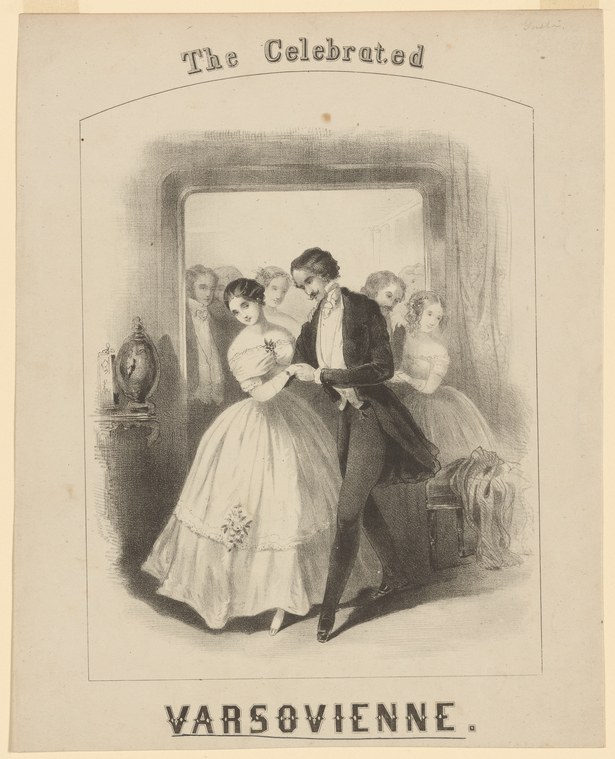
A ballroom scene rendered in soft-focus lithographic style, depicting a moment of social dance among the genteel classes. In the foreground, a man in black tailcoat bends slightly toward a woman in a pale, gathered ball gown, her skirt falling in full folds to the floor. She holds a fan in one hand. Behind them, a group of fashionably dressed onlookers—both men and women in evening wear—occupy a richly appointed interior with classical architectural details: a tall doorway or arch frames the scene, and a classical urn sits on a pedestal to the left. The lighting is even and diffuse, typical of lithography, with soft shading that suggests the warm interior glow of a formal ballroom. The overall mood is one of genteel propriety and social ritual rather than vigorous movement.
The dancing
The central couple are not in strict closed ballroom hold; rather, the man leans toward the woman in an attitude of attention or courtship, while she remains poised and upright. Their bodies suggest conversation or the moment before or after dancing rather than mid-step. The woman's posture is erect, her skirt arranged around her; the man's posture is deferential. The surrounding figures are stationary, watching—they form a social circle rather than active dancers. No footwork is visible; weight appears to be settled rather than traveling.
The dance depicted
This is almost certainly a Viennese waltz or similar couple dance of the Gilded Age, rendered at a moment of social pause rather than in motion. The setting, dress, and composition all point to the fashionable ballroom practices of the 1860s–1880s in Britain or America. The title "The Celebrated Varsovienne" confirms this: the varsovienne was a popular ballroom dance of that era—a promenade couple dance in 2/4 or 3/4 time, less energetic than a waltz but a staple of formal ballroom social life. The image captures the social choreography of the dance—the attention, the witnessing, the propriety—more than the actual footwork.
How it was made
This is a lithograph, identifiable by the soft tonal gradations, the way light models the figures, and the characteristic slightly chalky texture of the medium. The technique allowed for mass production and circulation as an affordable print, likely as a cover for sheet music (the title's prominence and the publication format suggest this). Lithography's ability to capture subtle gradations of tone made it ideal for rendering the textures of fabrics—the stiffness of the man's tailcoat, the drape and transparency of the woman's gown—and the social atmosphere of the ballroom.
About this work
This is a mid-nineteenth-century lithographic cover or advertisement depicting a moment from ballroom social life at the height of the Victorian era. It illustrates the Varsovienne, a couple dance that occupied a particular social niche between the more vigorous waltz and the more formal quadrille. The work is neither a document of the dance in motion nor a celebration of technical skill; rather, it is a record of ballroom culture as a social performance—a coded ritual of courtship, propriety, and public display. The image belongs in a dance archive as a primary source for understanding not what the Varsovienne looked like when danced, but what the culture of ballroom dancing meant to the classes who practiced it.
How to look at it
The artist has chosen not a moment of vigorous movement but one of social presentation: the pause, the attention, the witnessing. Notice how still the figures are, and how carefully their postures are arranged—the woman's composure, the man's deference. Notice too the spectators in the background, who are as important to the composition as the dancing couple. This is a lithograph designed to be read as much as a social diagram as a dance scene—it shows you not how to dance the Varsovienne but what it meant to dance it in public, among one's peers, under observation.
The period
The Varsovienne emerged in the 1850s and was at peak popularity in Britain and America during the 1860s and 1870s, when this print was likely made. It occupied a middle ground between the decorous quadrille (which was thought suitable for all ages) and the intimate waltz (which scandalized conservatives for its closeness). The Gilded Age ballroom was a site of strict social choreography: the choice of dance, the choice of partner, the arrangement of spectators—all conveyed social meaning. Lithographed ballroom scenes were common commercial products in this period, sold both as prints and as sheet-music covers, part of the broader commercialization and domestication of dance in the Victorian era.
Where it lives
This work comes from the New York Public Library's collection of prints depicting dance. Based on the format and the lithographic technique, it was likely published as a cover for sheet music, indicating both its commercial circulation and its audience: amateur pianists and music pupils in middle-class households of Britain and America.
Dance in this work
Questions about this work
What is the Varsovienne?
A couple dance in moderate 2/4 time, popular in ballrooms from the 1850s to about 1900. It was danced in promenade position (side-by-side, facing the same direction) and was less intimate than a waltz but more animated than a quadrille. It often featured a turning element and was frequently used as an opening or closing dance at balls.
Why is everyone just standing there?
The artist has captured a moment of social pause—before, after, or between the actual steps. This was typical of ballroom imagery in the Victorian era, which was as much about showing social position and propriety as about depicting the physical act of dancing.
How do we know this is a Varsovienne?
The title tells us: it is printed at the bottom of the composition. This is almost certainly a sheet-music cover, and the title would have been the name of the piece and the associated dance.
More dance artwork





