49 works in this view — arrow keys or swipe to move between them.
Dance in Art
Ballroom dancing on British and American 19th-century music covers
Unknown artist
- Collection:
- Prints depicting dance
- Source:
- New York Public Library
- Rights:
- Public domain — free to use, share and adapt.
- Recorded as:
- Public Domain
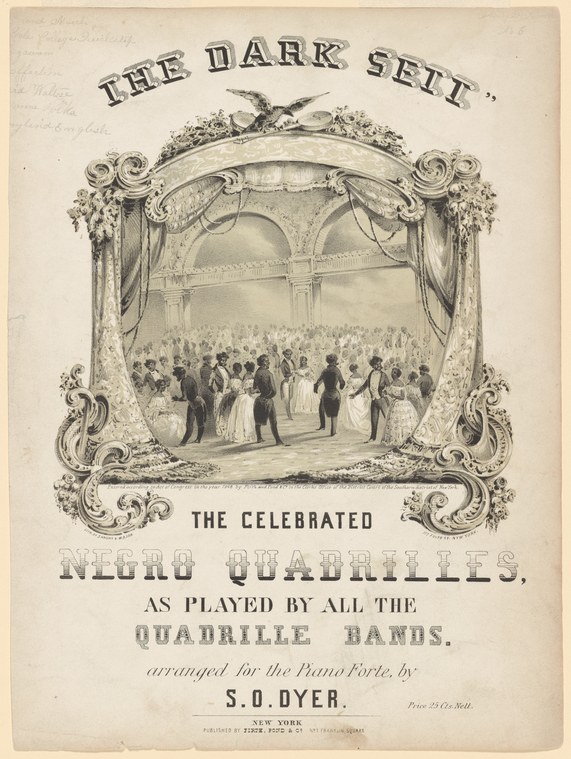
The image documents a crucial moment in the history of cultural appropriation: the systematic renaming and repackaging of African American musical and dance traditions for consumption by white ballroom audiences. For dance historians, it also provides rare visual evidence of the scale, setting, and social formality of quadrille dancing in the commercial ballroom context. The title—problematic by modern standards—is itself a historical artifact that reveals how such music was understood and marketed at the time.
What you are looking at
This is the title page of a published musical score, framed by an ornate architectural proscenium arch decorated with scrollwork, foliage, and an eagle at the apex. Through the arch, we look into a ballroom scene rendered in fine line engraving. A large gathering of formally dressed figures fills the space—men in dark coats and women in full-skirted gowns typical of mid-to-late 19th-century dress. The dancers occupy a rectangular floor beneath a vaulted ceiling with arched openings; the architectural setting suggests an elegant public assembly room or concert hall. The figures are arranged in groups and patterns across the floor, some in motion, others stationary or conversing. The lighting is even and bright, typical of interior gas-lit venues of the period. The composition emphasizes the scale of the event and the formal propriety of the occasion—this is not a street dance or folk gathering, but a genteel social ballroom scene.
The dancing
The figures throughout are rendered in silhouette or simple outline, making precise identification of holds and footwork impossible. However, the postures suggest upright, formal carriage consistent with 19th-century ballroom etiquette. Several pairs are positioned in what appear to be closed or semi-closed holds typical of couple dances. The women's voluminous skirts dominate the visual composition, and the overall sense is of measured, choreographed movement rather than improvised or athletic dancing. No extreme positions, jumps, or dramatic gestures are visible; the mood is restrained and social.
The dance depicted
The title announces this as a collection of 'Negro Quadrilles' (the original term, now recognized as offensive), arranged for piano by S. D. Dyer and playable by 'all the Quadrille Bands.' Quadrilles were structured square dances performed in sets of four couples, extremely popular in ballrooms on both sides of the Atlantic throughout the 19th century. The "Negro Quadrille" was a commercialized variation that incorporated rhythmic and melodic elements derived from African American musical traditions, marketed to white ballroom audiences. This image documents the context in which such music was consumed—in formal, segregated ballroom settings. The specific steps and figures cannot be determined from the engraving, but the scene confirms that quadrilles were danced in large, organized groups in purpose-built halls.
How it was made
This is a wood or steel engraving, recognizable by the fine parallel lines (hatching) used to create tone and shadow, the crisp black line work, and the decorative typography. The ornamental frame suggests this was prepared for commercial publication—likely the cover or title page of a bound musical score. Engraving was the standard medium for music publishing in this period, allowing multiple impressions to be printed from a single plate. The quality and detail of the architectural surround indicate this was a relatively high-end commercial product, marketed to affluent households with pianofortes. The New York imprint (visible at the bottom) and the reference to 'Quadrille Bands' suggest this was sheet music intended for domestic use and professional dance band performance.
About this work
This is a commercial music-publishing document from the mid-19th century, showing how African American-influenced dance music was packaged and marketed to white American and British ballroom society. The image is a visual record of ballroom culture at a moment when quadrilles dominated social dancing, and when music publishers were actively commodifying and renaming African American musical traditions for white audiences. The engraved proscenium arch frames the ballroom scene as theater—despite occurring in a 'real' social space, the dance is presented to the viewer as a spectacle, a performed event worthy of artistic documentation. This doubles as a historical document of both dance practice and of the racial politics embedded in 19th-century commercial entertainment.
How to look at it
Pay attention to the architectural frame: the proscenium arch transforms the actual ballroom into a stage, asking the viewer to regard the dancers as performers. Notice the density and formality of the figures—no one is dancing alone, no one is in elaborate costume, no one is elevated or spotlit. This is ballroom dancing as a group activity governed by strict rules of protocol and spacing. The very small scale of the individual figures (tiny in the engraving) emphasizes the crowd and the occasion over individual virtuosity. Compare this to contemporary depictions of minstrel or stage dancing, where individual performers are dramatically enlarged and foregrounded. The choice to show the full crowd, orderly and arranged, reflects the values of ballroom culture: collective participation, social hierarchy, and decorum.
The artist
The engraving is credited to S. D. Dyer as the arranger of the musical score, but Dyer's role was as a musician and music publisher, not the visual artist. The engraver is not identified in the visible record. This was common practice in 19th-century music publishing, where the engraver of the title page and illustrations was often uncredited, seen as a craftsperson executing the publisher's design brief rather than as an independent artist.
The period
The quadrille was at the height of its social dominance in the 1840s–1870s, taught in dancing schools and performed at all levels of society from royal courts to working-class dance halls. The 'Negro Quadrille' emerged as a commercial category in the 1840s–1850s, during a period of intense interest in minstrelsy and blackface performance. While minstrel shows were the primary vehicle for the commodification of African American music and dance, sheet music markets offered another avenue: instrumental arrangements of popular tunes for domestic piano or band performance. This sheet music sits at the intersection of ballroom culture (respectable, formalized, white) and the appropriation of African American musical traditions. By mid-century, such arrangements were ubiquitous in music catalogs on both sides of the Atlantic.
Where it lives
This work is held by the New York Public Library as part of its collection of prints depicting dance. The publication information visible at the bottom indicates it was printed by Firth, Pond & Co., a major New York music publisher of the period. The object is a printed sheet—either a cover for a bound score or a standalone title page and partial score.
Dance in this work
Questions about this work
What are 'Negro Quadrilles' and why is that term used?
Quadrilles were 19th-century square dances performed by sets of four couples. 'Negro Quadrilles' were commercial instrumental arrangements that incorporated rhythmic and melodic elements from African American music, marketed to white ballroom audiences. The term reflects the racist language of the period; modern scholarship avoids it in favor of more precise historical description. These pieces document an early form of cultural appropriation, where African American musical traditions were extracted, repackaged, and sold to affluent white consumers.
Where would people have danced quadrilles?
Quadrilles were danced in formal ballrooms—purpose-built or designated rooms in hotels, assembly halls, private homes, and social clubs. The architectural setting shown here, with its vaulted ceiling and formal dimensions, is typical of such venues. Quadrilles required space for multiple couples and an orchestra or band, so they were out of reach for ordinary working people; they belonged to the social world of the genteel middle and upper classes.
Why is this image framed by a proscenium arch?
The ornate frame transforms the ballroom into a theatrical space, inviting the viewer to regard the dancers as a spectacle. This was a common design convention in 19th-century music publishing—it elevated the content (making it worthy of artistic representation) and created a boundary between the viewer and the scene, much as a theater curtain does. It also reflected a middle-class anxiety about performance and respectability: by framing the dance as art rather than mere recreation, the publisher legitimized both the music and the social practice.
More dance artwork





