49 works in this view — arrow keys or swipe to move between them.
Dance in Art
Ballroom dancing on British and American 19th-century music covers
Unknown artist
- Collection:
- Prints depicting dance
- Source:
- New York Public Library
- Rights:
- Public domain — free to use, share and adapt.
- Recorded as:
- Public Domain
For historians of dance and fashion, this print is a primary document of 19th-century ballroom culture and the pedagogy of Cellarius, one of the most influential dancing masters of his era. For dancers and choreographers, it preserves a visual record of posture, frame, and decorum that distinguishes Victorian ballroom from both earlier baroque court dance and later competitive ballroom technique. The image shows how dance was sold to the middle classes: as refinement, propriety, and aspiration.
What you are looking at
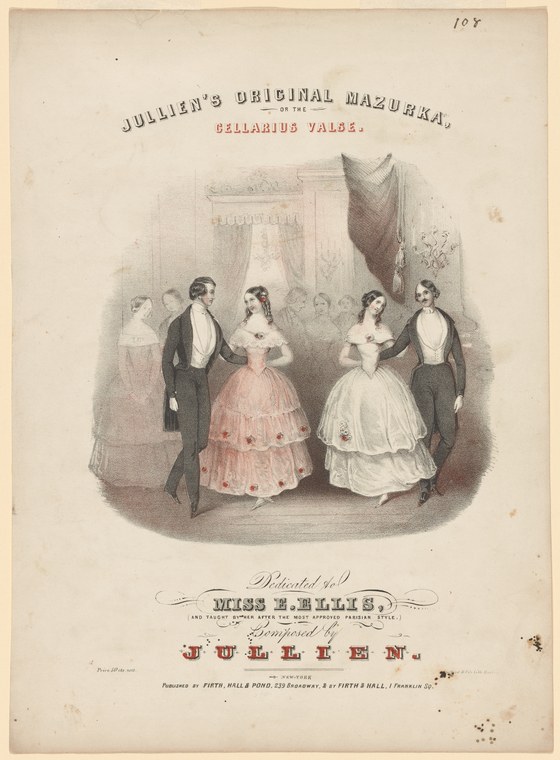
A lithograph depicts an elegant ballroom scene with five figures in formal 19th-century dress. In the foreground, two women in full skirts—one in pale pink with red embroidered details, the other in white—stand facing male partners in black tailcoats. A fifth figure appears in the background left. The setting is a grand interior with classical architectural elements: a tall draped curtain on the right, classical columns and a fireplace or doorway behind. The composition has the theatrical polish of a music-cover illustration, with soft shading that creates depth and a sense of refined, composed elegance. The women's voluminous skirts and the men's formal posture suggest a moment of social display rather than energetic movement—these are dancers posed or paused mid-conversation, not mid-motion.
The dancing
The two couples in the foreground are arranged in a formal, almost heraldic symmetry. Each woman stands with upright carriage, her arms at rest or held with gentle grace; the pink-dressed woman's arm appears extended toward her partner in a gesture of connection rather than active dancing. The men stand in classical ballroom posture, facing their partners at a respectful distance. No closed holds are visible; the frame suggests the social proximity and decorum of early Victorian ballroom etiquette rather than the dynamic partnering of later competitive ballroom. The overall frame is static and presentational—these are dancers acknowledging the social ritual rather than executing a step sequence.
The dance depicted
This is social ballroom dancing of the 1850s-1870s, most likely a waltz, mazurka, or galop—the standard repertoire of the Victorian ballroom as depicted in popular prints. The title references 'Cellarius Valse', which refers to Henri Cellarius, a celebrated French dancing master whose publications *La Danse* (1847) and *Les Principes de la Danse* codified the technique and etiquette of ballroom dancing for the middle and upper classes. The image prioritizes the social and sartorial aspects of ballroom culture—the correct deportment, dress, and spatial relationships between partners—over the specific footwork of any single dance. It is a document of ballroom *culture* rather than a precise choreographic record.
How it was made
This is a hand-colored lithograph, a commercial printing technique that allowed rapid, affordable production of popular images. The soft modeling of the figures, the subtle gradations of gray in the background, and the selective hand-coloring of the women's skirts in pink and white are characteristic of 1850s-70s music-cover lithography. Lithography's ability to capture fine detail and delicate line work made it ideal for capturing the refined surfaces of silk, lace, and tailored fabric—visual markers of wealth and status central to the social meaning of the dance. The technique's commercial and reproducible nature indicates this was a mass-market product, likely one of hundreds circulating as sheet music covers or standalone prints.
About this work
This is a ballroom dance lithograph from the mid-to-late Victorian era, commissioned as or derived from a music cover for a Cellarius waltz. It documents the social and aesthetic conventions of upper- and middle-class ballroom dancing at the height of the waltz's dominance in European and North American society. The work sits at the intersection of dance instruction, fashion illustration, and popular entertainment—genres that overlapped significantly in 19th-century visual culture.
The print's value as a historical document lies in how it *presents* ballroom dancing to the public: as an elegant, orderly, geometrically balanced social ritual. The emphasis on correct deportment, appropriate dress, and decorous spacing between partners reflects the role of dancing masters like Cellarius in codifying ballroom practice for a rapidly expanding middle class. This is not a candid capture of actual dancers, but a prescriptive image of how ballroom dancing should look.
How to look at it
Observe the formal symmetry and stillness of the composition. Notice how the artist has lavished detail on costume—the precise rendering of the women's skirt decoration, the sheen of silk, the tailoring of the men's jackets—while the bodies themselves are posed and static. Look at the distance between partners: they are not in closed hold, but at the formal, decorous spacing appropriate to a social introduction or a moment between dances. The architecture of the ballroom—the columns, the grand curtain—frames this as a display of elegance and status. This is a document of how ballroom dancing was *supposed to look*, not how it necessarily was danced.
The artist
The artist is not recorded in the catalogue. The work bears all the hallmarks of mid-19th-century commercial music-cover illustration—competent, competently colored, addressed to a mass market rather than a collector's cabinet. The lithographer was likely a journeyman or studio hand, one of hundreds producing dance and music covers for the publishing industry in Paris, London, or New York. The absence of attribution is itself typical; such work was often unsigned or signed only with a studio name.
The period
This print dates to the era when the waltz had become the dominant social dance of respectable society—the 1850s through 1870s. Henri Cellarius's publications and teaching were at their height of influence in this period, standardizing technique across Europe and America. The same decades saw the rise of commercial music publishing and the mass production of sheet music and related illustrations for the home market. Ballroom dancing was experiencing a shift from aristocratic diversion to middle-class social practice and mark of respectability; images like this both recorded and encouraged that democratization.
Where it lives
The print is held in the New York Public Library's collection of prints depicting dance, catalogued as a work depicting ballroom dancing on British and American 19th-century music covers. The source and holding indicate this is one of many such commercial prints, likely one of multiple printings or related issues.
Dance in this work
Questions about this work
Who was Cellarius and why does he matter?
Henri Cellarius was a French dancing master and author who, in the mid-19th century, published influential instruction books standardizing the technique and etiquette of ballroom dancing. His publications reached far beyond France and became the authoritative reference for correct ballroom practice across Europe and America. He transformed ballroom dancing from an aristocratic art into a codified, teachable middle-class accomplishment.
What dance is being shown here?
The title references a waltz, and the formal, upright posture and distance between partners is consistent with Victorian waltz technique as codified by Cellarius. However, the print prioritizes the social and sartorial dimensions of ballroom culture—correct dress, deportment, and spatial decorum—over the specific footwork of any single dance. It is as much a fashion plate as a dance document.
How do I know this was a commercial print?
The hand-colored lithography technique, the unsigned or studio attribution, the size and format, and the subject matter—a idealized, prescriptive image of ballroom propriety designed for mass circulation—all mark this as a commercial product. It was likely sold as a standalone print or as a cover for published sheet music, reaching a broad middle-class audience.
More dance artwork





