49 works in this view — arrow keys or swipe to move between them.
Dance in Art
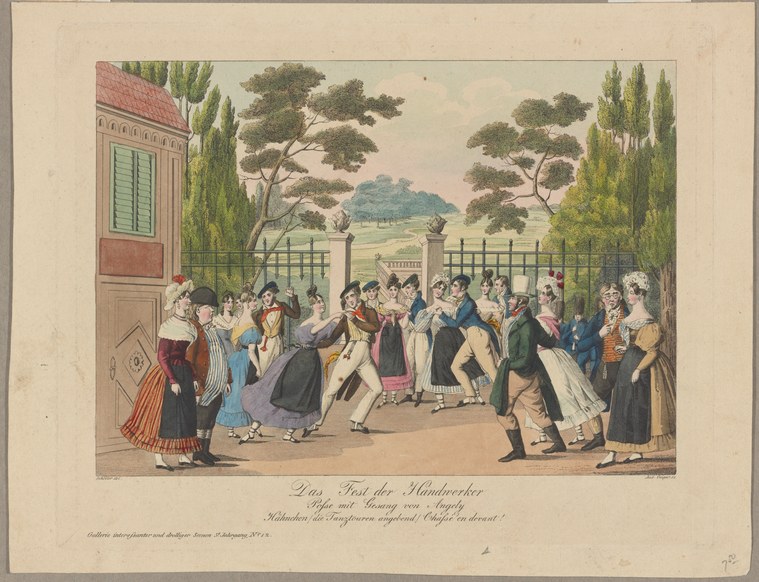
Das Fest der Handwerker: Posse mit Gesang von Angely
Unknown artist
- Collection:
- Prints depicting dance
- Source:
- New York Public Library
- Rights:
- Public domain — free to use, share and adapt.
- Recorded as:
- Public Domain
This print documents how ballroom and social dance were represented in popular entertainment during the Regency era, showing the visual conventions theaters used to depict refined dancing for a public audience. For historians of dance notation and performance, it is evidence of which dances were considered prestigious enough to stage and how they were adapted for theatrical presentation.
What you are looking at
A hand-colored engraving depicts an open-air festive gathering in what appears to be an 18th-century European garden or courtyard. A large crowd of elegantly dressed figures in contemporary costume—women in long skirts and men in coats and breeches—congregates around a central performance space. Tall cypress trees frame the composition on both sides, and a classical gate with decorative stonework closes the middle distance. The scene is bathed in even, naturalistic light typical of daytime outdoor entertainments. The figures are distributed across the foreground and middle ground in varied poses: some stand in conversation, some appear to be dancing, others watch. The mood is one of leisurely social pleasure rather than formal performance—this is a crowd at entertainment, not an audience in a theater.
The dancing
The dancers occupy the center of the composition in loose, informal groupings rather than disciplined formations. Several couples are visible in what appears to be a closed or semi-closed ballroom hold, with upright posture and measured spacing. Other figures stand or process with arms at their sides or gesturing conversationally. The women's long skirts dominate visually and restrict leg movement; weight appears to be centered and vertical. The overall carriage is dignified and restrained—this is social dancing among the leisured classes, not folk or theatrical performance. No visible footwork suggests the measured, controlled steps of formal court or ballroom style rather than jumps or complex floor patterns.
The dance depicted
This engraving most likely depicts the Quadrille or a similar formal court dance of the 1780s–1800s, or possibly a generic "festive dance" occasion rather than a single named dance. The title *Das Fest der Handwerker* (The Craftsmen's Festival) with music by Angely suggests a comic operetta or theatrical piece rather than documentation of an actual dance, making the specific dance style uncertain. The setting and costumes—Regency-era dress, formal social arrangement, outdoor garden venue—are consistent with historic-regency social dancing, but the theatrical context and the emphasis on spectacle over precise choreographic detail prevent confident identification of a single style. The image serves more as a period illustration of "dancing at an entertainment" than as evidence of how a particular dance was performed.
How it was made
This is a hand-colored engraving, typical of early 19th-century theatrical illustration and popular prints. The line work shows the even, precise parallel hatching characteristic of copper-plate engraving, with hand coloring applied afterward—visible in the distinct hues of clothing, foliage, and architecture. The technique allowed wide circulation at moderate cost, making theatrical subjects accessible to a broad public. The care taken in the composition and the inclusion of legible figures throughout the scene suggests this was issued as a commercial print documenting or advertising the performance, likely distributed to promote the operetta or to preserve a record of its staging.
About this work
This is a theatrical illustration, likely from a printed score or playbill for a comic operetta titled *Das Fest der Handwerker*, with a libretto by Angely. It captures an idealized representation of an open-air festive gathering where members of the leisured classes engage in social dancing among neoclassical architectural elements and carefully composed landscape. The work belongs to the tradition of 18th–early 19th-century theatrical prints that documented and publicized operatic and comic staged entertainments. As a visual record of how dance was imagined and represented in popular theatrical contexts of the period, it reveals contemporary ideas about leisure, social rank, gender, and spectacle as much as about actual dance practice.
How to look at it
Observe the careful composition: the artist has placed the dancers neither at the extreme foreground nor lost in the crowd, but distributed throughout the scene so that the eye can read both individual couples and the collective social event. Notice the stillness of the moment—no one is captured mid-leap or in extreme motion; instead, the engraver has chosen a measured, stately instant of social choreography. The formal framing with architectural and botanical elements (gates, cypress trees) signals that this is a genteel, controlled environment, not a spontaneous or rowdy entertainment. The hand coloring emphasizes the richness of the fabrics and the careful dress codes of the era, reinforcing that this is about social display as much as movement.
The artist
The artist is not identified in the catalogue record. The engraving is credited only to the composer Angely and the theatrical work *Das Fest der Handwerker*. The style and execution suggest a professional theatrical engraver working in the early 19th century, producing prints for commercial distribution alongside or independent of the stage production itself. Without further documentation, individual artistic identity cannot be established.
The period
The Regency era (1811–1820 in Britain; the term is used more broadly for early 19th-century neoclassical style across Europe) saw a renewed enthusiasm for formal ballroom dancing—particularly the Quadrille, which had recently arrived from France and was becoming fashionable in elite circles. Simultaneously, comic operas and theatrical pieces that incorporated dance were extremely popular vehicles for entertainment and social satire. This print dates from a moment when dance was being codified into named, standardized forms taught by professional masters, yet theatrical presentations often took liberties with accuracy in favor of spectacle and comedy. The garden setting and leisurely composition reflect the Romantic-era idealization of nature and rural simplicity, even in depictions of urban, fashionable entertainment.
Where it lives
This engraving is held in the New York Public Library as part of its collection of prints depicting dance. It is catalogued as a theatrical or operatic illustration rather than as documentation of actual dance practice, and carries minimal metadata beyond the title and composer's name.
Dance in this work
Questions about this work
Is this a real dance or a made-up theatrical one?
It is most likely a theatrical representation of real social dances of the period—such as the Quadrille or country dances—adapted and arranged for an operetta called *Das Fest der Handwerker*. Theatrical presentations often took liberties with authentic choreography for the sake of spectacle and comic effect. The print documents how dance was imagined and staged for public entertainment rather than how it was danced in actual ballrooms.
Who created this print and when?
The engraver is not identified in available records. It is attributed to a work by composer Angely and was produced as a theatrical print, likely in the early 19th century based on style and costume. The hand-coloring and engraving technique were standard for popular theatrical illustration of that era.
What can we learn about Regency dance from this image?
The image shows the formal posture, upright carriage, and restrained gesture associated with ballroom dancing of the period. The closed and semi-closed holds visible in the composition reflect how couples engaged with each other. However, because this is a theatrical illustration rather than documentary evidence, it represents idealized or stylized movement rather than precise choreographic practice.
More dance artwork





