49 works in this view — arrow keys or swipe to move between them.
Dance in Art
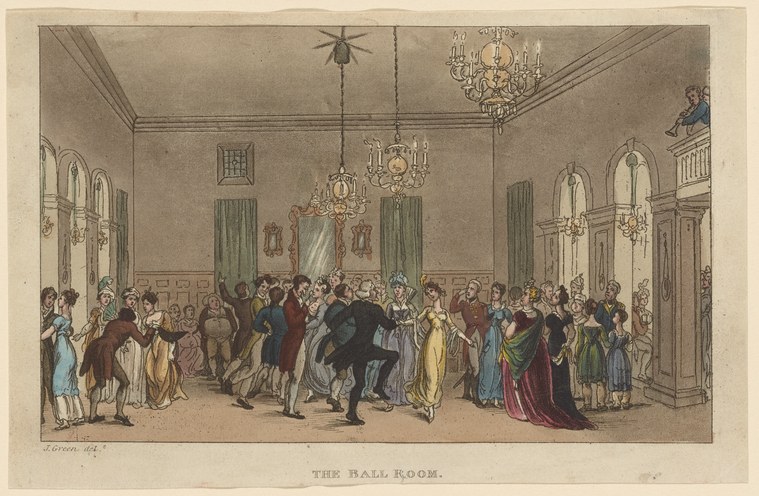
The ball room
Unknown artist
- Collection:
- Prints depicting dance
- Source:
- New York Public Library
- Rights:
- Public domain — free to use, share and adapt.
- Recorded as:
- Public Domain
This work documents the visual reality of a pivotal moment in the history of social dance: the transition from the ordered formations of the 18th-century country dance and cotillion to the closed-hold partnered dances (waltz, quadrille) that would dominate the 19th century. For historians and dancers, it is concrete evidence of how bodies were arranged in space, how couples held one another, how ballrooms were lit and furnished, and how the spectacle of fashionable dancing functioned as a marker of class and respectability. The print form also tells us that this was not elite spectacle but rather a documented norm being circulated to and consumed by a broad educated middle class.
What you are looking at
A crowded formal ballroom scene in which dozens of fashionably dressed figures mill about in conversation and dance. The space is a grand interior with neoclassical proportions: tall arched doorways punctuate the walls at left and right, the ceiling is coved and coffered, and three large chandeliers with multiple candles hang from above, providing light that falls evenly across the gathered company. The figures are rendered in a controlled hand-coloured engraving style, with women in high-waisted empire-silhouette gowns of pale silk (white, pale blue, pale yellow, pale green) and men in dark tailcoats and breeches. In the left-middle distance, a small group of musicians with instruments can be glimpsed, suggesting an orchestra. The composition is busy but orderly: some figures stand in conversational clusters, others promenade, and at least two pairs are actively dancing—one couple in the centre-right, the woman's pale gown swirling, the man in dark coat stepping forward. The mood is one of restrained sociability: faces are small and formal, posture is upright, and the gathering has the ceremonial air of a fashionable assembly rather than exuberant revelry.
The dancing
The dancers visible maintain an upright, composed frame characteristic of Regency-era ballroom deportment. In the central pair, the man leads with his body inclined slightly forward and his arms extended in the closed hold typical of the period; the woman follows with her weight forward, her pale skirts billowed by motion. Her posture shows the characteristic alignment of the waist and hip that marks a trained ballroom dancer of the era. Other figures stand or walk with the stiff formality expected in polite society: shoulders back, arms controlled, the women's arms either at their sides or held decorously. There is no suggestion of folk informality or the loose limbs of street dance—this is strictly codified movement in a supervised space.
The dance depicted
This depicts a Regency-era ballroom assembly, the dominant social and dance form of Britain and Europe roughly 1800–1830. The specific dances performed would have included the cotillion, quadrille, country dance, and increasingly the waltz, though the closed pair visible here—with the relative closeness and full-body orientation—suggests either a waltz or one of the newer Continental dances beginning to replace the older longways and set formations. The presence of an orchestra, the formal dress code, the segregation of sexes in conversation groups, and the architecture of the room all confirm this as a subscription ball or assembly-room dance, the public ballroom of the gentry and professional classes rather than a private house party or theatrical performance.
How it was made
This is a hand-coloured engraving, a technique that combined the precision and tonal range of line engraving with selective watercolour or gouache tinting applied after printing. The inscription at the lower left appears to read a date (possibly 1823) and what may be the artist's name, though the record does not confirm attribution. The technique allowed for wide circulation in print form—such images were sold as single sheets or in bound collections and found their way into middle-class homes, serving both as entertainment and as records of fashionable behaviour. The careful colouring distinguishes this from a plain engraving and suggests it was a higher-end product, aimed at buyers who could afford the additional labour. The line work shows considerable skill in rendering the architecture and crowd without descending into chaos, and the selective focus on a few foreground figures keeps the composition legible.
About this work
This is a snapshot of a fashionable Regency ballroom assembly, rendered in engraved and hand-coloured print form. It sits within a well-established tradition of ballroom and assembly prints that documented the social and dance practices of the gentry and professional classes in Britain and Europe between roughly 1800 and 1840. The print serves as both a mirror of actual practice—the dress, the room, the orchestra, the mix of dancing and conversation are all historically accurate—and as a kind of visual instruction manual or aspirational image for viewers who might wish to understand or imitate the manners of polite society. It records not only *what* was danced but *how*: the closed pair hold, the upright posture, the segregation of the sexes in standing groups, and the hierarchical control of movement that marked the ballroom of the period.
How to look at it
Observe the architectural space first: the room's proportions and chandeliers establish this as a formal, well-appointed venue of the period. Then trace the movement: the dancing pair in the centre-right is frozen mid-step, the woman's skirts displaced by the motion of turning. Notice the contrast between active dancers and the standing figures: the dancers are few and represent a minority of the gathering at any given moment, while most guests stand in conversation clusters or promenade. This reflects the actual rhythm of a Regency ball, where active dance was punctuated by rest and socialising. Finally, attend to the dress: the women's high-waisted Empire silhouettes and the men's dark tailcoats and breeches, along with the absence of any ornament beyond the women's narrow ribbons and simple jewellery, are precise details of Regency fashion and signal the date and class of the gathering.
The artist
The artist is not recorded in the catalogue. The style and inscription suggest a London print shop production of the 1820s, possibly by a professional engraver working in the commercial ballroom-print trade. Such prints were a significant commercial genre: shops like those of Thomas McLean, William Marshall, and others produced dozens of ballroom scenes, assembly scenes, and dance instruction images for a steady market. The hand-colouring may have been applied by apprentices or piece-workers in the shop, and individual copies vary slightly in colour intensity and selection.
The period
The Regency era (1811–1820 in the strict sense, but extended to roughly 1830 in cultural terms) saw a dramatic shift in social dance. The waltz, long danced in German and Austrian courts and among the gentry, began to appear in London ballrooms around 1812, causing moral panic among conservative observers alarmed at the close body contact and the woman's loss of independent movement within the formation. Simultaneously, the quadrille—a square-formation dance with fixed figures—spread from France and became a standard feature of polite assemblies. The ballroom itself was undergoing change: subscription assemblies and public rooms in fashionable towns (Bath, Brighton, London) supplemented or replaced private house dances, and they were increasingly sophisticated spaces with good lighting, sprung floors, and professional musicians. In art, the ballroom scene was a staple of satirical and observational prints, and hand-coloured engravings like this one served as both documents and social commentary.
Where it lives
This work is held in the NYPL's collection of prints depicting dance and belongs to the broader category of commercial ballroom and assembly engravings produced and circulated in Britain during the early 19th century. Such prints were sold individually or bound into collections and were intended for a domestic audience of middle-class readers interested in fashion, manners, and social life.
Dance in this work
Questions about this work
Was the waltz really danced this way in the 1820s?
The figure visible here—a man and woman in a closed hold, upright posture, relatively close contact—is consistent with contemporary descriptions and images of the waltz as danced in Britain during this period. However, the pose is frozen mid-step for compositional clarity, and an actual waltz in motion would involve continuous turning and a smoother, less stiff carriage. The image shows the outer form but cannot convey the flow and momentum of the dance itself.
Why are so few people actually dancing?
This was normal. In a Regency assembly, active dancing occurred in sets or sequences, with musicians playing a set dance (country dance, cotillion, or quadrille) for 10–15 minutes, after which the floor would clear and guests would converse, promenade, and refresh themselves. The image captures a moment when perhaps one or two sets are in progress while the majority of the room is in conversation. This reflects the social function of the ball: it was as much a venue for courtship, display, and conversation as it was for dancing.
What would the music have sounded like?
The orchestra visible in the left background would have consisted of violins, a cello or bass, and possibly a flute or clarinet, playing in the Classical idiom influenced by Mozart and Beethoven. The music for country dances and cotillions was in regular phrase structures (usually 32 or 64 bars), allowing dancers to anticipate the major figures and changes. The waltz, by contrast, was in a steady 3/4 time that permitted continuous rotation.
Is this a print or a painting?
This is a print—specifically, an engraving that has been hand-coloured after printing. The fine lines visible throughout and the even tone of the paper, along with the absence of individual brushwork, confirm it as a multiple rather than a unique object. The hand-colouring was applied selectively to highlight the dress and foreground figures.
More dance artwork





