49 works in this view — arrow keys or swipe to move between them.
Dance in Art
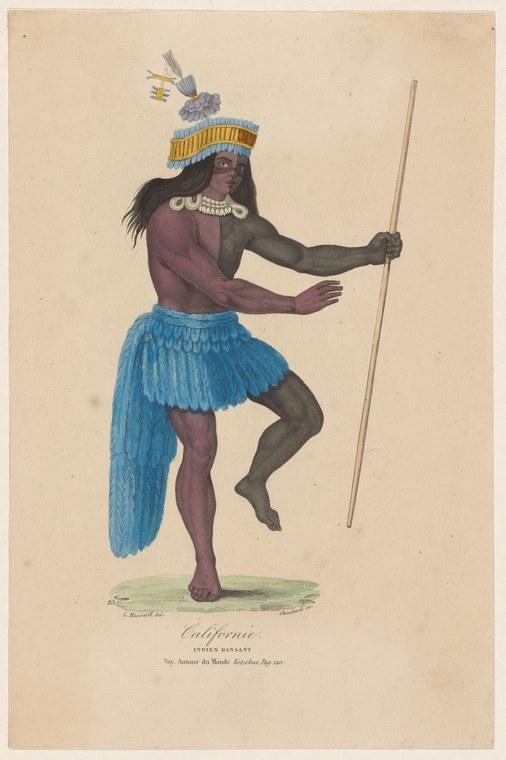
Californie indien dansant
Unknown artist
- Collection:
- Prints depicting dance
- Source:
- New York Public Library
- Rights:
- Public domain — free to use, share and adapt.
- Recorded as:
- Public Domain
This print documents the visual strategies through which 18th- and 19th-century European art and publishing created and circulated racial and ethnic stereotypes, embedding them in supposedly scientific ethnographic illustration. For dance historians, it reveals how non-European movement was conceptualized, appropriated, and domesticated for European audiences—posing as documentation while actually reflecting colonial desire and fantasy.
What you are looking at
A single figure stands in a contrapposto stance against a plain cream background, holding a long straight staff or spear at hip height with the right arm extended. The dancer wears a golden cylindrical headdress decorated with what appears to be feathers or plumes, and a white beaded choker or collar. The torso is bare and darkly rendered; the lower body is draped in a voluminous skirt of bright turquoise-blue feathering that extends asymmetrically, covering one leg fully while leaving the other bare from mid-thigh. The dancer's weight rests on one leg in a relaxed stance; the other leg is bent slightly at the knee. The bare feet are planted firmly on a small rectangular ground line. The rendering is hand-colored, likely engraving with watercolor or gouache applied after printing. The style and materials suggest this is a colonial-era ethnographic illustration, executed with careful attention to costume detail but from an external, observational perspective.
The dancing
A single standing figure displays a naturalistic, weight-distributed stance rather than a codified dance posture. The body is frontal and open, the right arm extended to hold the staff at a relaxed angle, the left arm hanging at the side with the hand visible and palm-forward. The slight bend in one knee and the slight shift in hip placement suggest ease and readiness rather than active movement through space. There is no partnering, no frame, and no suggestion of the turned-out, elevated carriage of European theatrical dance. The weight appears grounded and the overall silhouette is one of standing readiness rather than mid-movement.
The dance depicted
This image cannot be confidently identified as any single codified dance style. The title "Californie indien dansant" (California Indian dancing) and the ethnographic presentation suggest this is meant to document or represent a Native Californian dance or warrior stance, likely based on secondhand European accounts rather than direct observation. The upright stance with staff and the warrior associations imply this may depict a ceremonial stance or preparation for combat rather than a social or theatrical dance. Without documentation of actual Californian Indigenous dance practices from this period, or identification of the artist's sources, the specific dance cannot be named. The work sits within a colonial tradition of illustrated ethnography in which non-European movement was rendered as exotic spectacle.
How it was made
This is a hand-colored engraving or aquatint, typical of late-18th or early-19th-century European illustrated ethnography. The fine linear rendering and careful modulation of tone suggest engraving; the soft chromatic transitions and the fluidity of the colored areas suggest hand-coloring with watercolor or gouache applied to a printed base. The technique allowed rapid reproduction and circulation of such images across Europe and colonial networks, embedding visual stereotypes of non-European peoples into the scientific literature and popular imagination of the period. The legibility and standardized format made this suitable for bound collections of costumes and customs.
About this work
This is a colonial-era ethnographic illustration, likely from a published collection of world peoples and costumes, depicting what is labeled as a California Indian dancer or warrior in ceremonial stance. It exemplifies the European artistic tradition of rendering non-European movement through the lens of exoticism and resource documentation—the figure is presented as a type or specimen rather than as an individual engaged in an actual social or ceremonial practice. The careful attention to costume detail (headdress, feathering, ornamentation) is accompanied by a static presentation that reduces dynamic movement to a posed, displayable form.
The work matters because it reveals how colonial science visualized and distributed knowledge about Indigenous movement and bodies. Rather than documenting actual dance, it projects European assumptions about 'primitive' peoples onto Indigenous practice, fixing them in a timeless ethnographic present. For historians of dance and visual culture, this image is a document of colonial imagination—what Europeans wanted to see and believe about Native Californians—rather than a record of what was actually danced.
How to look at it
Attend to the static, posed quality of the figure—this is not a moment caught mid-movement but a deliberate staging for the engraver's view. The staff is held not as a weapon in use but as an attribute or emblem, displayed for the artist's and viewer's inspection. Notice how the bare skin, feathering, and ornamentation are rendered with almost anthropological precision, turning the body into a surface of information about 'type' and 'costume' rather than an agent of movement. This is how colonial art transformed living, moving humans into specimens.
The artist
The artist is not recorded in the catalogue. The work is consistent with the large corpus of colored ethnographic engravings produced in France and other European centers in the late 18th and early 19th centuries, often compilations of costumes and peoples drawn from travel accounts, missionary reports, and colonial sources rather than direct observation. Such works were sold individually or bound in albums aimed at educated collectors and institutions.
The period
This print dates to an era when European ethnographic illustration was consolidating as a genre—the period roughly from 1770 to 1820 when travel literature, natural history, and imperial expansion created a voracious market for images of 'exotic' peoples and customs. In the same decades, theatrical exoticisme in ballet and pantomime was appropriating and fantasizing non-European dance, particularly from the Americas and the Pacific. At the same time, Enlightenment natural history was beginning to classify and categorize human populations visually, a project that would deepen during the 19th century into full racial taxonomy. This image sits at the intersection of scientific pretension, theatrical fantasy, and colonial desire.
Where it lives
From the New York Public Library Prints Collection, identified as part of a broader series of ethnographic engravings. The notation "Indiens Dansant" and reference to indigenous dancing suggests this was part of a multipart collection or album, likely a European publication on world peoples and their customs. The inscription and format are consistent with late-18th-century French ethnographic publishing.
Dance in this work
Questions about this work
Is this based on an actual Californian Indigenous dance?
Almost certainly not. European ethnographic illustrations of this period were rarely based on direct observation. This image likely derives from secondhand written accounts, missionary reports, or the artist's imagination of what a 'warrior' or 'wild' indigenous person should look like. It reflects European fantasy more than documented practice.
What does the staff signify?
The staff is presented as an attribute associated with Indigenous warrior or ceremonial identity. Whether it represents an actual weapon, a dance prop, or simply a symbol of the artist's idea of indigenous masculinity is unclear. Colonial illustrations often used such objects to mark the 'otherness' of non-European peoples.
Why is this in a gallery of dance?
Because it is titled as a depiction of dancing and entered into a collection as such. However, it may better be understood as a stilllife of costume and body-as-type than as a representation of actual dance movement. It matters to dance history not as documentation but as evidence of how dance was imagined, appropriated, and presented to European audiences.
Who made this and when?
The artist is not recorded. Based on style, technique, and subject matter, it likely dates to between 1780 and 1820 and was produced in France or another European center of ethnographic publishing. More specific attribution would require comparison with known print collections and publishing archives.
More dance artwork





