49 works in this view — arrow keys or swipe to move between them.
Dance in Art
Dance on music covers
Unknown artist
- Collection:
- Prints depicting dance
- Source:
- New York Public Library
- Rights:
- Public domain — free to use, share and adapt.
- Recorded as:
- Public Domain
For historians of dance and costume, this print is a rare survival that shows how ballroom dance was actually performed and taught—the hold, the posture, the dress, and the social mixing of the sexes. The frieze format shows an understanding that movement cannot be fully notated, and that a student needed both score and image. For musicians, it is evidence of how dance music was published and circulated among amateurs. For social historians, it documents the rituals and amusements of the 18th-century polite classes.
What you are looking at
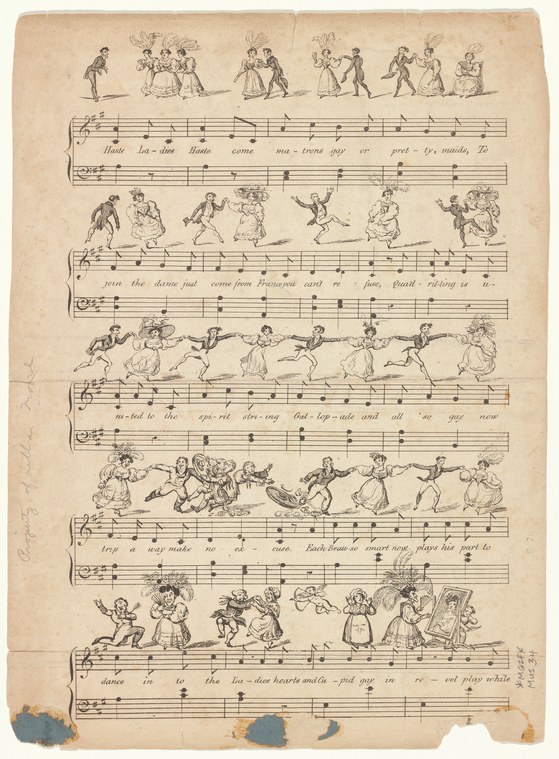
This is a musical score with five systems of staff notation, each accompanied by a strip of lively vignettes showing figures in energetic motion. The engraving depicts a narrative sequence of social dancing and entertainments—couples performing formal dances, groups of revelers, musicians, and bystanders in what appears to be a ballroom or assembly setting. The figures are rendered in a delicate, caricatural style typical of 18th-century satirical prints. Across the five sections, we see sustained interaction between male and female dancers in various configurations: closed holds, promenade positions, and formations suggesting cotillion or country-dance figures. The women wear full skirts with panniers and high hair, the men in breeches and tailcoats; the costume and setting place this firmly in the mid-to-late 18th century. The tone is cheerful and mildly comic—one figure appears to stumble, another is carried aloft—suggesting this is music for social amusement rather than serious theatrical performance.
The dancing
The dancers throughout maintain the upright posture and relatively close positioning expected of 18th-century ballroom dance. Most visible pairings show men and women in closed or semi-closed hold, with arms in the frame typical of the period—the woman's right hand on the man's shoulder or held at waist height, his left hand at her waist or holding hers. The weight appears centered and the movement smooth rather than forceful. Multiple groups suggest set dances rather than spontaneous partnering: couples are arranged in lines and circles. The footwork is not detailed enough to read individual steps, but the overall carriage and positioning of the feet suggests traveling steps and turns rather than complex floorwork. The figures are animated and engaged—facing one another, leaning slightly into the dance, suggesting the sociability and conversational nature of the genre.
The dance depicted
The music and imagery together document a cotillion, quadrille, or country dance—the standard ballroom social dances of the 1760s–1780s. The presence of multiple couples in geometric formations, the formal dress, the apparent social rather than theatrical context, and the gaiety of the vignettes all point to a fashionable assembly or ball rather than a stage performance. Cotillions and quadrilles were danced by any number of couples in square or longways sets and featured a mix of held promenade figures and separated or chained passages. The musical notation would show the tempo and structure of these figures. Without clearer detail of the individual steps or a legible inscription, the precise dance type cannot be narrowed further, but the image is unambiguous that this documents elite social ballroom practice of the late 18th century.
How it was made
This is an engraving—a relief print in which the image is incised into a metal plate and printed. The fine parallel lines used for shading and the precision of the figure work are characteristic of line engraving. The combination of musical score and narrative frieze above each system was a common commercial format in the 18th century, allowing a single print to serve both as a playable score and as a visual record of the dance's social context and appearance. This dual function—instructional and decorative—meant such prints circulated widely among music teachers, dancing masters, and amateur musicians. The worn appearance and blue stains suggest this was a working copy, handled and stored, rather than a collector's print.
About this work
This is an engraved broadsheet score for a fashionable ballroom dance of the late 18th century, with a frieze of figures above each staff system showing how the dance was performed. The print combines a playable musical score with documentary evidence of the costume, posture, and social context of elite dancing in an age before ballet schools had formalized the teaching of ballroom technique. The engraving format and the wear of the surviving impression indicate it was made for practical use—by musicians, dancing masters, and their pupils—rather than as a collector's print. It records a moment when social and theatrical dance were almost entirely separate, and when the ballroom was the principal stage for dance in polite society. The work is valuable precisely because it merges instruction with documentary: you can read both the music and the movement simultaneously.
How to look at it
The viewer should attend to the relationship between the music above and the frieze below each system: how a single musical phrase corresponds to a recognizable figure or moment in the dance, and how the positions and groupings shift as the music progresses. Note the formality of the dress and the precision of the postures—this is not folk dancing but an urban, elite practice. The comic or exaggerated quality of some figures (the tumbling, the embrace) should not obscure the underlying seriousness of the dancing: these are moments of actual steps and turns, rendered in a spirit of gentle satire rather than ridicule. The condition of the print—its stains and creasing—should remind you that this was a working document, used and reused.
The period
This engraving belongs to the mid-to-late 18th-century boom in published dance instruction. The cotillion and quadrille had recently become fashionable in Paris and London, and a vast literature of printed scores, step notations, and instructional manuals appeared to meet demand. Dancing masters like Kellom Tomlinson and Jean-Georges Noverre were establishing codified techniques for ballroom dance, distinct from both theatrical ballet and folk forms. At the same time, engraving allowed printers to produce illustrated broadsheets that merged musical score with narrative or instructional imagery—a format that appears here. The image and notation together show the transitional moment when social dance was beginning to be systematically documented, though still in a spirit of utility rather than historical preservation.
Where it lives
The print is held in the New York Public Library's collection of prints depicting dance, which contains primarily 18th and 19th-century prints, broadsides, and instructional materials. The library's catalog identifies it as an undated, anonymous work, likely British or French in origin, and probably issued sometime between 1760 and 1790.
Dance in this work
Questions about this work
Can you tell what dance this is from the image alone?
The image clearly shows a ballroom social dance of the 1760s–1780s, most likely a cotillion or quadrille. The multiple couples in formations, the formal dress, and the use of both close and open positions all point to this family of dances. Without a clearer inscription or more detailed footwork, the precise dance cannot be named, but the genre is unambiguous.
Why is there music with the pictures?
This format served both teaching and performance. A dancing master could use the score to teach the steps and timing to musicians; the frieze showed students how the dance should look in motion and in full dress. The combination of score and image made the print useful to both musicians and dancers, multiplying its market and its circulation.
What do the exaggerated poses tell us?
The slightly comic or exaggerated quality is typical of 18th-century satirical prints and should not be mistaken for inaccuracy. The figures are still recognizably executing real steps and holds—the satire is gentle and affectionate, part of the print's appeal to its audience. It documents the dance while also amusing viewers.
More dance artwork





