49 works in this view — arrow keys or swipe to move between them.
Dance in Art
Pastoral dance scenes of the eighteenth century
Unknown artist
- Collection:
- Prints depicting dance
- Source:
- New York Public Library
- Rights:
- Public domain — free to use, share and adapt.
- Recorded as:
- Public Domain
This work documents the aesthetics and body language of eighteenth-century courtly dance as it was imagined and circulated in popular print culture. For dance historians, it reveals the posture, spacing, and gendered dynamics of a courtship ritual performed through movement—and shows how dance was used as a visual language of social status and romantic attention.
What you are looking at
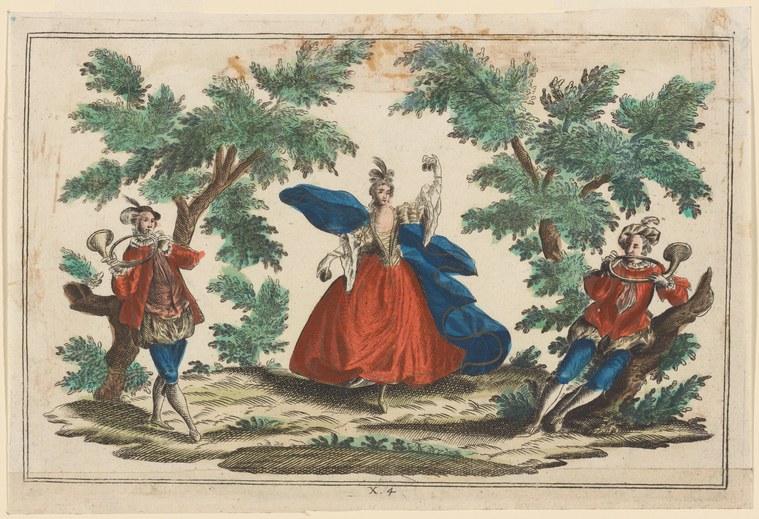
A pastoral idyll unfolds in a wooded glade where three figures enact a courtship dance. At center, a woman in a flowing red gown with a dramatically billowing blue cloak stands in a contrapposto pose, her body weight shifted, her right arm extended. She is flanked by two male figures in red coats and blue breeches, each holding a tricorn hat and gesturing toward her with theatrical attention. The composition is framed by tall trees with feathery green foliage; the ground beneath is sketched with grass and bare earth. Light falls from the upper left, catching the woman's voluminous skirts and the glossy folds of the blue fabric. The overall effect is one of studied elegance and courtly play—a moment suspended between movement and stillness, as if the woman has just executed a turn or is about to. The print is hand-colored in greens, reds, and blues over black engraved lines.
The dancing
The woman's stance is upright and composed, her weight poised on one leg in a posture that suggests training and control; her extended arm addresses one or both of her suitors. The two male figures maintain an open, inviting frame, their bodies angled toward her without contact, and their raised arms (one holding a hat aloft) create a gesture of presentation or admiration. All three figures occupy the same ground plane and are bound by sight lines and gestural attention rather than physical connection. The bodies are modeled in a way that suggests the artist understood courtly deportment—the elongation of the female figure, the controlled stance, the theatrical projection of the male figures' attention.
The dance depicted
This depicts a pastoral dance of eighteenth-century courtly tradition, most likely a menuet or contredanse of the type performed in aristocratic society. The woman's isolated, elevated position and the attentive stance of her two partners suggest either a moment of solo display within a group dance or a trio form. The setting—the rural glade rather than the ballroom—and the mythological or pastoral costume (the dramatic cloak, the studied informality) indicate this is imagined as a pastoral fantasy or operatic interlude rather than an actual court dance. The print likely documents or romanticizes fashionable leisure dancing of the mid-eighteenth century.
How it was made
This is a hand-colored engraving, identifiable by the crisp black line work, the careful cross-hatching used to model form and shadow, and the flat, applied watercolor washes in the three primary colors. Engravings of this type were mass-produced and relatively affordable, allowing them to circulate widely among the educated classes as prints for framing, illustration, or bound collections. The technique—engraving the line work first, then applying color by hand to multiple impressions—was standard for popular prints of the 1700s and suggests this was a commercial publication aimed at a market interested in fashion, dance, and courtly manners.
About this work
This hand-colored engraving presents a pastoral dance scene from eighteenth-century European courtly culture. Three figures—a woman and two men—enact a moment of flirtation and display in a wooded setting, their bodies and gestures following the conventions of courtly dance and movement. The print belongs to a large category of eighteenth-century popular prints that documented, celebrated, and idealized the leisure and manners of the aristocracy and aspiring middle classes. Such prints were widely circulated as instruction, entertainment, and fashion records, and this example preserves both the movement vocabulary and the social choreography of courtly courtship.
How to look at it
Notice the woman's posture and the men's orientation toward her: the artist has frozen a moment of display and attention, not a moment of contact or shared movement. The studied quality of the poses—the extended arm, the raised hats, the careful balance—tells us this is courtly dance, where deportment and the projection of emotional states mattered as much as the steps. The pastoral setting is key: the rocky ground, the overhanging trees, and the casual placement of the figures within a landscape suggest this is meant to evoke a fantasy of innocent pleasure, not the formality of the ballroom. The colored washes bring out the quality of the fabrics and the richness of the scene, inviting the viewer to admire both the elegance of the figures and the picturesque charm of the setting.
The period
The eighteenth century saw an explosion of print culture devoted to fashion, manners, and leisure among the European aristocracy and merchant classes. Dance was central to courtly life and social advancement, and prints depicting dance served both as instruction (teaching the 'correct' posture and steps) and as aspirational imagery—picturing an idealized world of elegance, leisure, and romance. The pastoral setting, with its evocation of Arcadia and rural innocence, was a favored convention for depicting courtship and romantic play; it allowed the artist to show fashionable society 'off duty' while maintaining the codes of politeness and decorum. Engravings like this were produced in series and sold individually or in bound collections, making them accessible to a broad audience beyond the court itself.
Where it lives
This work is part of the NYPL's collection of prints depicting dance, a category within the broader holdings of prints and drawings. The catalogue record gives only minimal information: the title, a notation of the era as unknown, and a generic dance style label. It is likely one of many such prints in the collection, part of the large corpus of eighteenth-century popular engravings devoted to fashion, manners, and leisure.
Dance in this work
Questions about this work
What dance is this depicting?
The exact dance form is not specified, but the posture, spacing, and courtly setting suggest this is one of the dances popular in aristocratic circles in the eighteenth century—likely a menuet, contredanse, or similar form. The pastoral setting and the theatrical quality suggest this may be an imagined or idealized version of courtly dance rather than a document of actual practice.
Why are the figures posed separately if they are dancing together?
In eighteenth-century courtly dances, physical contact was limited and formal. Dancers moved through space together, made eye contact, and gestured expressively while maintaining distance. This print captures the visual and gestural aspects of courtly dance—the display, attention, and controlled movement—rather than literal physical contact.
What was the audience for prints like this?
These prints were aimed at the educated and aspiring merchant and aristocratic classes who wanted to learn or imagine themselves as part of fashionable society. They served as instruction in manners and movement, as fashion illustrations, and as entertainment—a way to view and admire courtly life.
How can you tell this is an engraving?
The crisp, thin black lines and the careful hatching (parallel lines used to create shadow and depth) are characteristic of engraving technique. The hand-applied color washes and the slight irregularities in the coloring indicate this is a hand-colored print, which was the standard method of adding color to engravings in this period.
More dance artwork





