49 works in this view — arrow keys or swipe to move between them.
Dance in Art
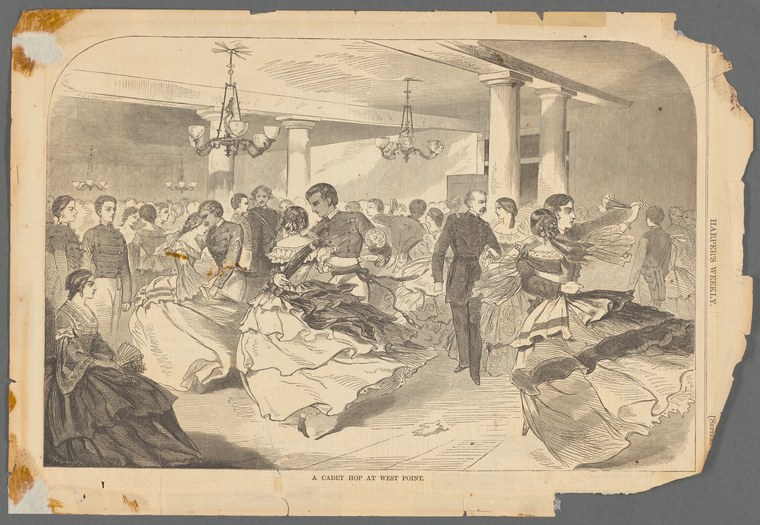
A cadet hop at West Point
Unknown artist
- Collection:
- Prints depicting dance
- Source:
- New York Public Library
- Rights:
- Public domain — free to use, share and adapt.
- Recorded as:
- Public Domain
This is rare documentary evidence of American military social dance in the nineteenth century, a context in which dance functioned as essential social bonding and courtship ritual. The image captures the informal, energetic quality of period social dancing—not the formal technique of a professional ballet or the folk traditions of common culture, but the lived social practice of an educated, institutional community. For dance historians, it documents how dance functioned in military life and offers visual evidence of period ballroom dress, setting, and couple dancing technique.
What you are looking at
A crowded interior ballroom or assembly hall, lit by chandeliers, shows a large social gathering of people in mid-nineteenth-century dress. The floor is dominated by a dancing couple at center: a man in a dark coat and a woman in a full-skirted light dress are engaged in an energetic dance, their figures caught mid-motion with visible swirl and momentum. Around them, spectators line the space—men in dark coats, women in elaborate crinoline skirts and bonnets—watching intently or conversing. The scene captures the informal social energy of a military cadet dance, with figures distributed across the composition in varying states of engagement: some standing in conversation, some turned toward the dancers, some in the background barely visible in shadow. The architectural setting is utilitarian—supporting columns, exposed beams, simple chandeliers—appropriate to a barracks or military academy hall rather than a grand ballroom.
The dancing
The central dancing couple shows the loose, energetic frame of social dancing rather than the formal closed ballroom hold of classical technique. The woman's full skirt swings wide, the man's posture is upright but relaxed, and both figures lean into the movement with visible momentum. The surrounding spectators stand at ease, some with hands at their sides, others gesturing in conversation—the body language is informal and social rather than formal. The density of figures and the way they cluster around the dancing couple suggests this is participatory social entertainment, not a performance being viewed from a distance.
The dance depicted
This depicts a cadet hop, a military social dance, most likely from the United States Military Academy at West Point based on the title. The dance appears to be a lively social waltz or galop—a popular couple dance of the period—performed not as a formal display but as part of the evening's entertainment within a military community. The artist captures the informal, convivial atmosphere that characterizes such dances: couples move through the space, spectators cluster and watch, the mood is one of relaxation and social ease. The dance is not a staged performance but social participation, which was the primary function of cadet hops in nineteenth-century military culture.
How it was made
This is a wood engraving or steel engraving, a technique that allows fine linear detail and permits large print runs for popular distribution. The technique is evident in the close parallel lines used for shading, the precise hatching on fabrics and faces, and the strong black lines defining form. This medium was standard for periodical illustration in the mid-nineteenth century, meaning the image was likely published in a newspaper or illustrated magazine and reached a broad popular audience. The technique's capacity for detail allowed the artist to convey the specific social atmosphere and contemporary dress with clarity.
About this work
This engraving documents a cadet hop at West Point, a social dance central to military academy life in the nineteenth-century United States. The artist captures not a formal performance but an informal gathering where officers and cadets danced as social recreation, with couples rotating through dances—likely waltzes, galops, or polkas—while spectators watched and conversed. The work is a social document: it shows the role of dance in military institutional life, the contemporary dress and ballroom architecture of the period, and the informal, participatory character of mid-century social dancing among educated middle and upper-class Americans. The engraving's publication format suggests it was distributed to a general audience, making visible a ritual of military culture that would otherwise be known only to those who experienced it.
How to look at it
Focus on the central dancing couple: the artist has captured a moment of energetic, outward movement—the woman's skirt in full swing, both figures leaning into the motion—rather than a static pose. This is motion frozen mid-action, not a formal, controlled moment. Notice also the contrast between the formal dress (the men's dark coats, the women's elaborate crinoline gowns) and the informal, relaxed postures of the surrounding spectators; this juxtaposition captures the social ease of the gathering despite the period formality of dress. The density of figures and the way the eye moves from the bright, active central couple outward to the darker, watching crowd is deliberate: the artist organizes the composition to keep the dance at the visual and social center.
The period
This engraving dates from the mid-nineteenth century (likely 1850s–1870s based on dress and artistic technique), when illustrated newspapers and magazines were the dominant visual media for documenting contemporary social life. The waltz and galop were the dominant couple dances of the period, and social dancing was a central feature of courtship and social bonding among the educated classes. West Point, founded in 1802, had established cadet hops as a key social institution by the mid-nineteenth century; these weekly dances served both social and courtship functions, bringing together officers, cadets, and young women from nearby communities. The engraving reflects the period's interest in documenting contemporary manners and social rituals through the popular press.
Where it lives
This engraving is held by the New York Public Library in its Prints collection, which documents social life, architecture, and public events in nineteenth-century America. It is catalogued simply as 'A cadet hop at West Point,' indicating it was likely published in a periodical—newspaper or illustrated magazine—without artist attribution, a common practice for periodical illustrations of the era.
Dance in this work
Questions about this work
What is a cadet hop?
A cadet hop is a social dance held regularly at a military academy, particularly at the United States Military Academy at West Point. These were formal but socially informal gatherings where cadets and officers danced with invited young women from nearby communities. The dances served social, recreational, and courtship functions within military institutional life. Hops typically featured popular ballroom dances of the era—waltzes, galops, polkas—and were occasions for demonstrating social refinement and forming social bonds.
When were cadet hops at West Point held?
Cadet hops became established as a regular institution at West Point in the early nineteenth century and remained a central feature of military academy social life throughout the nineteenth and twentieth centuries. By the mid-nineteenth century (the likely date of this engraving), they were held weekly during the academic year and were major social occasions.
What dances are shown here?
The primary dance visible in the engraving appears to be a waltz or galop, the dominant couple dances of mid-nineteenth-century ballroom culture. These were dances in closed or semi-closed position where couples rotated around the ballroom floor. The energetic, swinging motion of the central couple's skirt and the rotational movement suggested by their positioning are characteristic of these dances.
Why was this image published?
As an engraved illustration in a periodical, this image documented contemporary American social life for a general, literate audience. Illustrated newspapers and magazines of the mid-nineteenth century regularly published scenes of social and institutional life, making them accessible to readers who would not experience such events firsthand. This engraving made visible the social practices of an educated military institution to a broader public.
More dance artwork





