49 works in this view — arrow keys or swipe to move between them.
Dance in Art
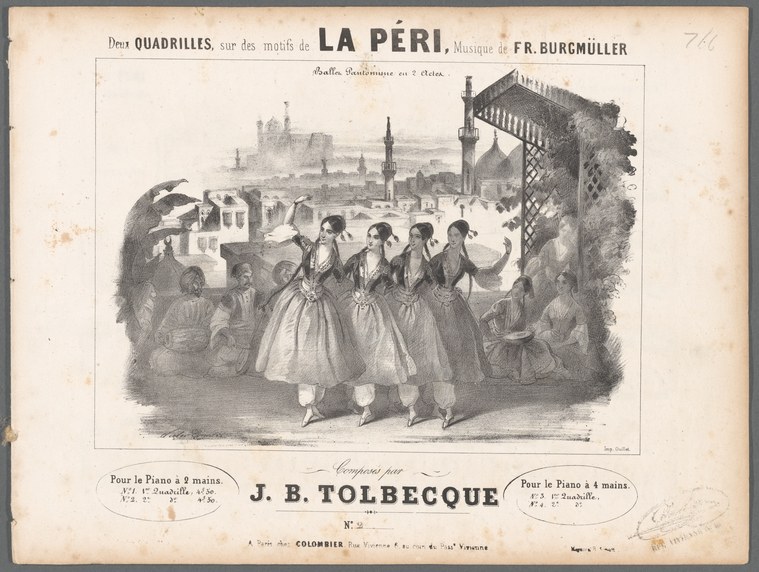
Deux quadrilles, sur des motifs de La péri, musique de Fr. Burgmüller
Unknown artist
- Collection:
- Prints depicting dance
- Source:
- New York Public Library
- Rights:
- Public domain — free to use, share and adapt.
- Recorded as:
- Public Domain
Quadrille sheet music covers are rare visual documents of ballroom dance practice before photography. This image shows us exactly how dancers of the Romantic era understood and presented the quadrille to themselves: the carriage, the spacing, the formation, and the theatrical consciousness with which they performed it. For dance historians, it is direct evidence of choreographic structure and social aesthetics of one of the nineteenth century's most important social dances.
What you are looking at
A lithographed sheet music cover depicts four women in mid-nineteenth-century ballroom dress arranged in a line across a theatrical stage or terrace. They wear bell-shaped skirts and fitted bodices typical of the 1840s-1850s. The women stand in profile or three-quarter view, their bodies angled as though caught in the figure of a quadrille—their posture suggests a promenade or chassé movement. Behind them, a Romantic-era cityscape with minarets and domed buildings (evoking an Oriental or Mediterranean setting) recedes in soft atmospheric perspective. To the left, shadowy figures of musicians and spectators occupy the middle ground. The composition is arranged as a theatrical proscenium view: the dancers occupy the stage proper, while the architecture and onlookers anchor the scene in a ballroom or opera-house setting.
The dancing
Four women stand in a linear formation, evenly spaced across the stage. Their bodies are held upright in the formal carriage of ballroom dancing, with arms positioned in what appears to be the frame of a quadrille—not the tight closed hold of a waltz, but a more open, processional stance. The nearest woman's skirt billows slightly, suggesting forward motion or a turn. Their feet are not clearly visible, but their weight appears distributed for traveling steps rather than pivoting. The formation and spacing suggest they are executing or about to execute a characteristic quadrille figure—possibly an allemande, promenade, or traversée.
The dance depicted
This is a quadrille, one of the most fashionable ballroom dances of the mid-nineteenth century. The title 'Deux quadrilles' indicates this is music for two separate quadrille sets, composed by Frédéric Burgmüller and arranged for four-hand piano. The image shows the dance as a theatrical display: four women in an ordered formation, without male partners visible, arranged for visual symmetry rather than functional couple-dancing. The theatrical setting and the absence of gentlemen suggest this may represent either a theatrical quadrille (as performed on stage) or a stylized promotional image for the dance itself. The Oriental setting—unusual for a quadrille—may indicate a themed or costumed variant, or may simply reflect the Romantic-era taste for exoticized backdrops on sheet music covers.
How it was made
This is a lithograph, evident from the soft pencil-like line quality, the subtle tonal gradations, and the characteristic texture of crayon-on-stone reproduction. The technique allowed rapid, affordable printing in quantities suitable for commercial sheet music distribution, making this a mass-market product aimed at amateur pianists and music-loving households. Lithography also permitted the inclusion of illustrative scenes alongside musical notation on a single sheet, a practice that turned sheet music into an aesthetic object as well as a functional one. The composition and technique suggest this was printed in France, likely in Paris, where Burgmüller was based and where quadrille publications were prolific.
About this work
This sheet music cover documents the quadrille at the height of its popularity, around the 1840s-1850s. The composition serves a dual function: it is both an advertisement for a musical work and a visual record of how the dance was understood and performed. The theatrical framing and all-female cast suggest a moment when the quadrille was becoming not just a social dance but a subject of artistic representation and theatrical appropriation. The image preserves not only the formal steps and figures of the dance, but the social context in which it was danced—the ballroom as a space of display, the importance of symmetry and order, and the femininity emphasized by the silhouette of the era.
How to look at it
Attend to the formal arrangement of the women and the deliberate spacing between them—this is not a random grouping but a precise choreographic formation. Notice the posture and arm carriage, which conveys the ballroom ideal of restraint and upright elegance, even in motion. The theatrical backdrop and staged quality are essential: this is not a documentary image of a real ballroom scene, but a stylized, idealized representation designed to sell both the music and the dance to prospective buyers. The absence of men is significant—it simplifies the image and emphasizes the visual spectacle over the social complexity of actual couple-dancing.
The artist
The composer Frédéric Burgmüller (1806–1874) was a prolific composer of piano music and dances, based in Paris. He was known for operatic and ballet music as well as for countless arrangements of popular dance types—quadrilles, galops, polkas—for the amateur music market. His works were published widely across Europe and were standard repertoire for any piano teacher or accomplished amateur. The illustrator of the cover is not recorded in the catalogue, but the style and quality of the lithographic work suggest a professional music publisher's workshop, likely in Paris.
The period
The quadrille reached its zenith of fashionability in the 1840s and 1850s, displacing earlier contradances and country dances in European ballrooms. It was the most complex and prestigious social dance of the era, requiring practice and coordination among dancers. Simultaneously, the quadrille was being absorbed into theatrical and concert dance: Romantic ballet and comic opera frequently featured quadrilles, often as opportunities for spectacle and ensemble work. The 1840s-1850s were also the peak of the decorative sheet music cover as a medium: publishers invested in attractive lithographic illustrations to encourage sales among the growing middle-class music-buying public. This image sits at the intersection of all these trends: commercial, social, and theatrical.
Where it lives
This is a published lithographic sheet music cover housed in the New York Public Library's collection of prints depicting dance. The print was part of the library's collection-building efforts to document dance through visual ephemera and promotional materials.
Dance in this work
Questions about this work
Who danced the quadrille, and where?
The quadrille was a social dance for the European bourgeoisie and aristocracy, performed at balls, assemblies, and private parties. It required four couples (eight dancers) arranged in a square formation, and was typically danced in sequence with other quadrilles throughout an evening. It was taught by professional dance masters and was considered a mark of accomplishment and social standing.
What are the figures in a quadrille?
A quadrille typically consisted of five figures, each lasting 32 bars of music. Common figures included the introduction, the allemande (a chain or weaving movement), the promenade, the traversée, and the finale. Each figure had strict choreography, though variations existed by region and period.
Why does sheet music have pictures?
In the nineteenth century, sheet music covers were illustrated and decorated to appeal to middle-class buyers. The image served as advertisement, attracting purchasers and conveying the style and character of the music. The cover image also helped buyers understand how the music should be danced or played—it was both artistic and instructional.
Is this from a real performance or made up?
This is likely a theatrical or idealized representation rather than a documentary image. The all-female cast, the Oriental backdrop, and the symmetrical staging suggest this is a stylized interpretation created to appeal to music buyers. It shows the quadrille as it was imagined and desired, not necessarily as it was danced in actual ballrooms.
More dance artwork





