49 works in this view — arrow keys or swipe to move between them.
Dance in Art
Ballroom dancing on British and American 19th-century music covers
Unknown artist
- Collection:
- Prints depicting dance
- Source:
- New York Public Library
- Rights:
- Public domain — free to use, share and adapt.
- Recorded as:
- Public Domain
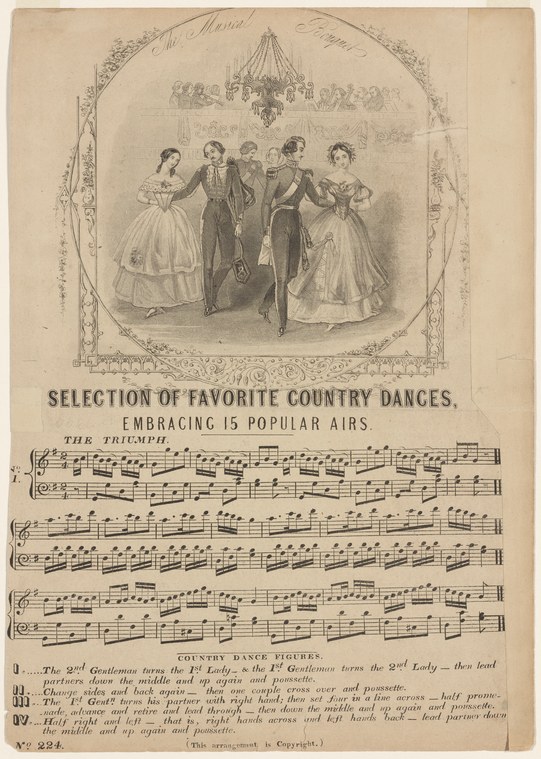
For dancers and historians, this object is a rare survival of the printed infrastructure that made 19th-century ballroom culture accessible to the middle classes. It shows not only what people wore and how they stood, but how they learned—through the combination of image, music, and numbered instruction—and thus reveals the teaching methods and commercial networks that sustained social dancing in the 1840s–50s. The specificity of the costume, the precision of the notation, and the survival of the complete sheet make it a primary source for understanding both the aesthetics and the mechanics of the era.
What you are looking at
This is a printed music cover for a selection of country dances, likely from the mid-19th century. The title page is framed by an ornate double border of scrollwork and floral motifs. Within this frame, an engraved scene shows five figures in a ballroom or drawing room setting. At the center stands a military officer in dress uniform with epaulettes and medals, flanked by two women in full skirts typical of the 1840s–50s era—high-waisted, voluminous, and reaching the ankle. To either side stand two additional figures: a man in civilian dress on the left and another woman on the right. A decorative chandelier hangs above them. The composition is formal and symmetrical, suggesting a moment of courtship or social introduction rather than active dancing. Below the scene, musical notation is printed in two staves, showing the opening measures of what is identified as "The Triumph." At the bottom of the page, numbered dance figures (I, II, III, IV) provide written instructions for executing the steps of four country dances.
The dancing
The central officer stands upright in a formal posture, his body vertical and his gaze directed outward. The two women nearest to him stand with their shoulders back, their arms held in the carriage typical of 1840s ballroom etiquette—one woman's left arm appears to rest near her waist, while the other's arms are at her sides. Their posture is upright and composed, with weight evenly distributed on both feet; neither figure is mid-step or mid-turn. The two flanking figures adopt similar formal stances. The overall configuration suggests a moment of introduction or social greeting rather than active partnership in dance; there is no hand-holding or closed dance position visible. The spacing between figures is measured and dignified, consistent with the social conventions of drawing-room dancing.
The dance depicted
This is a printed instructional sheet for country dances—social group dances performed at balls and private gatherings in Britain and America during the 19th century. Country dances (also called "contre dances") typically involved multiple couples arranged in parallel lines or squares, with figures that included allemandes, turns, and processional movements. The printed figures below the scene—labeled I through IV—are shorthand notation instructing dancers how to execute the specific movements of each dance to the musical accompaniment above. The image itself does not depict active dancing but rather the social setting and formal dress in which these dances were performed, emphasizing the ballroom context and the partnership between officers, gentlemen, and ladies typical of the period.
How it was made
This is an engraved print, likely a wood engraving or steel engraving, printed with letterpress text and musical notation. The fine line-work of the frame, the figures, and the decorative elements suggests the work of a professional engraver. The technique allowed for mass reproduction, making this an affordable, widely distributed publication aimed at households and dancing masters who needed both visual reference and musical scores. The combination of instruction, music, and narrative image on a single sheet indicates this was a commercial product sold to the middle classes as a guide to fashionable ballroom practice. The quality of the engraving and the precision of the typography suggest a London or New York publisher of some standing.
About this work
This is a mid-19th-century printed music cover and instructional sheet for country dances—the most popular social dances of the era in Britain and America. It serves a dual purpose: the engraved vignette shows the ballroom setting and formal dress in which such dances were performed, while the printed musical notation and numbered figures below provide the tune and step-by-step instructions for dancers to follow. The work is a product of the commercial dance publishing industry that flourished in the 1840s–50s, when printed dance manuals and sheet music were in high demand among the expanding middle class. It belongs in a gallery of dance art not because it depicts dancing in action, but because it reveals how dance was taught, learned, and integrated into the social life of its time—and because the engraved image itself is a period document of ballroom fashion and etiquette.
The cover exemplifies a specific moment in dance history: the transition from aristocratic court dances to democratic social dancing in public ballrooms and private drawing rooms. Country dances, unlike the formal quadrilles that would dominate later in the century, were accessible, participatory, and widely published. This sheet is evidence of how dance instruction moved from the dancing master's studio to the printed page, allowing amateurs to learn at home with the aid of a musical guide and visual reference.
How to look at it
Look first at the formal arrangement of the five figures: their spacing, their upright posture, and the absence of physical contact. This is a moment of social ritual—introduction and courtship—not a moment of motion. The engraver has chosen to show not the dance itself but the setting in which dancing occurs, allowing viewers to see the dress, the interior, the social composition of the ballroom. Next, read the printed figures and music below: note how the numbered notation (I, II, III, IV) breaks the dance into discrete, teachable units, each to be performed to a specific musical phrase. This combination of image and instruction was how the 19th-century amateur learned to dance—not by watching a master or attending a class, but by studying a sheet at home. The chandelier, the wallpaper, and the decorative border all signal that this is a genteel, domestic scene, reinforcing the idea that these dances were for the drawing room and the formal ball, not the street.
The period
This sheet was produced during the peak of the country dance's popularity in Britain and America, a period when social dancing was a central feature of middle-class courtship and entertainment. The 1840s–50s saw an explosion of printed dance instruction—sheet music, dance manuals, and combination sheets like this one flooded the market, driven by the expansion of piano ownership, the rise of lithography and steel engraving, and the commercial ambitions of publishers in London, New York, and other urban centers. At the same time, fashions in dress—particularly the full-skirted silhouette shown here—were undergoing rapid change, making printed costume reference valuable for dancers who wished to appear au courant. The military officer in the scene reflects the social prominence of the military in the period; officers were often the most accomplished dancers and the most photographed exemplars of ballroom fashion. By the 1860s, the quadrille and the polka would begin to displace the country dance, but in the 1840s–50s, sheets like this one were ubiquitous.
Where it lives
The New York Public Library holds this print as part of its collection of dance-related prints and illustrations. It is cataloged as a single printed sheet, likely produced for retail sale to the public. No publisher, engraver, or printer is identified on the surviving impression.
Dance in this work
Questions about this work
What are country dances and who danced them?
Country dances (or contre dances) were social group dances in which multiple couples stood in long lines or squares and performed figures together to live music. They were enormously popular among the middle and upper classes in Britain and America from the 17th century through the 19th century, and were often the main event at balls, assemblies, and private parties. Both men and women participated, and they were considered appropriate for polite society. By the 1840s–50s, when this sheet was printed, country dances were beginning to yield ground to the quadrille, but they remained fashionable, especially in America.
How did people learn these dances?
Before the 19th century, people learned by hiring a dancing master or attending public assemblies where the dances were performed. From the early 1800s onward, printed sheets like this one made it possible to learn at home: a musician (usually on piano) would play the printed tune, while the dancers followed the numbered figures printed below. This dramatically expanded access to dance knowledge and made it possible for people of modest means to participate in fashionable dancing. Printed dance instruction remained the primary teaching medium until the advent of film and video in the 20th century.
Why is there a military officer in the scene?
Officers were prominent figures in 19th-century ballroom culture and were frequently depicted as the exemplars of elegant dancing and fashionable dress. Their presence in a dance scene signaled refinement, propriety, and social aspiration. The public was fascinated by military uniforms and by the officers who frequented London and New York ballrooms, and publishers knew that including a smartly dressed officer on a cover would appeal to consumers.
What do the women's dresses tell us?
The full, ankle-length skirts, the high waistlines, and the fitted bodices are characteristic of the 1840s–50s, a period of dramatic expansion in women's skirt volume made possible by multiple layers of petticoats and, by mid-century, the crinoline cage. The fashion is crucial for dating the print and for understanding the physical constraints of dancing: in these heavy, voluminous skirts, a woman's movement was restricted to certain kinds of steps and figures, and the visible swirl of fabric as she turned was part of the visual spectacle of the dance. Printed sheets like this one, with contemporary costume, helped dancers stay in fashion.
More dance artwork





