49 works in this view — arrow keys or swipe to move between them.
Dance in Art
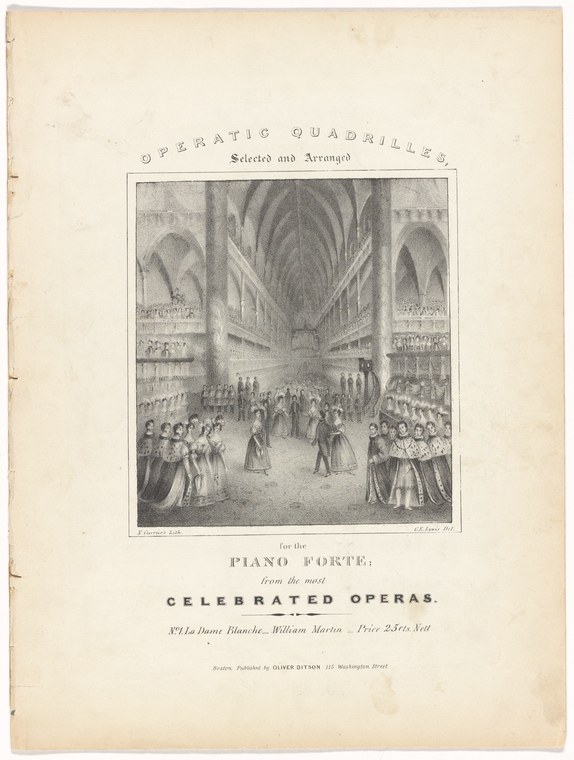
Operatic quadrilles: selected and arranged for the piano forte; from the most celebrated operas
Unknown artist
- Collection:
- Prints depicting dance
- Source:
- New York Public Library
- Rights:
- Public domain — free to use, share and adapt.
- Recorded as:
- Public Domain
Operatic quadrilles represent a specific moment in dance history when popular ballroom dances were systematized, notated, and transformed into theatrical spectacle. This engraving is direct visual evidence of how these dances were staged and imagined for the opera house, showing the choreographic priorities and spatial arrangement of the period. For anyone researching the adaptation of social dance to theatre, the intersection of music and dance publishing, or the visual culture of early 19th-century entertainment, this work is a primary document.
What you are looking at
A grand interior cathedral or concert hall is crowded with formally dressed figures arranged in two distinct choruses flanking the central nave. The space is defined by soaring Gothic arches and vaulted ceilings rendered in dramatic perspective. On the left and right sides, ranks of women in white gowns stand in organized formation, facing inward. Between them, in the central floor space, a smaller group of figures in darker formal dress enacts what appears to be a central dramatic moment. The composition creates a theatrical proscenium effect, with the architecture framing the action as if for a stage. The print technique renders this scene in fine tonal gradation, with deep blacks in the shadowed arches and delicate halftones suggesting the depth and grandeur of the space.
The dancing
The two flanking choruses of women are positioned in nearly symmetrical ranks perpendicular to the central action, their bodies upright and still, dressed uniformly in high-waisted white gowns typical of early 19th-century formal wear. The central figures, fewer in number and in darker dress, occupy the transverse space where the quadrille would be danced. Their posture suggests formal ballroom positioning rather than active movement—the moment appears to be arrested between figures rather than caught mid-step. The overall arrangement prioritizes visual symmetry and hierarchical composition over the depiction of dynamic physical movement.
The dance depicted
This is operatic quadrille, a theatrical adaptation of the quadrille—the fashionable four-couple square dance of the Regency and early Victorian period—arranged and performed as part of operatic productions. The quadrille appears here in its most formal, ceremonial context: not as a ballroom social dance but as a tableau vivant or processional moment within opera, where the dance is stylized and integrated into narrative spectacle. The white-clad choruses may represent opera chorus members or ballet corps, suggesting that this publication documents orchestrated choreography for the stage rather than social dancing, marking the period when ballroom dances were adapted for theatrical presentation.
How it was made
This is a steel or copper engraving, identifiable by the fine parallel hatching, crisp linear definition, and the capacity to render both deep blacks and delicate midtones. The technique allowed for the creation of multiple impressions suitable for bound collections and mass circulation, and the careful architectural perspective suggests it was engraved from a drawing. The publication format—a collection of operatic quadrilles for piano forte—indicates this was a commercial music and dance publication, likely imported or published in London given the publisher credit 'DOBE GIBSON' visible at the bottom. The engraving technique was the standard for distributing both visual and musical repertoire in this period.
About this work
This engraving documents a quadrille as performed in the European operatic theatre of the early 19th century, likely 1820s–1840s. Rather than capturing social dance, it presents a theatrical tableau: a choreographed arrangement of chorus members in formal procession or ceremonial formation within an imagined grand interior. The work belongs to a genre of practical publications—dance instruction materials and operatic scores with illustrations—that show how ballroom dances were adopted and transformed for the stage. It represents the intersection of dance, music, and visual culture at a moment when the boundary between ballroom and theatre was permeable, and when popular dances could be published as both social recreations and spectacular theatrical moments.
The image is valuable precisely because it shows dance not as it was performed in drawing rooms but as it was imagined and choreographed for an audience. The formal architectural setting, the symmetrical massing of figures, and the arrested action all indicate theatrical rather than social intention. The work documents a repertoire that has largely vanished—operatic quadrilles are rarely performed today—making contemporary visual evidence of their staging and composition historically significant.
How to look at it
Attend to the symmetrical composition: the careful mirror-imaging of the two flanking choruses and the central space reserved for the actual dance. The artist chose a moment of stillness or formal arrangement rather than stepped movement, suggesting the priority was visual spectacle and architectural grandeur rather than the technical execution of the dance. Note the uniformity of the white-gowned figures and their upright, formal posture—this is not naturalistic observation of ballroom dancing but an idealized, theatrical vision. The fine engraved lines and controlled hatching create depth and shadow that emphasize the cathedral-like interior, making the dance secondary to the space it occupies.
The period
The quadrille became the dominant fashionable dance in Europe between 1815 and 1860, arriving in England from France around 1815 and quickly becoming a staple of both ballroom and theatrical entertainment. During this Regency and early Victorian period, the boundaries between social and theatrical dance were fluid: the same dances performed in assembly rooms were choreographed for the opera house and ballet. Publishers capitalized on this demand by producing illustrated dance and music publications for home use and professional performance. The title references operas by major composers—La Dame Blanche, William Marion, and Nury Erris Nell—suggesting this collection drew its quadrilles from current operatic repertoire, adapting theatrical choreography for amateur pianists. This practice of extracting and republishing dance music from successful operas was standard in the period.
Where it lives
The work is held as part of the New York Public Library's collection of prints depicting dance, catalogued as part of their broader holdings of theatrical and dance imagery. The publisher credit 'DOBE GIBSON' and the presence of operatic titles suggest this is from a music and dance publication of the 1820s–1840s, though the exact date and full publishing information are not currently recorded.
Dance in this work
Questions about this work
What is a quadrille and why would it appear in opera?
The quadrille is a square dance for four couples arranged in a set, popular in European ballrooms from 1815 onward. Composers incorporated quadrilles into operas both because the dance was fashionable and because it allowed for large-scale theatrical choreography involving chorus members. The result was a hybrid form: recognizable as the social dance audiences knew, but staged and synchronized for dramatic effect.
Why are the figures so formally arranged and still?
The engraving captures a moment of formal tableau or procession rather than active dancing. In theatrical contexts, quadrilles were often presented as spectacle—a massed display of costumed figures in architectural space—rather than as technical demonstrations of footwork. The symmetry and stillness are intentional, serving the opera's visual and narrative needs.
What does 'selected and arranged for piano forte' mean?
This publication extracts the music and choreography of quadrilles from successful operas and adapts them for home use. Someone with access to a piano could study the music and the accompanying illustration to learn or recreate these theatrical quadrilles in a ballroom or drawing room, making high culture accessible to amateur musicians and dancers.
How do we know this is an engraving and not a drawing or painting?
The technique is visible in the fine parallel hatching lines, the crisp linear edges, and the controlled tonal ranges from deep black to delicate gray. Engravings were made by incising lines into a metal plate, and the resulting prints show characteristic precision and linearity that distinguish them from drawings or paintings.
More dance artwork





