49 works in this view — arrow keys or swipe to move between them.
Dance in Art
La mazurka des salons
Unknown artist
- Collection:
- Prints depicting dance
- Source:
- New York Public Library
- Rights:
- Public domain — free to use, share and adapt.
- Recorded as:
- Public Domain
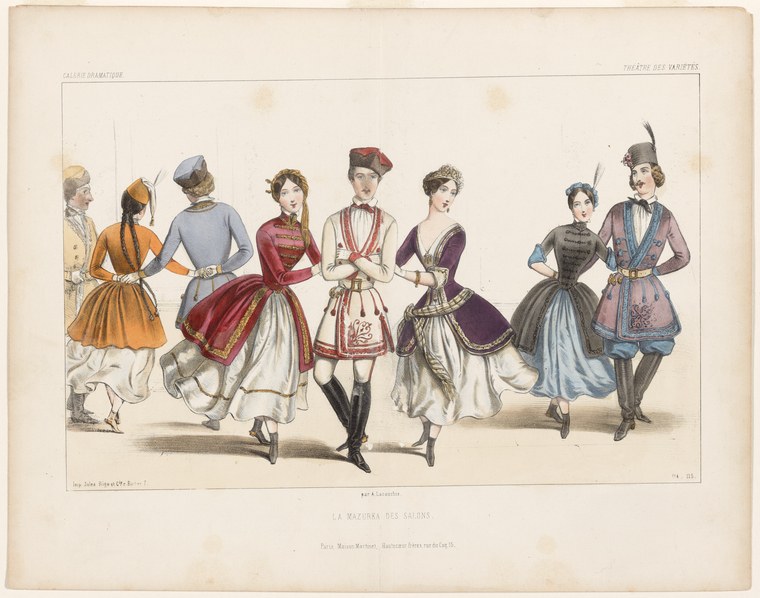
This print documents a specific historical moment — the craze for the mazurka in Western European ballrooms — and shows how national and folk dances were absorbed into salon culture through fashion and etiquette. It is valuable as evidence of what a mid-century ballroom dancer actually wore and how the body was positioned in space during a fashionable dance, unmediated by theatrical costume or artistic interpretation.
What you are looking at
A colored lithograph presents nine figures arranged in a loose line across the composition, each dressed in fashionable 1850s attire. The scene appears to be a salon or ballroom setting, suggesting an indoor social dance occasion. The figures are shown in various poses suggesting movement and social interaction — some facing forward, others in profile or three-quarter view, creating a sense of sequential narrative or tableau. The palette is soft and muted, with warm ochres and blues in the clothing contrasting against the pale cream background. The dresses are voluminous with full skirts, fitted bodices, and elaborate trimmings; the men wear formal jackets, some with decorative braids or colored vests. The composition reads left to right as a procession or display of fashion and deportment, with no background setting or architectural detail — the focus is entirely on the figures and their dress.
The dancing
The dancers occupy upright, elegant postures consistent with ballroom etiquette of the period. Several figures display the arm positions and frame of the waltz or mazurka — women with hands held at waist height or lifted, men standing beside or slightly behind their partners. The spacing between figures suggests they are not in continuous closed holds but rather posed individually or in loosely arranged pairs, allowing the viewer to appreciate each figure's dress and posture. The weight appears evenly distributed and the bodies still rather than caught mid-movement, suggesting this is a fashion plate or costume study as much as a record of actual dance.
The dance depicted
The title identifies this as the 'Mazurka des salons' — the salon or drawing-room mazurka, a social version of the Polish national dance that became fashionable across Europe in the mid-nineteenth century. The salon mazurka was danced by couples in ballroom dress and settings, less technically demanding than its theatrical counterpart. The image documents the costume and formal presentation of this dance as it appeared in polite society, showing both the steps were executed and the fashion context in which they were performed. The composition suggests this is a documentary or instructional print, possibly from a fashion journal or dance manual.
How it was made
This is a hand-colored lithograph, a reproductive process that allowed relatively inexpensive mass production of illustrated images for periodicals and books. The color appears to have been applied by hand or in a limited number of passes, giving the palette a characteristic softness and slight irregularity at the edges of forms. Lithography was the dominant technology for illustrated fashion journalism in the 1850s, allowing publishers to distribute images of current styles and social practices to a wide middle-class audience. The technique's ability to capture fine detail in clothing while simplifying background and setting made it ideal for fashion documentation.
About this work
This is a mid-nineteenth-century lithograph documenting the salon mazurka, a social dance that swept through European ballrooms in the 1850s and 1860s. The print serves simultaneously as a fashion plate and a dance record, showing how the mazurka was dressed and danced in polite society. The nine figures demonstrate the variety of styles and dress available to dancers of different ranks or roles within the ballroom. The image belongs in a gallery of dance because it captures not the theatrical or folk versions of the mazurka, but the moment when a national dance was adopted and adapted for urban social life, becoming a marker of cultural cosmopolitanism and good taste.
How to look at it
Study the postures and hand positions: notice how the women's arms are held and where the men position themselves relative to their partners. The variation across the nine figures suggests either different couples at different moments in the dance, or different interpretations of the proper deportment. Pay attention to the detail of the dress — the trim, the layering, the cut of the jackets — as these details were the point of the print for its contemporary audience. The absence of any setting or background focuses all attention on the body and its covering; the dance exists here only as a pretext for fashion display.
The artist
The artist is not recorded in the catalogue. The print bears a signature or studio mark in the lower left (appearing to read "Hom. Dambrun" or similar), suggesting a professional lithographic atelier. Such prints were often produced by commercial publishing houses rather than by named individual artists; the lithographer may have been an employee or contractor rather than the original designer or illustrator. The style is consistent with mid-century French fashion illustration.
The period
The mazurka became a craze across European cities in the 1840s and 1850s, introduced from Poland and Russia and quickly adopted by the ballroom elite. Unlike the waltz, which was already established, the mazurka retained an air of exotic novelty and national character. The mid-century ballroom was highly regulated by etiquette — dance was a principal site of courtship, social display, and the performance of refinement. Fashion lithographs like this one were published regularly in illustrated newspapers and periodicals aimed at the urban middle class, serving as guides to both fashion and social practice. The 1850s saw the height of the crinolined skirt, which would dominate women's silhouettes for the next two decades.
Where it lives
The work is held in the New York Public Library's Prints collection, a repository of illustrated matter including fashion plates, theatrical designs, and social documentation from the eighteenth century onward. This particular print is catalogued as a color lithograph but has not been comprehensively described; the donor or accession history is not recorded in the current entry.
Dance in this work
Questions about this work
What is the mazurka and why was it so popular in the 1850s?
The mazurka is a Polish national dance in triple meter, characterized by a distinctive rhythm and accent pattern. It became fashionable in Western European ballrooms in the 1840s-50s, imported through Russian and Polish aristocratic circles. It carried the cachet of the exotic and national while remaining elegant and teachable to the urban middle classes. Unlike the already-familiar waltz, the mazurka's novelty and martial character (it has roots in military training) made it desirable as a marker of cosmopolitanism and fashion awareness.
What can we learn about ballroom dance from this print?
This print shows the formal dress, posture, and spatial relationships of mid-century salon dancing. The upright carriage, the careful positioning of arms, and the distance maintained between partners all reflect the social codes of the ballroom. The variety of dress — different colors, trims, and styles — suggests that dancers had choices within the bounds of formality, and that fashion and dancing were inseparable practices. The print is instructional: it shows both what to wear and implicitly how to stand and move.
Is this a fashion print or a dance record?
It is both. For its contemporary audience in the 1850s, it was primarily a fashion plate — a guide to current styles. But it is also a documentary record of how a fashionable dance was actually performed and dressed in ballroom society. The two purposes were fully integrated: to be a fashionable dancer, you had to adopt the correct dress, and fashion lithographs showed you how.
More dance artwork





