49 works in this view — arrow keys or swipe to move between them.
Dance in Art
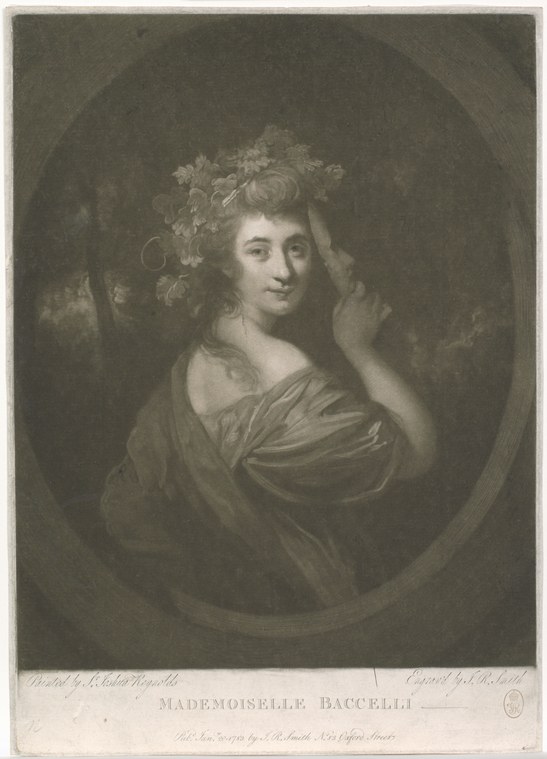
Mademoiselle Baccelli
Unknown artist
- Collection:
- Prints depicting dance
- Source:
- New York Public Library
- Rights:
- Public domain — free to use, share and adapt.
- Recorded as:
- Public Domain
Theatrical portraits like this are primary documents of dance practice and fashion. They record what a professional dancer looked like, how she was styled, and how she was marketed to audiences—information rarely preserved in any other form. For historians of late 18th-century dance, fashion, and the theatrical professions, this print is evidence of the social standing, costume conventions, and aesthetic ideals of the period.
What you are looking at
A three-quarter-length portrait of a young woman set within a tondeau (circular frame) against a dark, undefined background. She is depicted in fashionable late 18th-century dress: a high-waisted gown of fluid fabric draped across one shoulder, her other shoulder and bosom bare in the classical style. Her hair is dressed high and adorned with flowers and foliage—roses and leafy sprigs arranged in an elaborate coiffure typical of the 1780s–1790s. She gazes outward with a gentle, direct expression, her right arm raised with the hand near her head in a graceful, contemplative pose. The print technique creates subtle modeling through fine parallel lines, lending luminosity to the skin and fabric. The circular framing device and her poised, idealized presentation suggest this is a theatrical portrait—a record of a named performer rather than a generic female beauty.
The dancing
A single standing figure, shown from the waist up within the circular frame. Her posture is upright and composed, with weight evenly distributed. The raised right arm bends gently at the elbow, the hand positioned near the head in a gesture that is both natural and theatrical—neither a dance position nor an anatomically neutral pose, but rather the kind of graceful arm carriage cultivated in theatrical training of the period. The left arm remains at her side. Her body faces slightly to the viewer's right, creating a three-quarter turn that was standard in portrait convention but also reflects the épaulement (shoulder and arm articulation) taught in theatrical deportment.
The dance depicted
This is most likely a theatrical portrait of a professional dancer of the 1780s–1790s rather than a depiction of a specific dance or moment in performance. The inscription identifies her as Mademoiselle Baccelli, a name associated with professional entertainers of the late 18th century. The dress—high-waisted, neoclassical, bare-shouldered—and the flower crown suggest roles in comic opera, pantomime, or the lighter theatrical dance forms of the period. The pose is theatrical rather than balletic: it does not show the turned-out positions, crossed legs, or pointed foot carriage of formal ballet technique. Instead, it captures the kind of graceful, naturalistic deportment that characterized the demi-caractère roles and popular entertainment dance of the era, where performers were valued for charm, expressiveness, and fashionable elegance as much as technical virtuosity.
How it was made
This is an engraving or stipple engraving, a reproductive print technique that allowed the image of a celebrated performer to circulate widely and inexpensively. The fine parallel lines and dots create tonal modeling without the heaviness of traditional line engraving; the light hatching visible in the background and the delicate rendering of the skin tone are hallmarks of the stipple method, which was popular in England in the 1780s–1800s for portraiture and theatrical records. The print was made after a painting (as indicated by the inscription 'Painted by R. Smirke' and engraved by another hand), a standard practice for disseminating images of celebrated performers to the public and to collectors.
About this work
This is an engraved portrait of Mademoiselle Baccelli, a professional dancer or entertainer of the late 18th century, made after a painting by Richard Smirke. It belongs to a recognizable category of prints: the theatrical portrait, circulated to promote and commemorate a performer. The work sits at the intersection of dance history and print culture—it documents not a dance itself but the theatricality, fashion, and public identity of a professional dancer at a time when the boundaries between ballet, pantomime, comedy, and popular entertainment were fluid. The image survives in collections of dance-related prints and provides visual evidence of how a late-Georgian dancer was dressed, groomed, and presented to the public.
How to look at it
Attend to the pose: this is not a ballet dancer in a formal fifth position or an attitude, but rather an actress or light comedian in a graceful, naturalistic stance. The flower crown and bare-shouldered dress are keys to understanding her role—likely comic opera, pantomime, or popular entertainment rather than the formal ballet d'action. Notice how the engraver used stipple and fine parallel lines to create an illusion of luminosity and flesh; the technique was state-of-the-art in its time for rendering the soft, living surface of skin and fabric. The circular frame (the tondeau) is also instructive: it was a fashionable framing device that gave intimate portraits a sense of precious, collectible elegance.
The artist
The painting was executed by Richard Smirke (1752–1845), a prolific English portrait and history painter known for his work in theatrical circles. The engraver's hand is not recorded in the available information. Smirke was a fashionable portraitist who frequently painted actors and dancers; his theatrical portraits were often engraved and sold as prints for distribution to playgoers and collectors. This work is typical of his practice: a flattering, fashionably dressed figure set against an austere background, designed to be reproduced and circulated.
The period
This print dates to the 1780s–1790s, the height of neoclassicism in European art and fashion. In this period, theatrical costume and deportment were becoming increasingly influenced by classical aesthetics—high waistlines, bare shoulders, flowing drapery, and flower crowns drew inspiration from Greco-Roman imagery. Simultaneously, the professionalization of dance was advancing: dancers were celebrities with named roles, and their images were commodities. The stipple-engraving technique was at its peak of refinement in England, and theatrical prints were a major genre of popular culture, sold in print shops and collected by theatre-goers. The image reflects both the aspirations of neoclassical taste and the commercial apparatus of theatrical celebrity.
Where it lives
This print is held in the New York Public Library's collection of prints depicting dance. It is a reproductive engraving, likely issued for commercial circulation and sale to the public in the late 18th or early 19th century. The NYPL holds it as part of a broader documentary collection of theatrical and dance imagery.
Dance in this work
Questions about this work
Who was Mademoiselle Baccelli?
The print identifies her by this stage name, but her full identity and detailed biographical record have not been established in the available sources. She was active as a professional performer (likely dancer, actress, or comic entertainer) in the late 18th century. The portrait suggests she was well-known enough to warrant a painted and engraved portrait—a significant marker of celebrity at the time.
What dance style is she performing?
She is not shown mid-dance, but rather in a posed theatrical portrait. However, the dress and styling suggest she performed in comic opera, pantomime, or popular entertainment dance—lighter theatrical forms rather than formal ballet. The naturalistic, graceful arm carriage and classical costume are consistent with the demi-caractère roles of the period.
Why is she wearing flowers in her hair?
The flower crown was a theatrical costume convention of the period, used to evoke classical mythology, a pastoral or comic character, or simply fashionable elegance. It was also a nod to neoclassical aesthetics, which dominated art and fashion in the 1780s–1790s.
What technique was used to make this print?
This is a stipple engraving, a refined reproductive technique that allowed artists to create soft tonal effects through small dots and fine lines. It was popular in England for theatrical and celebrity portraiture because it could render skin and fabric with remarkable delicacy and luminosity. The technique made reproductions of paintings widely available and affordable.
More dance artwork





