49 works in this view — arrow keys or swipe to move between them.
Dance in Art
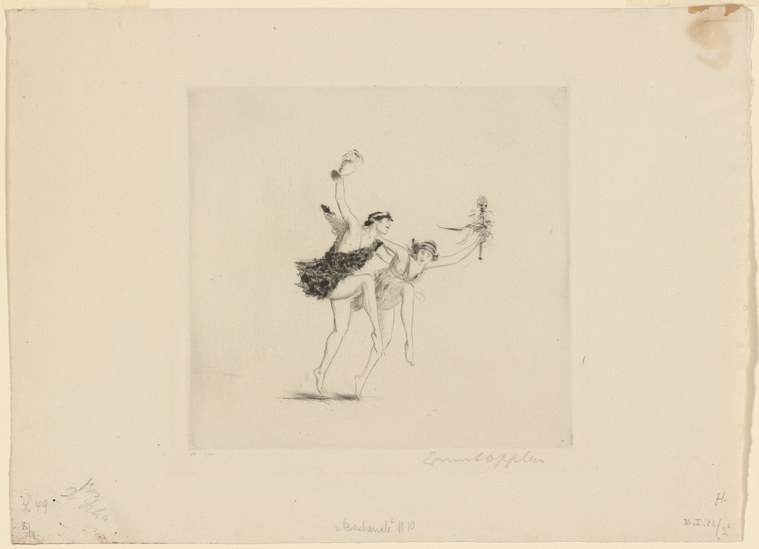
Bacchanale
Unknown artist
- Collection:
- Prints depicting dance
- Source:
- New York Public Library
- Rights:
- Public domain — free to use, share and adapt.
- Recorded as:
- Public Domain
This work documents how early 20th-century artists imagined and represented ecstatic, non-ballroom movement through the language of female bodies in extreme extension. It reveals the aesthetic distance between academic neoclassical revival imagery and the social dances of the period, and shows how 'bacchanal' functioned as a permissible vehicle for depicting female physicality and abandon in art.
What you are looking at
A line drawing executed in ink on paper depicts three female figures in a moment of exuberant, playful movement. The central figure dominates the composition, her body arched dramatically backward with arms raised and legs extended in a high kick, her torso twisted with dynamic energy. To her left stands a second figure in profile, arms raised with similar buoyancy. At right, a third smaller figure completes the group, also with raised arms. All three wear short skirts—the central figure's rendered with hatching to suggest fabric or pattern—and the drawing style captures a sense of joyful, uninhibited motion. The figures appear to be in mid-celebration or revelry, their poses suggesting synchronized group movement rather than formation dancing. The composition is spare and economical, using minimal line work against a plain ground, giving the drawing an immediacy and sketch-like quality that emphasizes spontaneity over formal precision.
The dancing
Three female bodies in profile or three-quarter view, all oriented rightward with their weight lifted and mobile. The central figure's extreme backward arch—with both legs raised and torso hyperextended—dominates; the other two flank her with upraised arms in a complementary pose. No closed holds or ballroom frame is evident. The bodies are slender and elongated, rendered with minimal anatomical detail. The footwork is not clearly resolved, but all three figures appear airborne or on the balls of their feet. The overall effect is of weightlessness and exuberance rather than grounded technique.
The dance depicted
The image likely depicts a bacchanal or Dionysian revelry—a classical theme rather than a specific codified dance form. The title 'Bacchanale' points to the mythological tradition of celebrating Bacchus or Dionysus, characterized by ecstatic, uninhibited movement rather than structured choreography. The exaggerated arch of the central figure's body and the raised-arm poses of all three suggest a late 19th- or early 20th-century interpretation of antique revelry, common in theatrical and academic art. The composition does not match any ballroom, folk, or concert-dance vocabulary; instead, it represents a romantic or theatrical fantasy of ancient orgiastic celebration rendered through the language of graceful, modernist line drawing.
How it was made
This is a pen-and-ink drawing on paper, likely executed as a preparatory study or independent work. The line work is economical and assured, using hatching only sparingly (on the central figure's skirt) to suggest form and fabric. No shading or wash is employed; the composition relies entirely on contour and positive line. The technique and paper stock suggest a European graphic tradition, possibly French, dating to the late 19th or early 20th century. The simplicity and immediacy of the line convey an artist comfortable with the medium, suggesting this is either a finished work or a highly refined sketch intended for publication or circulation among collectors.
About this work
This ink drawing depicts three female figures in a state of exuberant, arched movement characteristic of early 20th-century theatrical fantasies of Bacchic revelry. The work belongs to a tradition of neoclassical and antique-inspired subject matter that was popular in European graphic art and dance design of the period. The title 'Bacchanale' anchors it in mythological tradition rather than contemporary social dance.
The drawing sits at the intersection of fine art and dance imagery, representing not a living dance form but a romanticized vision of ancient ecstasy. It captures a moment of theatrical effervescence—the kind of subject matter that appeared in ballet, music-hall entertainment, and illustrated books of the era. For the historian of dance imagery, it exemplifies how artists of the period translated mythological and literary themes into bodily form.
How to look at it
Notice the extreme backward arch of the central figure's torso and the near-vertical lift of her legs—this pose is biomechanically difficult and unsustainable, making it a freeze-frame of a moment of peak energy rather than a static position. The artist chose the moment of maximum extension and exuberance, not repose. The three figures, though distinct, operate as a unit through the alignment of their raised arms and the visual rhythm of their silhouettes. Observe how minimal line-work conveys a sense of lightness and weightlessness—what is not drawn contributes as much as what is.
The artist
The work is not attributed in the catalogue, and the signature or inscription visible on the paper is not clearly legible in the reproduction. The drawing technique and subject matter suggest a European artist trained in academic tradition, working in the late 19th or early 20th century. Without secure attribution, further context cannot be established.
The period
The image dates to an era when neoclassical and mythological themes retained strong cultural currency in fine art, ballet, and theatrical design. The early 20th century saw growing interest in antique subjects alongside modernism; artists revived bacchanal imagery as a counterpoint to strict academic formalism and as an outlet for depicting movement and ecstasy. Simultaneously, professional concert dance and ballet were developing their own movement vocabularies, yet illustrators and fine artists continued to draw on classical mythology for both legitimacy and imaginative freedom.
Where it lives
The work is held in the New York Public Library as part of the 'Prints depicting dance' collection, where it appears to be catalogued with minimal descriptive information. It is a paper-based graphic work suitable for study collections and exhibitions.
Dance in this work
Questions about this work
What does 'Bacchanale' mean in dance?
Bacchanale refers to a celebration or dance in honor of Bacchus (or Dionysus), the Greco-Roman god of wine and ecstasy. It became a staple theme in ballet and theatrical art, symbolizing uninhibited joy, revelry, and abandon. The term does not denote a specific codified dance technique, but rather a theatrical genre or subject that allowed artists to depict exuberant, emotional movement.
Who danced bacchanales, and where would you have seen one?
Bacchanal scenes appeared in theatrical ballet, opera, and music-hall entertainment from the 19th century onward. Professional dancers and corps de ballet would perform choreographed bacchanals as divertissements or celebratory scenes within larger works. Such scenes combined elements of contemporary ballet technique with classical costume and mythological narrative.
Is this drawing from a specific ballet or theatrical production?
Without attribution or secure dating, it is impossible to connect this drawing to a specific production. It may be a study by a choreographer, stage designer, or illustrator, or a work of independent artistic interest inspired by the bacchanal theme.
Why are the figures so exaggerated and contorted?
The extreme arch and hyperextension reflect the artistic tradition of depicting ecstasy and abandon through the language of the body pushed to its physical limits. The artist is not documenting realistic movement, but rather expressing the emotional and spiritual intensity of Bacchic revelry through exaggeration and formal distortion.
More dance artwork





