49 works in this view — arrow keys or swipe to move between them.
Dance in Art
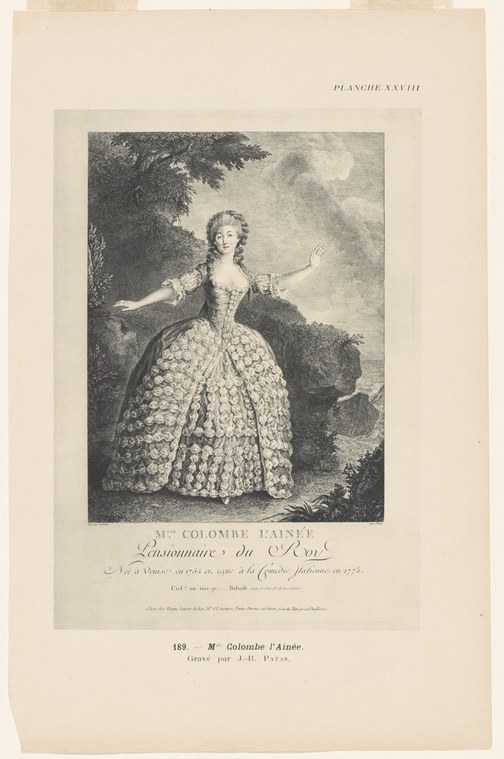
Mlle Colombe L'Aînée: pensionnaire du roy
Unknown artist
- Collection:
- Prints depicting dance
- Source:
- New York Public Library
- Rights:
- Public domain — free to use, share and adapt.
- Recorded as:
- Public Domain
This engraving is one of the few surviving records of a named French court dancer from the period and shows how court dance and high fashion were inseparable in the rococo imagination. For dance historians, it offers concrete evidence of the posture, arm positions, and dress conventions of mid-18th-century court dancing, translated into a medium designed for circulation and collecting. The care lavished on the rendering of the dress also reveals the centrality of textile and costume to the visual and kinetic experience of court dance.
What you are looking at
A young woman in an elaborate mid-18th-century court dress stands in a three-quarter pose within a woodland or garden setting, her body gracefully angled and her right arm extended in an elegant gesture. Her gown is extraordinary: a fitted bodice with a deep décolletage closed with a decorative stomacher, and a voluminous skirt constructed with deep, sculptural pleats that form a near-geometric pattern—the fabric appears to be quilted or embossed with a repeating scallop or shell motif that gives it pronounced dimension and texture. Her left arm curves naturally at her side. Behind her, dark foliage frames the figure, and the sky is luminous. The engraving is finely detailed, with careful attention to the play of light across the fabric's surface and the definition of each pleat. The woman's posture and the thoughtful extension of her arm suggest both nobility and a controlled, formal movement vocabulary.
The dancing
A single figure, a young woman en face with a slight turn of the torso. Her weight appears centered, with the body held in an upright, composed stance. The extended right arm is raised to approximately shoulder height with the hand open and palm forward in a gesture of presentation or invitation—a classic courtly pose. The left arm hangs with a gentle curve, the hand touching or near the fabric of the skirt. The body is held with the vertical alignment and turnout expected of court dance training, though no active footwork is visible. The pose is static yet animated by the reach of the arm and the sculptor's attention to the body's proportions.
The dance depicted
This is a portrait of a court dancer, most likely a pensionnaire (a contracted dancer or performer) in the royal ballet or court entertainment of mid-18th-century France. The inscription identifies her as Mlle Colombe l'Aînée, a 'pensionnaire du roy'—a dancer employed by the king. The pose, dress, and setting align with the conventions of French court dance of the Rococo period, a world in which aristocratic amateur dancers and professional court performers danced formal, geometric dances such as the minuet and the courante in precisely prescribed postures. The arm position and the formal presentation suggest a single moment extracted from a court dance or an embellished social dance, captured in a canonical pose that was both recognizable to viewers of the time and flattering to the subject. This is not a narrative or theatrical scene but a portrait that uses the language of dance as a marker of status and refinement.
How it was made
This is a finely executed engraving, identifiable from the fine parallel lines (hatching) used to create shadow and depth, the precise outlines, and the characteristic print surface. The technique allowed for wide distribution of the image and suggests that Mlle Colombe was sufficiently prominent to merit such a publication. The engraver has lavished care on the rendering of the dress's pleated fabric, using careful line work to suggest the three-dimensional sculpting of the quilted or embossed surface. The inscription and the framing suggest this is a formal print, likely published separately or as part of a collection of performers or court beauties. Engravings of this quality and subject matter circulated among the educated classes and would have served both as mementos of actual performers and as fashionable images of courtly refinement.
About this work
Mlle Colombe l'Aînée, identified in the inscription as a royal pensionnaire, is presented here in an engraved portrait that celebrates both her status as a court dancer and the sumptuousness of mid-18th-century court costume. The image freezes a canonical pose from the court dance repertory—the composed vertical alignment, the extended arm, the formal address—translating a moment of performance into a stationary portrait. This is a record of a real person and a real profession: the court ballet and entertainment dances of Rococo France depended on such trained, employed performers, and prints like this advertised their elegance and polish to a wider audience. The work sits at the intersection of fashion, portraiture, and dance documentation, using the visual language of the period to present the dancer not as a narrative figure but as an emblem of courtly accomplishment.
How to look at it
Attend to the posture: the straight spine, the squared shoulders, and the alignment of the body from head to toe, which embodies the vertical and upright carriage demanded by court dance training. Notice the arm position—neither dropped nor raised dramatically, but extended in a gesture that is both welcoming and formally prescribed. Observe the treatment of the dress, particularly the deep, regular pleats that suggest movement and volume while the body itself is still—this is a period when the dress itself was an essential element of dance, and the engraver has taken pains to show how the fabric would respond to the dancer's motion. The woman's gaze and expression are composed and impersonal, in keeping with the conventions of court portraiture and the suppression of individual affect in favor of ideal refinement.
The artist
The engraver is not recorded. The style and production suggest a professional engraver working in Paris in the mid-18th century, producing portraits of performers and society figures for the market in fashionable prints. Such engravings were typically published by print dealers and collected by wealthy amateurs and connoisseurs. The inscription indicates that the original portrait or performance was known to the publisher, but the engraver's identity has been lost.
The period
This print dates to an era when the French court ballet was at its height and when the minuet and other court dances were the preeminent social and professional dances of the European elite. The period saw a flowering of printed images of performers, fashions, and court life, driven by a market for luxury prints and the rise of the professional performer as a celebrity. Simultaneously, the rococo taste for ornament, curvature, and sensual surface is evident in the sculptural pleating of the gown and the luminous, delicate handling of the engraving itself. This is also a moment when dance was beginning to be documented visually in ways designed for preservation and circulation—the engraving is both a fashion plate and a dance record.
Where it lives
The print is held in the New York Public Library's collection of prints depicting dance, which includes fashion plates, theatrical prints, and portraits of performers spanning several centuries. This particular work appears in that collection as a record of 18th-century court dance and costume.
Dance in this work
Questions about this work
Who was Mlle Colombe l'Aînée?
The inscription identifies her as a pensionnaire du roy—a salaried performer in the French royal court entertainment, likely active in the mid-18th century. Beyond this print, little is known of her, which is not uncommon for court dancers of the period unless they achieved exceptional fame or left written records. The title 'l'Aînée' (the elder) suggests she may have had a sister or relative who was also a performer.
What is a 'pensionnaire du roy'?
A pensionnaire was a salaried court performer, as distinct from an amateur courtier. The king's support of such performers was a matter of royal prestige, and employment at court carried significant social status. Pensionnaires danced in court ballets, balls, and entertainment and often came from professional dancing families or had trained extensively in the dance techniques of the period.
What dance is she performing?
The engraving shows a single pose rather than a dance in motion, but the posture and arm position are consistent with the minuet or other formal court dances of the rococo period. The extended arm and upright carriage are characteristic of the movement vocabulary taught to court dancers, and this pose would have been recognizable to viewers as embodying the refined, geometric elegance of court dance.
Why is so much detail given to the dress?
The dress was central to the beauty and effect of court dance. The pleating, quilting, and surface texture of the skirt would have moved and created visual interest as the dancer moved, and the silhouette and posture required by such dress were inseparable from the dance technique itself. For an engraver, rendering the dress was both a display of technical skill and a testament to the magnificence of the royal court and the wearer's status.
More dance artwork





