49 works in this view — arrow keys or swipe to move between them.
Dance in Art
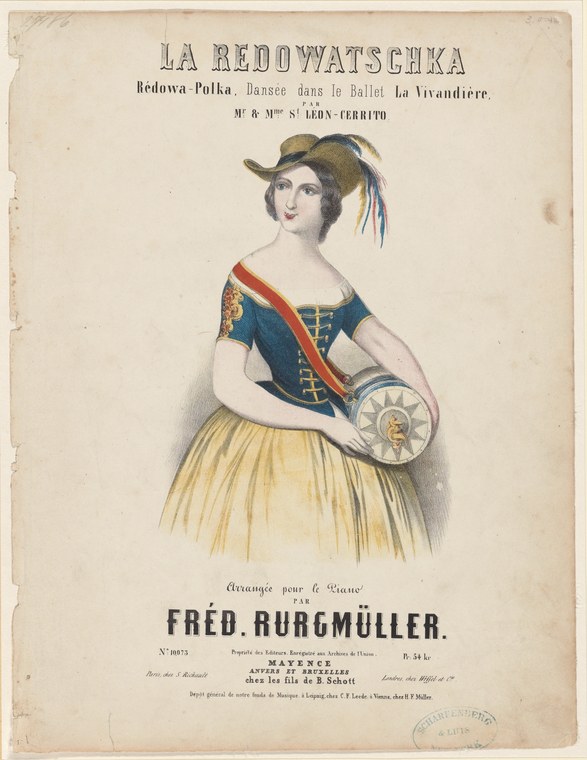
La redowatschka, rédowa-polka,: dansée dans le ballet La vivandière par Mr. & Mme. St. Léon-Cerrito, arrangée pour le piano par Fréd. Rurgmüller [sic]
Unknown artist
- Collection:
- Prints depicting dance
- Source:
- New York Public Library
- Rights:
- Public domain — free to use, share and adapt.
- Recorded as:
- Public Domain
Mme. St. Léon-Cerrito was one of the most celebrated dancers of the Romantic ballet era, and this cover documents a specific moment in theatrical and dance history when the redowa—a relatively new Bohemian dance form—was brought into the ballet repertory as a show piece. Sheet music covers like this are primary evidence of which dances appeared in ballets, how they were marketed to audiences, and what dancers wore, offering historians of both music and dance a record otherwise lost to performance.
What you are looking at
A hand-colored lithographic sheet music cover depicting a woman in mid-nineteenth-century theatrical dress, posed in three-quarter view against a plain background. She wears a dark blue off-shoulder bodice with gold embroidered detail and a red diagonal sash, paired with a voluminous pale yellow skirt in the Romantic ballet style. A decorative hat with feathers and a long trailing ribbon crowns her dark hair. She holds a small painted fan or prop in her right hand, her body angled to suggest movement. The composition is a portrait rather than a scene—a single figure study typical of dance sheet music covers, where the performer is presented to audiences as both artwork and advertisement. The lithography is finely executed with careful hand-coloring; the skin tones are delicate, the fabrics rendered with attention to texture and light.
The dancing
A single standing figure, weight distributed evenly but the torso and head angled in a pose suggesting a moment of controlled stillness within movement. The arms are not held in any closed ballroom frame; the right arm is extended slightly downward holding the fan, the left rests naturally at her side. The posture is upright and dignified, the chest open. There is no visible indication of footwork or the specific mechanics of any particular dance position—the image is a portrait of a costume and a moment, not a study of kinetic action.
The dance depicted
This is sheet music for the Redowa, a Bohemian polka variant that was popular in European ballrooms and theaters of the 1840s–1860s. The title identifies the dancer as Mme. St. Léon-Cerrito, performing this piece in the ballet *La Vivandière* (The Canteen Woman), a work set in a military camp. The redowa was a couple's dance with a rising action in three-quarter time, often danced in both social and theatrical contexts. As a ballet number, it would have required technical footwork and partnering, though this image shows the performer in isolation and in street dress or costume for the character rather than capturing the mechanics of the dance itself.
How it was made
A hand-colored lithograph, the principal medium for affordable sheet music covers and dance imagery in the mid-nineteenth century. The lithography allows for fine detail in the dress and facial features; the hand-coloring (likely applied by workshop staff) adds commercial appeal and precision to the costume information—essential for an image meant to sell both the music and the memory of a celebrated performance. This technique enabled mass production and wide circulation among music-buying audiences, making the performance of specific dancers and dances known to people who would never see the stage.
About this work
This is a sheet music cover for a piano reduction of a redowa-polka danced by the celebrated partnership of Mme. St. Léon-Cerrito in the 1840s–1850s ballet *La Vivandière*. It documents both a specific historical performance and the Romantic-era practice of selling music and theatrical memory to the home market through hand-colored lithographed covers that featured the dancer in costume. The redowa itself—a European ballroom dance that crossed into theatrical ballet—sits at the intersection of social and staged dance, and this image captures the theatrical presentation of a social form. The work belongs in a dance gallery as evidence of how nineteenth-century performers were marketed, how specific dances circulated through print, and how the theatrical ballet drew on and performed contemporary social dances.
How to look at it
This is not an action photograph or even a dance instruction image; it is a portrait of a performer in character, the kind of image that would hang in a lithographer's window or be bought by admirers. The pose is elegant but static, designed to show off the costume and the face rather than to document movement. The voluminous skirt and the delicate line of the arm suggest the Romantic ballet aesthetic—weightless, ethereal, but constrained within formal dress. Notice the precision of the embroidery and the rendering of light on the satin; these details mattered enormously to audiences who understood theatrical costume as a language.
The artist
The image is credited to the lithographer and arranger: Fréd. Rurgmüller (listed with a printing error in the original as "Rurgmüller"), who arranged the piece for piano. The cover was printed by Mayence (Mainz), a major music publishing center. Rurgmüller was an accomplished pianist and composer active in the mid-nineteenth century; his role here is both to arrange the music and to present it through this illustrated cover. The hand-coloring would have been executed by workshop staff under supervision.
The period
The redowa entered European ballrooms in the 1830s–1840s as a Bohemian import, joining the polka and other new couple dances that fascinated the urban middle and upper classes. By the 1850s, it had been absorbed into theatrical ballet vocabulary, where it provided spectacle and topical appeal—audiences could recognize and applaud a dance they knew from their own social experience. *La Vivandière* was first choreographed in 1832 and remained in repertory through the Romantic era, and this cover likely dates to the 1840s–1850s when Cerrito was at her peak. The Romantic ballet itself was shifting from court-centered spectacle to a commercial middle-class entertainment, and sheet music covers were a crucial part of that apparatus, allowing performances to circulate in image and domestic music-making.
Where it lives
This sheet music cover is held by the New York Public Library in its prints collection documenting dance iconography. The object is a commercial music publication, one of thousands produced in this format, and would have been sold through music shops and by subscription.
Dance in this work
Questions about this work
What is a redowa?
A redowa (or redowska) is a Bohemian couple dance in three-quarter time, popular in European ballrooms from the 1830s onward. It was a turning dance with a rising action, technically demanding and fashionable among the social elite. It appeared in theaters and ballets as a way to demonstrate both the dancer's technical skill and the fashionability of the company—audiences loved to see dances they recognized from their own social world performed on stage.
Who was Mme. St. Léon-Cerrito?
The hyphenated name indicates a partnership: this was likely Fanny Cerrito, one of the great ballerinas of the Romantic era, dancing with a partner surnamed St. Léon (possibly Arthur Saint-Léon, a celebrated dancer and choreographer of the period). Cerrito was known for her technical brilliance and her roles in character ballets set in exotic or contemporary locations.
Why is this a sheet music cover rather than a theater program or portrait?
Music was both a commodity and a memory aid in the nineteenth century. Audiences who heard a dance in the theater could buy the piano arrangement and perform it at home, or simply display the cover as a souvenir. This image served multiple purposes: advertising the music, preserving the memory of the performance, showing the costume and the dancer's likeness, and allowing the music itself to circulate and be enjoyed in domestic settings.
More dance artwork





