49 works in this view — arrow keys or swipe to move between them.
Dance in Art
La Sennora Pepita De Oliva
Unknown artist
- Collection:
- Prints depicting dance
- Source:
- New York Public Library
- Rights:
- Public domain — free to use, share and adapt.
- Recorded as:
- Public Domain
This work illustrates the nineteenth-century theatrical economy in which Spanish and Latin American performers were marketed to European audiences through celebrity prints, and how costume—embroidered, jeweled, theatrically enhanced—was used to signal authenticity and exoticism. For dance historians, it is evidence of what 'Spanish dance' meant to audiences of the period: a visual identity defined by dress and presentation, often divorced from the actual choreography or technique being performed.
What you are looking at
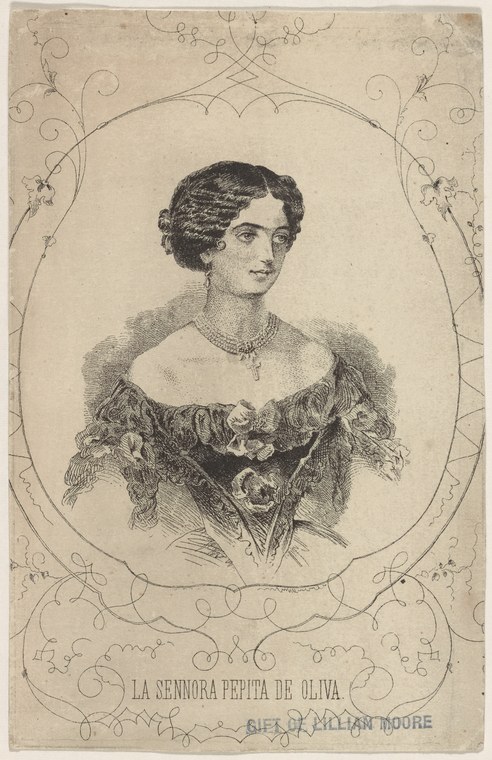
A three-quarter-length portrait of a woman presented in the costume of a Spanish dancer, enclosed within an ornamental frame of delicate scrollwork and tendrils. The subject wears an off-the-shoulder dress of dark fabric richly decorated with embroidered or appliqué designs featuring floral and ornamental motifs. A jeweled pendant hangs at her neck. Her dark hair is styled in the fashion of the mid-nineteenth century, arranged in waves and loops pinned close to the head. The composition is formal and frontal—the woman faces three-quarters left, her gaze directed away—and the elaborate border suggests this is a portrait print meant for display or collection, part of a series celebrating notable performers of the era.
The dancing
The figure is stationary and posed rather than captured in motion. Her shoulders are drawn back, the exposed décolletage and off-shoulder line of the dress emphasizing an upright, dignified carriage. There is no visible footwork or dynamic weight shift; the body is arranged for presentation to the viewer. The dress itself, with its voluminous gathered sleeves and heavy embellishment, is characteristic of Spanish or flamenco costume as understood in European popular culture of the period, though the pose itself is that of a studio portrait rather than a dance action.
The dance depicted
The title identifies this as Señora Pepita de Oliva, a performer whose name suggests Spanish or Latin American origin. The ornamental border and production style suggest a mid-nineteenth-century theatrical print, likely Spanish or issued in Spain. However, the image shows a posed portrait rather than a scene of dancing: the subject is not engaged in footwork, hand movement, or the dynamic posture characteristic of flamenco performance. The costume signals Spanish dance tradition, but the formal, static presentation is that of a celebrity or theatrical portrait rather than dance documentation. Without further biographical information, it is unclear whether this figure was primarily a flamenco dancer, a theatrical performer in Spanish costume, or a musician.
How it was made
This is an engraving or lithograph, executed in black ink on aged paper. The delicate ornamental frame—composed of scrolling tendrils, vines, and geometric flourishes—is characteristic of mid-nineteenth-century commercial theatrical or celebrity prints, where such borders were used to elevate and frame the subject for the middle-class market. The monochromatic technique and the formal presentation suggest this was part of a series or collection of theatrical personalities, mass-produced for circulation among admirers of the stage. The style of border and the quality of line work place it in the period roughly 1840s–1870s.
About this work
This is a theatrical portrait print of a woman identified as Señora Pepita de Oliva, presented in Spanish dance costume. Although the dress and title suggest a connection to flamenco or Spanish theatrical dance, the work itself is a formal celebrity portrait rather than a depiction of dance in action. The ornamental frame and production method indicate it was issued as a collectible print for the commercial market, part of the nineteenth-century culture of theater-going and performer celebrity. The image belongs in a dance gallery not because it shows movement, but because it documents how a dancer or Spanish performer was presented to the public and how costume signaled identity and cultural association.
How to look at it
Attend to the tension between portrait convention and dance identity. The subject is posed statically, in the manner of a nineteenth-century society portrait, yet the costume and the ornamental border signal her as a performer and exotic figure. The off-shoulder dress and jeweled neck ornament were not everyday dress but deliberate costume choices designed to evoke a sense of Spanish or Orientalist glamour. Notice how the embroidered details of the dress are rendered with care—they are the visual marker of her distinction and her cultural positioning. The face itself is idealized and refined, not caricatured, suggesting that this performer was presented to audiences as a woman of taste and cultivation, not as a curiosity.
The artist
The artist is not recorded. The style and execution are consistent with mid-nineteenth-century European theatrical lithography and engraving, possibly Spanish or executed in Spain. The ornamental border design suggests the work of a commercial print house rather than a fine artist; such borders were standardized templates applied to many portrait subjects. Prints of this type were often issued by theater companies, music halls, or commercial publishers without individual artist attribution.
The period
This portrait belongs to the age of theatrical celebrity and the growth of commercial entertainment culture in the nineteenth century. The flamenco tradition had become increasingly visible in European high society and popular entertainment by mid-century, as Spanish and Andalusian performers toured in London, Paris, and other capitals. Performers like María Dolores Serral ('La Nena') and others became celebrated figures, their likenesses circulated in prints and photographs. At the same time, the Romantic movement had fostered European fascination with Spain as a source of exotic, passionate, and 'authentic' culture. This print reflects that appetite and the machinery by which performers were commodified and consumed as images.
Where it lives
This print is held in the New York Public Library's collection of prints depicting dance. The catalogue record provides minimal detail; the title and the visual evidence of theatrical production suggest it was issued in the nineteenth century, likely in Spain or for the Spanish and European market, but no publisher, date, or printer is currently recorded.
Dance in this work
Questions about this work
Was Pepita de Oliva a famous flamenco dancer?
The catalogue record does not identify her biography. The title 'Señora Pepita de Oliva' and the Spanish costume suggest she was a performer associated with Spanish dance tradition, and this print confirms she was celebrated enough to be reproduced and sold. Without additional research, we cannot establish her specific repertoire or whether she performed flamenco in the strict sense or rather Spanish-themed theatrical dance.
Why doesn't she look like she's dancing?
This is a celebrity portrait, not a dance documentation. The artist's purpose was to present the performer to audiences as an image for collection and display, not to capture a moment of performance. The costume is the primary message: it signals her identity and appeal. Many nineteenth-century theatrical portraits are similarly static—the drama and movement of performance were understood to happen on the stage, not in the print itself.
When was this print made?
The style of the ornamental border, the fashion of the dress and hair, and the printing technique suggest a date roughly between 1840 and 1870, but the catalogue record does not provide a definitive date. The aged appearance of the paper is consistent with this period, but without publisher information or other marks, precision is not possible.
What does the decorative border tell us?
The ornate scrollwork frame was a standard feature of commercial theatrical and celebrity prints, designed to elevate and distinguish the subject for middle-class collectors. Such borders were often applied across many different portraits, suggesting that this print was part of a series or collection marketed to theater enthusiasts. The border is thus as much a marker of commercial production and mass circulation as it is an artistic choice.
More dance artwork





