49 works in this view — arrow keys or swipe to move between them.
Dance in Art
Les contrastes
Unknown artist
- Collection:
- Prints depicting dance
- Source:
- New York Public Library
- Rights:
- Public domain — free to use, share and adapt.
- Recorded as:
- Public Domain
The print shows that dance history is inseparable from social history: what counted as 'correct' dancing was a battleground for ideas about class, gender, and propriety. The exaggerated contrast between the two couples makes visible what was normally implicit—that ballroom dancing was coded behavior, every position and gesture legible as a statement of character.
What you are looking at
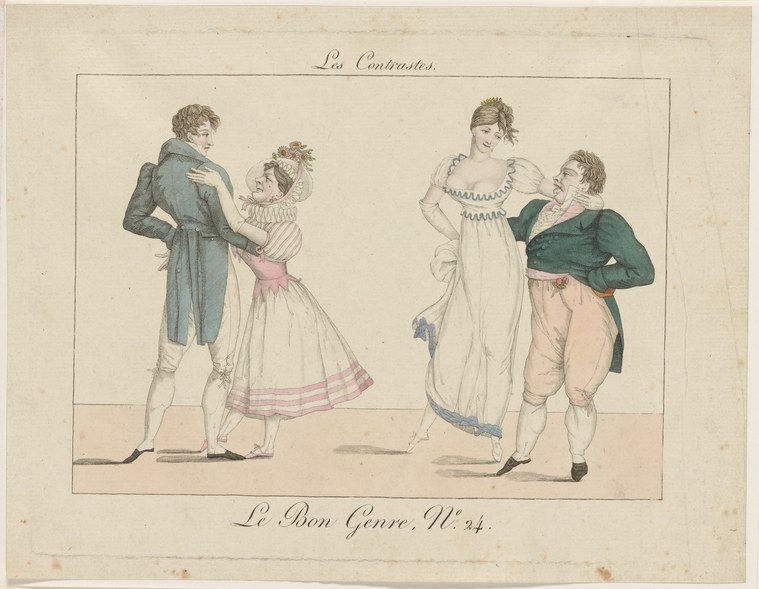
A satirical print titled *Les Contrastes* (The Contrasts) presents four figures arranged to emphasize opposing manners and deportment. On the left, a man in military dress—dark coat, pale breeches, boots—stands with his back turned, holding hands with a woman in a pale pink dress with decorative hem trim and a flowering headdress; her posture is demure and upright. On the right, a woman in a high-waisted white Empire-line gown with a jeweled neckline adopts an exaggerated forward lean and coquettish pose, her arm extended, while a portly man in green coat and pale breeches behind her grabs her waist in a proprietary gesture. The composition divides the picture vertically: restraint and formality on the left, exuberance and impropriety on the right. The figures stand on a bare stage-like ground; the print is hand-colored in soft pastels typical of early 19th-century fashion and satirical prints.
The dancing
The two couples are posed rather than actively dancing, each pair occupying opposite halves of the composition. The left couple stands in a correct, formal posture—the woman's frame is vertical and composed, the man's attention turned away in propriety. The right couple abandons convention: the woman leans sharply forward at the waist in an exaggerated flirtation, her weight forward, while the man's grip on her waist is physical and assertive. The contrast in body tension and spatial relationship between the pairs is the print's entire visual argument. No footwork or active movement is depicted; this is a tableau of social attitude.
The dance depicted
This is not a depiction of a specific dance but rather a satirical commentary on social dancing manners and courtship behavior. It likely references the early 19th-century ballroom, where propriety in the waltz, cotillion, or quadrille was a matter of intense social concern. The print mocks the exaggerated flirtatiousness of one style of partnering against the stiff correctness of another. Both couples appear to be participating in formal ballroom dancing of the Regency era, but the print's purpose is moral and satirical rather than documentary—it warns against excessive familiarity while mocking excessive restraint.
How it was made
This is a hand-colored engraving or aquatint, a technique that allowed rapid production and wide circulation of satirical prints in the early 19th century. The clean line work, the precision of the figure drawing, and the soft hand-applied color are consistent with commercial satirical publishing in France or England circa 1800–1830. The technique permitted sharp social commentary to reach a broad audience, from middle-class drawing rooms to print shops. Such works were collected, posted, and discussed; they shaped public opinion about decorum and fashion.
About this work
This print is a witty social satire of ballroom etiquette presented as a study of contrasts in dance deportment. It belongs to a long tradition of Regency-era prints that used the dance floor as a stage for critique of manners, class, and gender relations. The work does not document a specific dance technique but rather the social meanings attached to how one holds one's body while dancing—a concern as urgent then as costume or music. It reveals that early 19th-century dance was inseparable from morality and that artists used the ballroom as a lens through which to examine the anxieties of courtship and social climbing.
How to look at it
Look at the vertical division of the composition: it is the entire argument. Notice how the left couple's hands meet in the middle of the frame at waist height in a formal, mediated way, while the right man's hand grasps the woman's waist directly. The woman on the left stands tall; the woman on the right pitches forward. The print freezes not a moment of movement but a moment of attitude—it asks you to judge two competing styles of courtship as they manifest in the body. The title *Les Contrastes* is not incidental; the artist has built the composition to make comparison unavoidable.
The period
This print dates to the Regency era (c. 1811–1820) or slightly later, a period of intense codification of ballroom manners in both England and France. The waltz had recently arrived in Western Europe and was regarded with alarm by moralists: the close hold and rapid rotation were seen as dangerously intimate. Satirical prints became a primary medium for this anxiety, mocking both the prudish and the libertine. Simultaneously, the Empire silhouette, visible in the women's high-waisted gowns, was fashionable, and the contrast between neoclassical restraint in dress and Romantic excess in behavior was a productive tension for artists. The print sits at the intersection of fashion satire, social commentary, and dance documentation.
Where it lives
This work is held in the New York Public Library's collection of prints depicting dance. It is a commercial satirical print of the early 19th century, likely French or English in origin, and would have circulated widely in printed form.
Dance in this work
Questions about this work
Is this a real dance or a made-up one?
Both couples are engaged in ballroom dancing—likely a waltz, cotillion, or quadrille of the Regency era. But the print is not documenting dance technique; it is using the ballroom as a setting to mock two opposing styles of courtship behavior. The 'dance' is real; the exaggeration is satirical.
Why are they dressed so differently?
They are not: both women wear the high-waisted Empire silhouette fashionable circa 1810–1820, and both men wear the coat and breeches of formal dress. The difference is in posture and comportment, not costume. The print argues that how you move in your clothes matters more than what clothes you wear.
What is the moral of the print?
The print presents a false choice: neither excessive propriety (the stiff left couple) nor shameless flirtation (the exuberant right couple) is endorsed. The satire cuts both ways. It reflects real anxieties about the waltz and about changing gender relations, but it also mocks those who were scandalized by change.
Who would have bought or displayed this?
Satirical prints were consumed by the middle class—shopkeepers, professionals, wives and daughters of merchants. They were bought as single sheets, collected in portfolios, or pasted into albums. They were conversation pieces, objects of humor and gossip, and occasionally propaganda for or against social change.
More dance artwork





