49 works in this view — arrow keys or swipe to move between them.
Dance in Art
Marie Taglioni
Unknown artist
- Collection:
- Prints depicting dance
- Source:
- New York Public Library
- Rights:
- Public domain — free to use, share and adapt.
- Recorded as:
- Public Domain
Taglioni was the defining ballerina of her age and a pioneer of pointe work and the Romantic aesthetic. This print is evidence of how dancers were marketed, remembered, and consumed as cultural icons in the 19th century—not through action, but through idealized portraiture that blended the real woman with theatrical fantasy.
What you are looking at
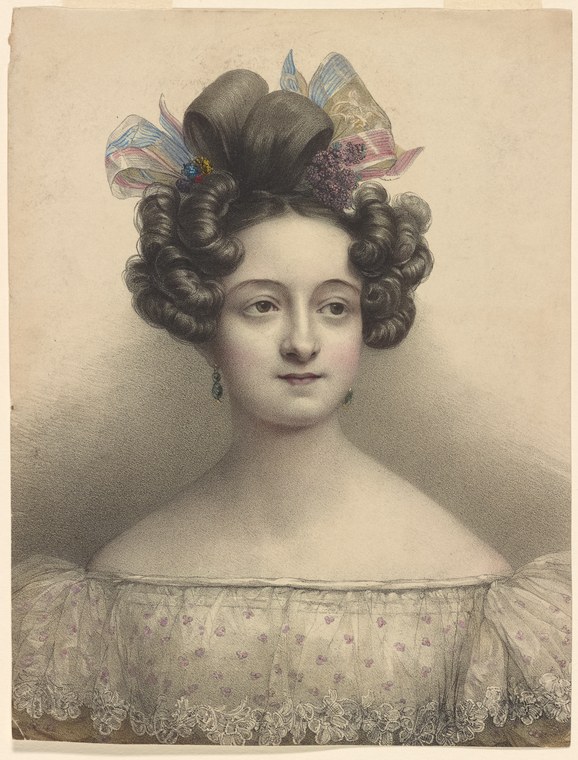
A young woman is shown in a three-quarter portrait against a plain, subtly shaded background. She wears an off-shoulder dress of pale muslin or silk with intricate lace trim at the neckline and sleeves, fashionable of the early 19th century. Her dark hair is arranged in glossy ringlets pinned close to the head on both sides, a style typical of the 1830s–1840s. Most striking is her elaborate headdress: a large dark bow or knot sits atop her head, from which emerge two pairs of wings—delicate, translucent, and colored in pale blue, pink, and gold leaf. The wings are rendered with fine detail and appear to reference theatrical costume or allegorical fancy dress. The woman's gaze is calm and frontal, her expression composed and serene.
The dancing
A single figure, shown from the shoulders up, facing the viewer directly with a relaxed, upright posture. Her arms are not visible; the composition focuses on the head, neck, and upper torso. There is no indication of active movement or dance position. The pose is static and formal, consistent with portrait convention rather than the capture of a dancing body in motion.
The dance depicted
This is not a depiction of dance in action. The work is a portrait, likely a commemorative or promotional print of the dancer Marie Taglioni. The theatrical wings in the headdress are costume elements or allegorical references that evoke her status as a celebrated performer, but the woman is posed motionless for portraiture, not shown dancing. Any connection to dance lies in the identity of the subject and the theatrical costume props, not in captured movement or technique.
How it was made
This is a hand-colored engraving or lithograph, likely from the 1830s–1840s, a period when such prints were mass-produced as commemorative images of celebrated performers. The technique combines printed line work (evident in the fine modeling of the face and hair) with watercolor or hand-applied pigment for the dress, wings, and background tone. This hybrid method made the image reproducible and affordable, allowing wide distribution to admirers and theater patrons. The quality and detail suggest a commercial print house of some reputation.
About this work
This is a commemorative portrait print of Marie Taglioni, the Swedish-Italian dancer who became the embodiment of Romantic ballet in the 1830s and 1840s. The work does not depict her dancing but rather presents her as a public figure and celebrity, adorned with allegorical and theatrical elements—the wings suggesting her ethereal, otherworldly presence on stage, an effect for which she was legendary. The portrait serves as a document of her fame and the visual culture surrounding theatrical performance in the Romantic era.
How to look at it
Attend to the contrast between the realistic portraiture of the face and the fantastical costume elements. The wings are not costume worn in performance; they are allegorical additions, a visual metaphor for the weightlessness and otherworldliness audiences experienced watching Taglioni dance. The fine rendering of the face—the softness of the gaze, the precision of the ringlets—grounds the image in the real woman, while the wings lift her into myth. This was a common strategy in Romantic-era star portraiture: to capture the performer's human likeness while simultaneously immortalizing her stage persona.
The artist
The artist is not recorded in the catalogue. The style and execution are consistent with commercial portrait printmaking of the 1830s–1840s, possibly French or English, produced for circulation among theatergoers and collectors of celebrity images.
The period
Marie Taglioni's career coincided with the height of Romanticism in ballet and the visual arts (1830s–1850s). Dance prints and lithographs of celebrated performers were a booming popular medium, competing with playbills, novels, and fashion plates for the attention of urban audiences. Taglioni's image was reproduced in countless formats—as engravings, lithographs, and later as photographs—each iteration refining her public persona as the ethereal, almost supernatural dancer of La Sylphide (1832). The theatrical wings and fairy-tale costume in this portrait are visual tropes of Romantic ballet, reflecting the genre's obsession with the supernatural, the feminine, and transcendence through movement.
Where it lives
The work is held in the New York Public Library's collection of prints depicting dance. It is a commercial reproductive print, likely one of many copies produced and distributed in the 19th century, and reflects the mass-market veneration of celebrity dancers in that era.
Dance in this work
Questions about this work
Why does this portrait have wings?
The wings are allegorical and theatrical, not costume worn in actual performance. They reference Taglioni's famous roles in Romantic ballets such as La Sylphide, in which she portrayed a sylph—a supernatural, weightless creature. The wings are a visual shorthand for her legendary ability to appear to float, defy gravity, and embody otherworldly femininity. They transform the portrait from a straightforward likeness into a romantic fantasy.
Who was Marie Taglioni?
Marie Taglioni (1804–1884) was a Swedish-Italian dancer and the most celebrated ballerina of the Romantic era. She was a pioneer of pointe work and the quintessential embodiment of the Romantic ballet aesthetic—ethereal, emotional, and technically virtuosic. Her performance as the Sylphide in La Sylphide (1832) defined the genre and made her an international star. She retired from performing in 1847 but remained an iconic cultural figure.
Is this a photograph?
No, this is an engraving or lithograph that has been hand-colored. The technique of printmaking allowed for mass reproduction, making Taglioni's image accessible and affordable to theater patrons and collectors. While photography existed by the mid-19th century, prints remained the dominant medium for theatrical portraiture and celebrity imagery during Taglioni's peak fame in the 1830s–1840s.
More dance artwork





