49 works in this view — arrow keys or swipe to move between them.
Dance in Art
Dancers on music covers
Unknown artist
- Collection:
- Prints depicting dance
- Source:
- New York Public Library
- Rights:
- Public domain — free to use, share and adapt.
- Recorded as:
- Public Domain
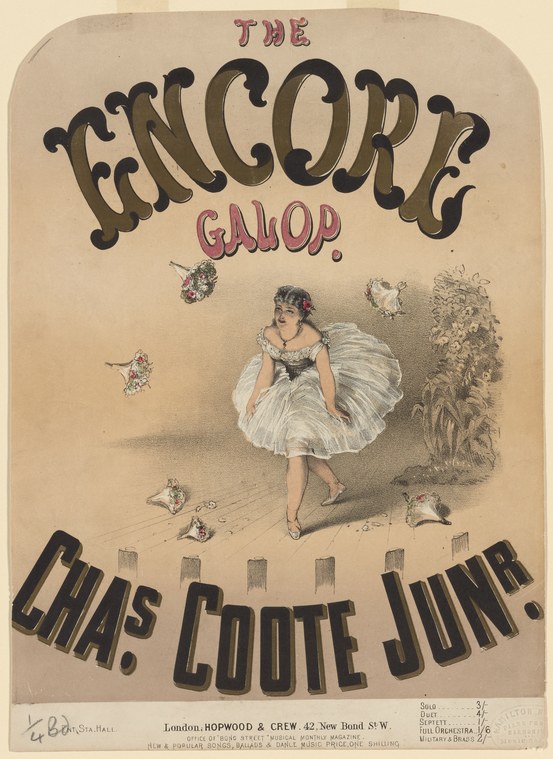
It shows how a ballroom dance entered theatrical culture and commercial spectacle, and how music publishers used idealized imagery of the female dancer to sell the dance itself. The print is evidence of the galop's cultural reach and of the visual grammar—the tulle skirt, the lifted frame, the barefoot elegance—that encoded 'dance' for 19th-century audiences.
What you are looking at
This is a chromolithographic music cover for a galop, a lively dance popular in the 19th century. The composition centers on a young woman in a white tulle ballet skirt and dark corseted bodice, captured mid-movement in a pose that suggests rapid, spirited motion. She is barefoot or in soft shoes, her body angled as if in flight. Around her float several smaller figures of couples dancing, rendered less distinctly in the background. To the right stands a tall cypress or similar ornamental tree, anchoring the composition with a vertical accent. The overall palette is soft and hand-colored—sepia tones, pale yellows, and delicate shading—typical of theatrical prints of the 1840s–1860s. The typography is boldly decorative: "THE" and "GALOP" arch above in exuberant letters, with the composer's name "CHAS. COOTE JUNN." in heavy capitals at the base, framing the dancer as the focus of commercial spectacle.
The dancing
The central figure occupies an elevated, buoyant pose: her torso is upright and her right leg appears to extend or sweep, while her left leg is bent, suggesting a hop or bound characteristic of the galop. Her arms are held loosely, one raised, in the relaxed frame appropriate to a swift, social dance. The smaller figures in the background are arranged in pairs, also in motion, confirming that this is a social dance scene rather than a formal theatrical arrangement. The artist has understood the galop's essential energy—lightness, rapid footwork, and an upright carriage—without depicting rigid technique.
The dance depicted
The galop was a fast, couple-based dance that became a craze across Europe and America from the 1830s onward. It typically moved at a rapid tempo in 2/4 time and was danced by pairs in closed hold, with quick side-steps and hops that created a bouncing, exuberant effect. This print documents the galop's popularity as a ballroom and theatrical entertainment, and as a subject for commercial music covers and sheet music. The barefoot or lightly shod soloist, in classical ballet costume, suggests that the galop was also absorbed into theatrical performance and that the boundary between ballroom and stage was permeable. The composition treats the dancer as an emblem of vivacity and modernity—selling not technique but joy and motion.
How it was made
This is a chromolithograph, a color printing process that allowed multiple colored inks to be applied sequentially from separate stone or zinc plates. The technique was revolutionary for mass producing colorful theatrical and commercial imagery in the mid-19th century. The soft gradations, the delicate hand-finishing visible in the dressing and face, and the bold typography are all characteristic of this process. Chromolithography made such prints affordable and widely circulated, allowing dance imagery to reach middle-class parlors and music rooms. The Hopwood & Crew imprint at the base indicates a London printer-publisher, situating this within a thriving trade in theatrical and musical prints.
About this work
This is a commercial music cover for Charles Coote Junior's galop, a popular social dance of the mid-19th century. The print celebrates the galop as a fashionable and energetic entertainment, featuring a soloist in classical ballet dress as a visual embodiment of the dance's lightness and speed. The image documents a moment when the galop moved from ballroom to stage and from anonymous social practice to named, publishable art. It is both a promotional object and a small archive of how a specific dance was costumed, posed, and imagined in its moment of greatest popularity.
The work belongs in a dance history collection because it captures the commercial circulation of dance imagery, the theatrical elaboration of a ballroom form, and the visual conventions through which 19th-century audiences understood movement and pleasure. Unlike paintings that hung in elite homes, this print was made to be purchased, displayed, and replaced—a mass medium for dance.
How to look at it
Attend to the moment of suspension captured in the dancer's body—the lifted right leg, the forward tilt, the light footfall suggested by her bare feet. The artist has frozen the galop at its moment of greatest buoyancy, not the earthier, faster footwork that characterized actual dancing. Notice how the background couples are subordinate and less finely rendered; the eye is drawn to the soloist and to the lettering, which treats the dance as a product. The composition is designed to sell: the woman's grace, the promise of lightness and modernity, the fashionable association with the ballet stage.
The artist
Charles Coote Junior was an active composer of dance music in the 1840s–1860s. The galop was among the most profitable genres for such composers; named galops by various hands were published by the hundreds, and music publishers competed for attention with increasingly elaborate cover illustrations. Coote's name appears on multiple surviving covers of similar design and quality, suggesting either a house style or a successful collaboration with a printer-publisher. Such composers occupied a commercial, not a concert-hall position; their work was consumed rather than preserved, and few biographical details survive.
The period
The galop was at peak popularity between 1835 and 1865, particularly in Britain and France. It epitomized modern dance—faster, more accessible, and less formally codified than the minuet or cotillion that preceded it. Simultaneously, ballet was undergoing its romantic revolution: the tulle skirt, pointe work, and ethereal female figure were becoming visual icons of dance itself. This print sits at the intersection: it borrows the costume and pose of romantic ballet to market a ballroom dance, revealing how visual codes migrated across social contexts. The chromolithograph itself was still a relatively new and prestigious process, lending the image a sheen of modernity that matched the dance's fashionable status.
Where it lives
This print is part of the New York Public Library's collection of prints depicting dance, a collection assembled to document the visual history of movement and entertainment. The Hopwood & Crew imprint, located at 42 New Road in London's Whitechapel district, indicates this was commercially produced and distributed in Britain, likely for sale to music retailers and amateur musicians.
Dance in this work
Questions about this work
What is a galop and why was it so popular?
The galop was a fast, couple-based ballroom dance that arrived from continental Europe in the 1830s and became a craze across Britain and America. It was rapid, joyful, and less formally codified than older dances, making it accessible to a broad middle-class audience. It was danced at balls, public assemblies, and on the theatrical stage, and it generated enormous commercial demand for sheet music and instructional material.
Why is the dancer wearing a ballet skirt if the galop was a ballroom dance?
By the 1840s–1860s, the classical ballet tutu and the idealized female dancer had become visual shorthand for 'dance' itself. Music publishers borrowed this imagery to make ballroom dances seem fashionable and theatrical. The soloist here is not necessarily performing a ballet; rather, the print is using ballet's visual prestige to market the galop to middle-class consumers.
What was chromolithography and why does it matter?
Chromolithography was a printing process that applied multiple colored inks from separate stones to create vivid, detailed images. It was much cheaper than hand-painting and allowed prints to be mass-produced and sold affordably. This meant that dance imagery, music covers, and theatrical ephemera could circulate widely, reaching homes and music rooms across a city or country.
Who was Charles Coote Junior?
Little is known of Coote beyond his name on surviving sheet music and covers. He was one of many composers of dance music who supplied the commercial market with galops, polkas, and similar pieces. Such composers were prolific but often uncelebrated; their music was consumable entertainment rather than concert art, and many works were forgotten after their initial commercial run.
More dance artwork





