49 works in this view — arrow keys or swipe to move between them.
Dance in Art
Dancers on music covers
Unknown artist
- Collection:
- Prints depicting dance
- Source:
- New York Public Library
- Rights:
- Public domain — free to use, share and adapt.
- Recorded as:
- Public Domain
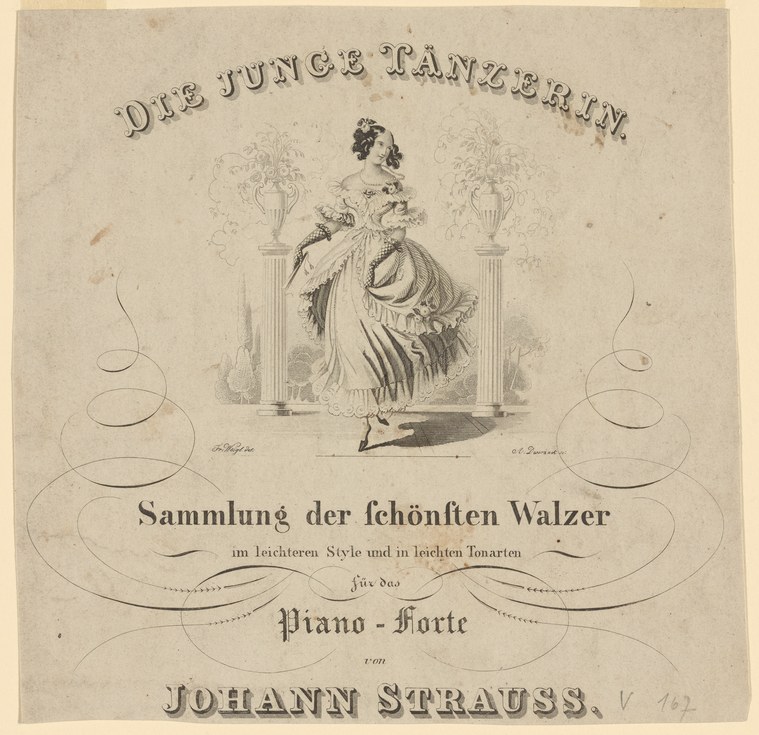
This is documentary evidence of how the waltz was visualized and sold to the middle-class piano-playing public—not as technique but as an ideal of feminine grace and social accomplishment. The image reveals the gap between the actual rotating, energy-driven motion of the waltz and its public presentation as a static, posed display of refinement.
What you are looking at
This is a music cover for a collection of waltzes for piano, rendered as an engraving in the mid-19th century. A single woman in an elaborate ball gown dominates the composition, positioned centrally between two classical columns topped with flowering urns. She wears a voluminous skirt with deep flounces and a fitted bodice, her posture upright and graceful. Her gaze is directed over her shoulder in a pose of refined elegance typical of ballroom dance portraiture. The background is spare, allowing the figure and architectural frame to command attention. The overall effect is one of restraint and formality—this is not a moment of exuberant movement but rather a portrait of poise and fashionable deportment.
The dancing
The dancer stands in a three-quarter pose with her weight seemingly on one leg, her torso turned slightly away from the viewer while her head turns back toward us. Her arm position is graceful but understated, with one arm at her side and the other lifted at the elbow. There is no visible partner, though the waltz was a couple dance; the solitary figure suggests this is an idealized portrait of the dancer rather than a moment of actual dancing. Her posture is upright and controlled, conveying the formal carriage expected of a ballroom dancer of the period.
The dance depicted
This is a waltz, the most fashionable couple dance of 19th-century Europe, particularly Austria and Germany. The title states plainly *Sammlung der schönsten Walzer* (Collection of the finest waltzes) for piano, published by the Viennese composer and conductor Johann Strauss. The solitary female figure in formal ball dress represents the waltz dancer of the Romantic era—not captured mid-motion but posed as an icon of grace and refinement. The waltz was a turning dance in triple time, danced in closed embrace, and by the 1830s–1850s it had become the defining dance of European aristocratic and upper-middle-class society.
How it was made
This is a steel or copper engraving, a reproductive printmaking technique that allowed multiple copies to be made from a single plate. The fine parallel lines (hatching) visible in the shading, the precise linear quality of the dress and columns, and the delicate rendering of the facial features are characteristic of engraving. This technique was the standard for music publication covers and social prints of the period, allowing publishers to circulate the image widely and affordably. The decorative border elements—the scrollwork and floral urns—are typical of Romantic-era commercial graphics.
About this work
This is a music cover engraving for a waltz collection published by Johann Strauss, one of the most celebrated dance composers of the 19th century. It serves as a portrait of ballroom elegance: a single woman in ball dress, posed with the refined deportment expected of a Romantic-era dancer, framed by neoclassical architecture. The work is not primarily a document of dance technique but rather of social aspiration and the cultural status of the waltz as the definitive dance of its time. For historians of dance, costume, and printmaking, it captures the visual codes through which ballroom dancing was marketed and understood in the mid-1800s.
How to look at it
Notice the pose: the dancer is not shown mid-turn but in a moment of poised stillness, looking back over her shoulder. This is a conventional portrait pose borrowed from fine art, not a representation of the actual kinetic reality of the waltz. The columns and urns frame her as a classical ideal. Observe too the costume—the bell-shaped skirt with its deep flounces would have created the visual spectacle of the waltz, with the skirt lifting and swinging as the dancer turned. This is a cover image designed to sell music to amateurs; the elegance and stillness suggest aspiration rather than the actual athleticism and speed of the dance.
The artist
The engraver is not named in the surviving record, which is common for reproductive commercial prints of this era. The work was created for publication by a major Viennese music publisher in service of Johann Strauss's wildly popular waltz compositions. Such prints were mass-produced commodities designed to appeal to amateur pianists and aspiring ballroom dancers across Europe.
The period
The waltz emerged as a dominant European dance form in the 1810s–1820s and reached its peak of fashionability during the 1830s–1860s. It was controversial at first—conservative critics condemned the close embrace and rapid turning—but by mid-century it had become synonymous with refined ballroom culture. Musically, Johann Strauss (the elder, and later his son) composed hundreds of waltzes that defined the sound of the dance. This cover dates to the height of waltz mania, when piano music for home entertainment was a booming market and dance prints were central to the marketing of both music and social aspiration.
Where it lives
This engraving is held in the New York Public Library's print collection of dance-related imagery. It is a published music cover, one of thousands produced by Viennese and European music publishers during the Romantic era to promote piano arrangements of popular dance music.
Dance in this work
Questions about this work
Who composed this music?
The title credits Johann Strauss, the most celebrated waltz composer of the 19th century. Strauss composed hundreds of waltzes for orchestra and piano that defined the sound of Romantic ballroom culture.
What is a waltz?
The waltz is a couple dance in triple (3/4) time, danced in closed embrace with continuous turning. It emerged in the late 1700s in Austria and Germany and became the defining ballroom dance of the 19th century across Europe and North America.
Why is she alone if the waltz is a couple dance?
This is a portrait image designed to market the music, not a literal representation of the dance in action. The single female figure was a conventional way to represent the ideal dancer and appeal to amateur musicians—typically women—who bought and played such music at home.
What does this print tell us about how people danced?
The image reflects the social presentation of the waltz—emphasizing grace, refinement, and upright posture—rather than the actual kinetic experience of rapid turning and close partnering. It reveals the gap between how the dance was practiced and how it was marketed to aspirational middle-class audiences.
More dance artwork





