49 works in this view — arrow keys or swipe to move between them.
Dance in Art
Spanische Tänze für's Pianoforte
Unknown artist
- Collection:
- Prints depicting dance
- Source:
- New York Public Library
- Rights:
- Public domain — free to use, share and adapt.
- Recorded as:
- Public Domain
For historians of dance and visual culture, this object reveals how Spanish and flamenco dance were mediated, stylized, and sold to European audiences in the nineteenth century. The image shows the gap between actual Spanish dance practice and its theatrical representation in Europe—a gap that had real consequences for how European dancers understood and performed Spanish material. For scholars of women and performance, it documents the eroticized and exoticized female body as a commercial vehicle, even in apparently innocuous popular ephemera.
What you are looking at
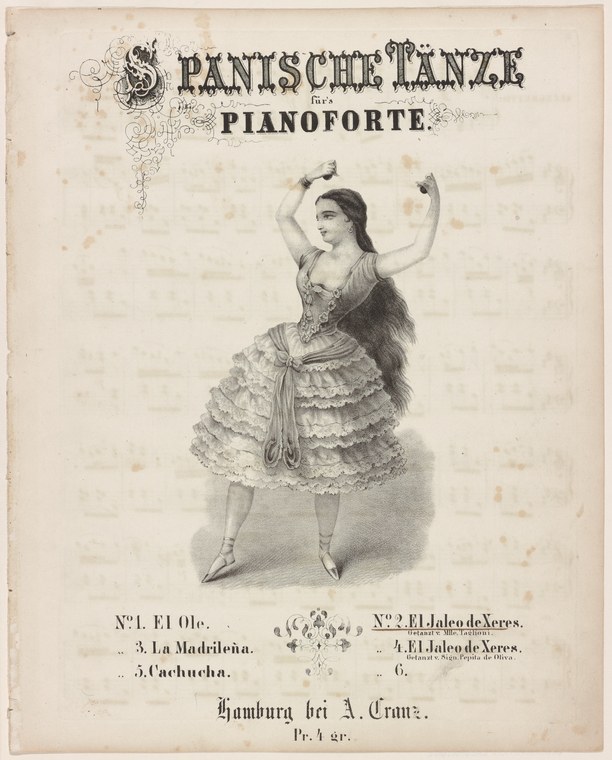
A single female dancer in theatrical costume dominates the composition, shown in three-quarter view against a plain background. She wears an elaborate mid-nineteenth-century ball gown with a fitted bodice, deep neckline trimmed with lace, and a voluminous skirt of layered white fabric—likely tulle or similar—that falls to mid-calf. Her dark hair is long and unbound, framing her face. Both arms are raised in a pose of apparent joy or exultation, with one arm bent more acutely than the other. She stands en relevé on the points of her feet—toes, not pointe shoes in the technical ballet sense, but on the extreme tips of her toes in the Spanish dance manner. The image is a lithograph, printed in black and gray tones on cream paper, with ornamental letterpress typography at the head identifying the work as "Spanische Tänze für's Pianoforte" (Spanish Dances for Pianoforte).
The dancing
The dancer is a solitary figure. Her weight is distributed onto the balls of her feet in a characteristic Spanish dance posture, not the turned-out, centered stance of ballet. Both arms are lifted and bent, creating an arc above her head—a pose associated with flamenco and Spanish dance rather than the straight lines of academic ballet. Her body faces the viewer while her head is tilted slightly, creating a moment of exuberance. The pose is suspended rather than caught mid-step; it suggests an affective moment—triumph, passion, or the release of music—rather than a technically specific step.
The dance depicted
This is a Spanish dance or flamenco image, almost certainly created as sheet music cover art for a European piano reduction of Spanish dances popular in the nineteenth century. The title explicitly identifies it as such. The dancer's costume, pose, and execution—particularly the use of the balls of the feet and the arm positions—align with the conventions of Spanish theatrical dance as it was performed and exported across Europe during the Romantic era. The work is not a documentary image of actual Spanish dance practice but a stylized, romanticized vision of it, shaped by the tastes and technical vocabulary of European theatrical dance.
How it was made
This is a lithograph, a planographic printing process that allowed for tonal gradation and fine detail, printed in black ink on cream paper. The ornamental letterpress at the top (title and imprint) is integrated into the printed sheet. Lithography was the dominant process for illustrated sheet music covers in the nineteenth century because it allowed rapid, economical production and could achieve the delicate rendering of fabric, pose, and facial expression visible here. The survival of this object in a collection of dance prints confirms it was a commercial, circulating artifact—not a fine art print but working ephemera. Hundreds of thousands of such covers were produced and distributed across Europe and the Americas.
About this work
This is a lithographed sheet music cover for a collection of Spanish piano dances, likely produced in the 1840s–1860s in Hamburg (the imprint reads "Hambura bei A. Cranz"). The central image is a romanticized representation of Spanish or flamenco dance as understood and reinvented by European audiences of the Romantic era. The dancer is not named, and the image is generic—a type rather than a portrait—designed to signal the contents of the music within: exotic, passionate, feminine, Spanish. The work belongs to the vast archive of European dance imagery from the period, which includes theater posters, souvenir prints, and commercial publishing. It documents not Spanish dance itself but the European fantasy of Spanish dance, and the complex cultural apparatus that made that fantasy commercially viable.
How to look at it
Attend first to the pose: the lifted arms and arched back create a moment of ecstatic abandon, quite different from the ethereal, bodiless quality of Romantic ballet imagery. The use of the ball of the foot—visible in the drawing—places the dancer in a different technical world from the centered, turned-out ballet vocabulary. The costume is contemporary (mid-nineteenth-century ball gown), not historical or ethnographic, which tells you this is a European fantasy, not a document. The face is animated and forward-looking; the gaze is not fixed on the viewer but engaged with the music and the moment. The lithographic technique allows fine rendering of the fabric and the play of light, making the image emotionally persuasive despite its artificiality.
The artist
The artist is unknown; the object is unsigned. This is typical of commercial lithography for sheet music covers, where individual artistic credit was rarely given to the designer. The work was published in Hamburg by A. Cranz, a major music publisher of the period. The style and technique are consistent with professional theatrical lithography of the mid-nineteenth century, but the anonymity of the maker places the focus on the image as a type—a cultural product rather than an auteur artwork.
The period
The Romantic era (roughly 1820–1860) saw an explosion of European interest in 'exotic' dance forms, including Spanish and Oriental material. This coincided with the rise of Romantic ballet—works like *La Sylphide* (1832) and *Giselle* (1841)—which privileged poetic narrative, female beauty, and otherworldly or exotic settings. Spanish dance occupied a specific niche in this landscape: it was perceived as earthy, passionate, and sensual in ways that contrasted with the ethereal, otherworldly quality of Romantic ballet proper. The market for piano arrangements of these dances was enormous; Cranz and other publishers issued them in vast quantities as domestic music for middle-class piano practice. The sheet music cover image was a form of marketing—it promised purchasers not just the music but a fantasy of the dancer, the dance, and the place it came from.
Where it lives
This work is held in the New York Public Library's collection of prints depicting dance. It survives as a published sheet music cover, suggesting it was widely distributed and that many copies existed; that most were discarded or worn out makes survival in an institutional collection noteworthy. The NYPL collection includes thousands of such objects, which together form a comprehensive archive of European and American dance imagery from the fifteenth century onwards.
Dance in this work
Questions about this work
Is this a real Spanish dancer?
No. The image is a stylized, European representation of Spanish dance, created for a commercial market. It shows a fantasy of Spain and Spanish dance rather than a documentary record. The dancer is not identified and may not have been a real person; the image is a type—an idealized figure meant to sell the music inside.
What are the dances listed in the text?
The cover lists six dances: El Olé, La Madrileña, Cachucha, El Jaleo de Xeres (listed twice), and an untitled piece. These are Spanish popular and theatrical dances of the period. The Cachucha and El Jaleo were well-known in European theaters; La Madrileña is a Madrid-associated form. The listing tells you that this is a collection of six separate pieces for solo piano.
What does 'für's Pianoforte' mean?
It means 'for the Pianoforte'—this is a piano arrangement of Spanish dances. The original music may have been written for orchestra, guitar, or other ensembles; Cranz published a reduction for solo piano so that amateurs could play them at home. This was the dominant mode of music circulation in the nineteenth century.
When was this made?
The catalogue record does not give a date. Based on the style of lithography, typography, costume, and publishing practices, it likely dates to the 1840s–1870s. The imprint (A. Cranz, Hamburg) is consistent with that period. A more precise date would require consultation of Cranz's publishing records, which may survive.
More dance artwork





