49 works in this view — arrow keys or swipe to move between them.
Dance in Art
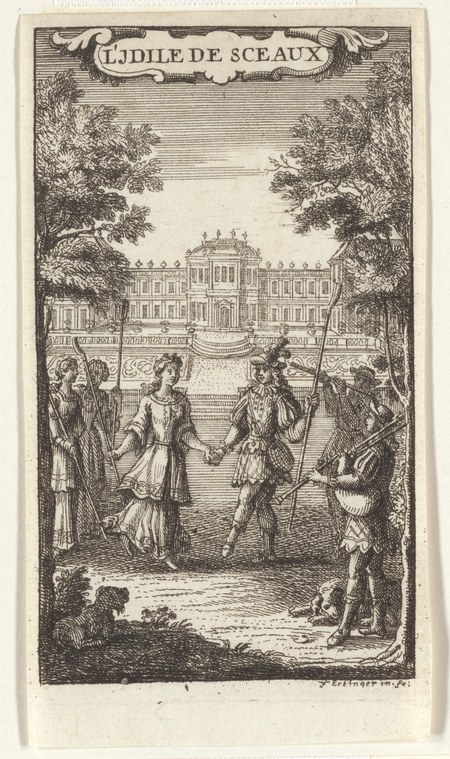
L'idile de Sceaux
Unknown artist
- Collection:
- Prints depicting dance
- Source:
- New York Public Library
- Rights:
- Public domain — free to use, share and adapt.
- Recorded as:
- Public Domain
For historians of social dance and etiquette, this engraving is a visual record of the unwritten but rigorous codes that governed who danced with whom and how the transaction of partnership was negotiated. For dancers studying the period, it documents the formal posture and bearing expected of aristocrats at leisure, the dignified carriage that preceded and framed all movement. It shows that dance in this world was not separable from courtship, social hierarchy, and the careful management of desire within strict protocols.
What you are looking at
This is an engraved scene set in the grounds of a grand country estate, with a symmetrical baroque mansion visible in the distant center, flanked by tall trees. In the foreground, four elegantly dressed figures occupy the manicured garden space: on the left, two women in long gowns with full skirts stand together; in the center, a man in period coat and breeches faces them, and on the right, another figure in masculine dress holds what appears to be a walking stick or cane. The composition is carefully balanced, with the figures arranged in a loose semicircle on the flat ground, creating both social intimacy and formal distance. The sky is open and bright, rendered with fine parallel lines typical of engraving technique. The title *L'idile de Sceaux*—"The Idyll of Sceaux"—refers to the actual château of Sceaux near Paris, a real location famous as a gathering place for aristocratic leisure and cultural performance in the 18th century.
The dancing
The bodies are arranged in a moment of social encounter rather than active dance. The central male figure bows or inclines slightly forward, with his body angled toward the nearer woman on the left, his arm extended in a gesture of address or invitation. The woman nearest to him holds her body erect, her skirt falling in formal folds; her companion stands beside her with similar posture. The rightmost figure stands more removed, holding a cane or baton-like object. All four maintain upright, dignified carriage typical of aristocratic deportment. The positioning suggests courtship ritual and social negotiation rather than the kinetic energy of active dance steps.
The dance depicted
This engraving depicts not active dance but the social choreography of courtship and flirtation among the aristocracy—the preliminary moment before or between dances. The formal bow of the central figure, offered to the woman on his left, is the conventional gesture of a gentleman soliciting a dance partner. The scene captures the ritualized etiquette of galant society, where approach, address, and acceptance were themselves forms of performative behavior. No footwork or hold is visible because the figures have paused in this moment of social negotiation. The work documents the theater of aristocratic interaction rather than the execution of a specific dance form, though the setting and context place it squarely within the world of 18th-century court and country-house dancing.
How it was made
This is an engraving, a technique that allowed fine detail and broad circulation. The artist used parallel lines of varying density to create tonal gradations and texture—the foliage, the distant architecture, and the play of light are all rendered through careful hatching and cross-hatching. Engraving was a common medium for reproducing scenes of aristocratic life and social manners in the 18th century, making such prints accessible to a educated, leisured public interested in records of fashion, etiquette, and refined behavior. The signature visible in the lower right indicates a professional hand trained in reproductive engraving.
About this work
This engraving documents a moment from the social world of 18th-century French aristocratic leisure—specifically the choreography of courtship and invitation that preceded formal dance at country estates like Sceaux. It is not a record of dance technique but of the ritualized gestures and protocols that framed dance as a social performance. The work belongs in a gallery of dance in art because it shows dance not as an autonomous art form but as embedded in the wider theatrical presentation of self that defined aristocratic life. It captures the moment when a gentleman seeks permission to dance, a moment governed by precise rules of address, posture, and response.
How to look at it
Attend to the geometry of the figures and their distance from one another: this is a scene of social negotiation, not physical contact. Notice the precise inclination of the gentleman's body—a bow is a coded gesture with rules—and the still, upright response of the woman he addresses. The architectural frame and manicured landscape are not mere background but signs of wealth, leisure, and the civilized spaces within which such encounters took place. The engraving style itself, with its controlled lines and clarity, mirrors the formality and restraint of the social world it depicts.
The artist
The engraver is not identified in the catalogue record. The signature visible in the lower right may be legible under magnification. The style and execution are consistent with professional reproductive engravers working in France in the 18th century, a period when scenes of galant life and aristocratic leisure were a major subject of printmaking, serving an audience of educated collectors and participants in such society.
The period
This work dates to the 18th century, the age of galanterie and the rococo, when dance was central to aristocratic life but understood not as a specialized art but as one element of refined behavior and courtship ritual. Sceaux itself was the seat of the Duchesse du Maine, a famous patroness of cultural events and theatrical performance in the early 18th century. The formal courtesy shown in this scene—the bow, the measured distance, the ceremonial invitation—reflects the codes of behavior documented in contemporary treatises on dancing and deportment. This was also the era of the minuet, the quintessential dance of aristocratic sociability, though no specific dance form is depicted here.
Where it lives
This engraving is held in the New York Public Library as part of its collection of prints depicting dance. It is the kind of popular print that circulated among the educated leisure classes of Europe, a record of fashionable life aimed at an audience that recognized and participated in the social world it showed.
Dance in this work
Questions about this work
Is this actually showing a dance?
Not an active dance, but the social ritual that surrounded dancing in aristocratic life. The gentleman is shown in the act of soliciting a dance partner through a formal bow. The work documents etiquette and courtship as performance—the choreography of social interaction.
What is Sceaux?
Sceaux is a château near Paris that became famous in the early 18th century as the seat of the Duchesse du Maine, a major patroness of theatrical and cultural events. It was a center of aristocratic leisure and performance, exactly the kind of place where such scenes of galant society took place.
What does the formal bow tell us?
The bow was a carefully codified gesture governed by rules of distance, inclination, and duration. It was the prescribed way a gentleman indicated his wish to dance with a particular woman. That it is the central action of this engraving shows how much of 18th-century dance culture was about etiquette and social negotiation, not just movement.
More dance artwork





