49 works in this view — arrow keys or swipe to move between them.
Dance in Art
Bolero dancers
Unknown artist
- Collection:
- Prints depicting dance
- Source:
- New York Public Library
- Rights:
- Public domain — free to use, share and adapt.
- Recorded as:
- Public Domain
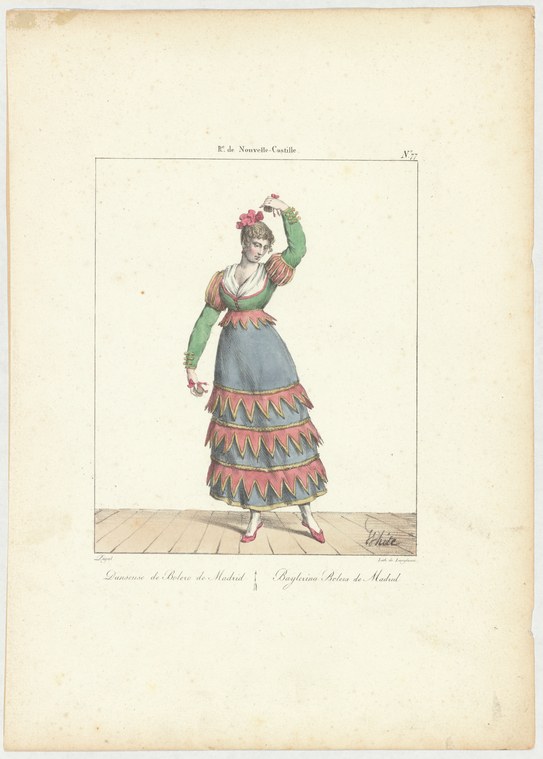
The image documents the visual transformation of Spanish dance aesthetics into Parisian theatrical fashion during a period when Spanish and bolero styles were becoming fashionable in European courts and theaters. It exemplifies how theatrical dance, particularly female performers, were consumed and circulated as commodified images—costume plates and celebrity prints that reached a far wider audience than the theater itself.
What you are looking at
A single female dancer stands on a wooden stage against a pale background, posed in an attitude of spirited performance. She wears a striking ensemble: a white or cream chemise with short puffed sleeves, a coral-pink sash or belt at the waist, and a full skirt composed of four tiers of scalloped flounces in alternating grey-blue and coral-red. Her posture is dynamic—one arm raised overhead with fingers touching her hair or a floral garland, the other arm bent at the elbow, her body tilted slightly backward in a contrapposto stance that suggests mid-movement. Her legs are straight and her feet point downward in soft slippers. The composition is frontal and theatrical, lit evenly across the figure, emphasizing the geometric geometry of the tiered skirt. The inscription below reads "Danseuse de Palais de Madrid" and "Régisseur Palais de Madrid" in French, indicating this depicts a dancer from the Madrid palace establishment. The hand-coloring is delicate and precise, heightening the decorative quality of the costume.
The dancing
A single standing figure with weight centered, not in active step or turn. The raised arm and tilted torso create a pose of presentation rather than locomotion—a moment of display or acknowledgment rather than propulsion through space. The arm position (one overhead, one at the side) is open and unrestrained, typical of early 19th-century court or theatrical gestural convention rather than the closed partnered holds of ballroom dance. The body is upright and the posture carries elegance and control, with no indication of the close contact, alignment, or technical frame that ballroom dancing requires.
The dance depicted
The inscription identifies this as a dancer from the Palais de Madrid, and the costume—particularly the tiered, scalloped skirt and the overall silhouette—closely resembles the dress of early 19th-century Spanish court and theatrical dance. The pose and presentation suggest a bolero dancer, a Spanish solo or partner dance that was fashionable in noble and theatrical circles during the Regency and early Romantic periods. However, the image alone does not depict the characteristic movement of bolero—the sharp hip action, footwork, or partner placement. Rather, it is a portrait of a dancer in costume, frozen in a moment of theatrical presentation. The pose is more about showing off the dress than documenting the dance technique itself.
How it was made
This is a hand-colored engraving or print, evident from the fine linear work, the even application of watercolor or gouache over the printed line, and the delicate cross-hatching visible in the background and contour lines. The technique allowed for wide circulation of fashionable costume imagery, and the hand-coloring—executed with precision and consistent in palette—suggests this was a moderately expensive print, likely aimed at an educated, urban audience interested in theatrical fashion and celebrity performers. The formal inscription in French indicates publication in France or for a French-reading market, despite the Spanish subject matter.
About this work
This is a hand-colored theatrical costume print, French or Franco-Spanish in origin, depicting a professional dancer of the Palais de Madrid in the early 19th century. The work belongs to the extensive print culture of the Regency and Romantic periods, when theatrical celebrity, particularly female dancers and their costumes, became subjects of fashionable collecting and display. It documents both the visual spectacle of Romantic-era stage dress and the circulation of Spanish dance aesthetics through French publishing networks. The precise costume rendering and formal presentation indicate this was not a study from life but a commercial print celebrating a notable performer or theatrical establishment.
How to look at it
Notice the exaggerated width and decorative elaboration of the skirt, rendered through the repetition of scalloped tiers in contrasting colors—a visual device that emphasizes movement and theatricality without depicting actual motion. The pose is formal and frontal, a convention of costume presentation rather than dance documentation. The face is generic and idealized, typical of theatrical prints aimed at selling the costume and the idea of the dancer rather than capturing an individual likeness. The inscription is essential: it tells you this is Madrid palace repertory, situating the figure within an institutional and geographical context that a viewer in Paris or London would have recognized as exotic and fashionable.
The artist
The artist is not recorded in the catalogue. The monogram or signature on the print (visible lower right) may be legible in a high-resolution original; hand-colored fashion and theatrical prints of this period were often executed by anonymous or journeyman colorists working for print publishers rather than by fine artists of individual reputation. The style and execution are consistent with French or Parisian workshop production of the 1820s–1840s.
The period
The early 19th century saw a surge of European fascination with Spanish and Spanish-influenced dance, partly through Napoleonic exposure to Spanish culture and partly through the Romantic movement's appetite for exoticism and national character. Bolero and other Spanish dances entered fashionable European ballrooms and theaters, where they were performed by professional dancers and taught to nobility. Simultaneously, the theatrical print industry was booming, with hand-colored engravings of famous dancers and their costumes serving as fashion plates and celebrity portraits. Regency and early Romantic theater placed unprecedented emphasis on costume spectacle and the visual allure of the female dancer, and such prints capitalized on public fascination with theatrical celebrities.
Where it lives
This work is part of the New York Public Library's "Prints depicting dance" collection, a holdings category that aggregates theatrical, fashion, and social dance imagery across media and periods. Such hand-colored prints were collected as documents of theatrical history, fashion, and social custom rather than as fine art objects.
Dance in this work
Questions about this work
Is this a bolero dancer?
The inscription and costume suggest Spanish dance, likely bolero repertory, but the image shows a static pose, not the characteristic movement of bolero—which involves sharp hip action, rhythmic footwork, and often partnered figures. This is a costume portrait of a bolero dancer, not a depiction of bolero technique.
Why is the skirt drawn with all those scalloped tiers?
The tiered scalloped design is both accurate to early 19th-century Spanish theatrical dress and exaggerated for visual effect—the repetition and the contrasting colors (grey-blue and coral) make the skirt appear even more voluminous and lively than it would in reality. The effect emphasizes movement and spectacle, key selling points for a theatrical costume print.
Who was the Palais de Madrid?
The Palais de Madrid was likely a theater or court establishment in Madrid, or possibly a theater or dance studio in Paris that catered to fashionable Spanish taste. The French inscription suggests the print was made for a French audience and marketed this dancer's connection to Spanish court or theatrical prestige.
How was this print colored?
By hand, after the engraved line was printed. A colorist or team of colorists applied watercolor or gouache in a consistent palette, working quickly and following a color key. The precision and even application suggest professional workshop production rather than individual artistic hand-finishing.
More dance artwork





