49 works in this view — arrow keys or swipe to move between them.
Dance in Art
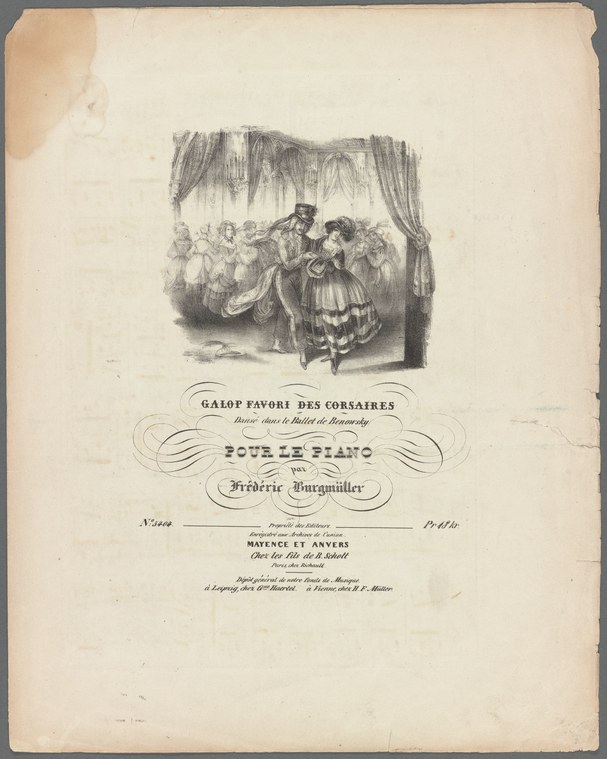
Galop favori des corsaires: dansé dans le ballet de Benowsky
Unknown artist
- Collection:
- Prints depicting dance
- Source:
- New York Public Library
- Rights:
- Public domain — free to use, share and adapt.
- Recorded as:
- Public Domain
This print reveals how 19th-century dance existed in multiple registers simultaneously: as stage spectacle, as publishable musical commodity, and as domestic entertainment. It shows that visual representations of ballet often prioritized theatrical setting and costume over the depiction of actual dancing bodies in motion. For historians of dance imagery, it documents the conventions of how ballet was marketed to and consumed by middle-class audiences through published scores.
What you are looking at
A theatrical scene from a ballet or operatic production showing an ensemble of formally dressed figures assembled on stage. The composition is dominated by heavy drapery—a curtain or scrim suspended above casts deep shadow across the upper half of the print. In the foreground right, a figure in a military costume with ornate striped detail (suggesting a pirate or corsair captain) stands prominently; this figure wears a tall hat and holds what appears to be a cape or heavy garment. A group of supporting figures, dressed in period costume with hats and formal attire, clusters to the left and behind, creating a theatrically composed scene of gathering or assembly. The lighting is theatrical—sharp contrasts between deep shadow and highlighted areas emphasize the stage space. The overall mood is one of spectacle and formal presentation rather than active movement; the figures appear poised or static rather than caught mid-leap or in balletic motion.
The dancing
The figures are largely upright and posed rather than engaged in active dance movement. The corsair figure on the right commands the composition through costume and positioning, standing with weight settled and cape or cloak draped dramatically. The ensemble behind appears to be watching or attending to this central figure, arranged in a loose grouping typical of operatic or theatrical tableau rather than choreographed formation. No visible pointe work, turned positions, or lifted movements suggest this is classical ballet technique; the postures read as stage acting with movement rather than dance proper.
The dance depicted
The title identifies this as the "Galop favori des corsaires" (Favorite Galop of the Corsairs) from the ballet *Benowsky*, a now-obscure work. The galop was a popular, energetic dance of the 19th century, typically performed in duple meter with a characteristic hopping step. The print is a musical score cover illustration, suggesting this was a dance number extracted from a larger theatrical production and published for domestic piano performance. However, the static, theatrical tableau composition shown here does not depict the dance itself in motion; it appears to be a scene from the ballet's narrative—likely a moment of dramatic assembly or confrontation among pirates—rather than a representation of how the galop was actually performed on stage.
How it was made
This is an engraving (indicated by the fine line work and tonal modeling throughout) used as a score cover or frontispiece for a published musical composition. The technique allows for rapid reproduction and distribution to a middle-class amateur market—these were items for home music-making, not fine-art prints. The engraved illustration situates the music within theatrical and narrative context, marketing the piece to piano owners who wished to perform ballet excerpts in their parlors. The image quality and printing standards suggest professional publication, likely French given the language and artistic conventions.
About this work
This is a theatrical score cover engraving from the 19th century, illustrating a number from the ballet *Benowsky*. It depicts not the dance itself but a narrative moment from the work—a staged assembly of corsair characters in formal theatrical costume and pose. The galop was one of the century's most popular social and theatrical dances, and its inclusion in ballets was standard; publishers regularly extracted such numbers and sold them as sheet music for amateur performers. The work sits at the intersection of theatrical spectacle, popular music culture, and the consumption of dance imagery by the non-professional public. It documents the visual and narrative framing of a dance work rather than its actual choreographic content.
How to look at it
Attend to the contrast between the work's title (which promises a *galop*, a fast, energetic dance) and what the image actually shows: a static theatrical tableau. This gap is instructive—it reveals that score-cover illustrations were not attempts to document choreography but to set dramatic and narrative mood. Notice the corsair figure's costume and bearing: the military precision and heavy drapery suggest spectacle and character portrayal over dance technique. The composition is fundamentally theatrical rather than choreographic, arranging figures for maximum stage effect rather than to show bodily movement.
The artist
The engraver is not recorded. The publication information names Mayence et Anvers (Mainz and Antwerp) as publishers, suggesting a Central European music-publishing operation of some scale. The style and execution indicate a professional commercial engraver working within the conventions of mid-19th-century score illustration. Frédéric Burgmüller, credited as composer, was a prolific composer of light theatrical music and pedagogical piano works in this period.
The period
The 19th century saw the rapid professionalization and commercialization of ballet, particularly in France and across Europe. Romantic ballet—emphasizing narrative, female ethereality, and exotic settings—dominated the theatrical stage from the 1830s onward. Simultaneously, a mass market for dance music developed through printed scores for home piano performance. The galop itself was a fashionable social dance of the 1840s–1880s, and its inclusion in theatrical ballets was both a way to anchor ballets in contemporary social practice and to generate reproducible, marketable musical content. This image captures that moment when stage dance and domestic music-making were commercially entangled.
Where it lives
This engraving is held in the New York Public Library's Prints depicting dance collection, part of the institution's broader holdings of dance ephemera. The object is a published score cover, a type of commercial printed music now preserved in research collections for its cultural and visual-historical significance rather than for musical performance.
Dance in this work
Questions about this work
What is a galop and why would it appear in a ballet?
A galop is a lively couple dance in 2/4 time, popular in 19th-century European ballrooms and theaters. Ballets regularly incorporated fashionable social dances of the moment, both to reflect contemporary taste and to create marketable musical content that audiences recognized. The galop's energetic, hopping character made it visually striking on stage.
Why doesn't this image show people actually dancing?
This is a theatrical scene cover rather than a choreographic diagram. It illustrates a narrative moment from the ballet—a gathering of corsair characters—rather than attempting to document the galop's actual steps or technique. 19th-century score covers prioritized dramatic context and costume over movement representation.
Who was Benowsky and what was his ballet about?
Count Maurice Benyovszky was an 18th-century Hungarian adventurer whose memoirs were popular in 19th-century Europe. Several theatrical works drew on his exploits, typically centering on piracy, exoticism, and adventure. The specific ballet *Benowsky* is now obscure, surviving mainly through published musical excerpts like this one.
More dance artwork





