49 works in this view — arrow keys or swipe to move between them.
Dance in Art
Rights and Access | About this Collection | Ballets Russes de Serge Diaghilev | Digital Collections
Unknown artist
- Source:
- Library of Congress
- Rights:
- Public domain — free to use, share and adapt.
- Recorded as:
- Public Domain
This photograph documents a moment in avant-garde dance history when the theatrical tableau and dramatic narrative were as important as technical virtuosity, and when photography became a key medium for capturing and promoting innovative dance work. The intimacy and emotional intensity of the pose reveal how early twentieth-century modernist dance prioritized expressive gesture and emotional authenticity over classical form.
What you are looking at
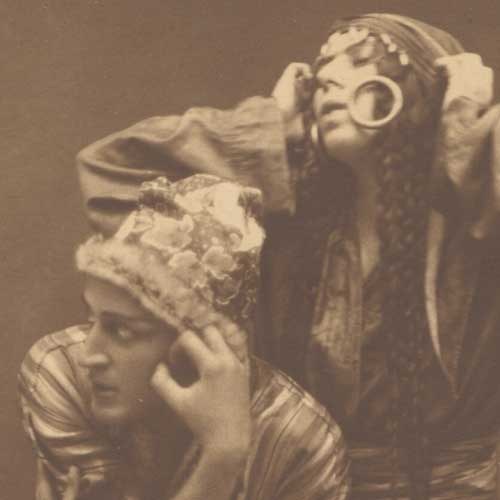
A sepia-toned photograph shows two figures in an intimate, theatrical pose set against a plain draped background. The figure in the foreground, positioned lower in the frame, wears a striped tunic and a close-fitting cap with ear-pieces or decorative elements, their body reclined with one hand raised to their face in a gesture of repose or reverie. The figure behind leans inward, their long hair visible and their body angled to frame the first figure; they wear a draped garment and large circular earrings. The composition is closely framed, with both figures occupying most of the picture plane, creating an atmosphere of theatrical intimacy. The lighting is even and flat, typical of studio photography, and the entire image has the warm tone characteristic of early twentieth-century photographic processes.
The dancing
The two bodies are arranged in an asymmetrical, close embrace. The foreground figure reclines with their weight supported on one arm, their head tilted back, the other arm raised and hand near the face—a classical pose of abandon or sleep. The background figure bends forward at the waist, creating a protective or attending frame around the first body. Neither dancer stands upright or in a formal dance position; the weight is distributed through the floor contact and the reclining arm. The spatial relationship suggests narrative or emotional content rather than balletic virtuosity.
The dance depicted
This appears to be a photograph from the Ballets Russes era, likely documenting a moment from a theatrical production. The costume details—the striped tunic, the decorative head covering, and the large earrings—suggest either an exotic or historical setting, possibly from a production with non-Western or fantasy themes common to Diaghilev's company. The pose itself is theatrical and sculptural rather than balletic in the academic sense; it emphasizes dramatic tableau and emotional or narrative content over technical display. Without a title or clearer documentation, the specific ballet cannot be identified with certainty, but the aesthetic and production values point strongly to early twentieth-century avant-garde theatre dance.
How it was made
This is a gelatin silver print or similar photographic medium from the early twentieth century, made in a studio setting. The even lighting, plain backdrop, and careful composition suggest a professional publicity photograph or cast documentation rather than a candid stage capture. The sepia toning may be original or result from aging; the photographic process allowed for close framing and intimate detail that would have been difficult to capture from the auditorium. Such photographs were typical documentation of Ballets Russes productions and would have circulated in programmes, press, and theatrical collections.
About this work
This is a studio photograph of two dancers in an intimate, highly stylized pose, likely from a Ballets Russes production of the early twentieth century. The composition emphasizes emotional and narrative content over technical display, with both figures arranged in a reclining or bent posture that suggests a moment of rest, sleep, or emotional surrender. The costumes—particularly the tunic, head covering, and earrings—point to a theatrical setting with exotic or historical associations, consistent with Diaghilev's company's aesthetic of cultural fantasy and modernist experimentation. The photograph represents the kind of publicity and documentary practice that Ballets Russes employed to capture and circulate images of its productions beyond the theatre itself.
How to look at it
Pay attention to the asymmetry of the pose and the way weight is distributed through the bodies: neither figure is vertical or in a traditional dance position, and yet the arrangement creates a strong visual and emotional composition. Notice the hand positions and head angles—these convey emotion and narrative rather than demonstrating technique. The close framing and studio lighting allow you to see the texture of the fabrics and the details of the costume, which are part of the work's theatrical effect. The photograph freezes a moment that would have been part of a larger narrative or scene, and the stillness of the camera emphasizes the sculpture-like quality of the pose.
The artist
The photographer is not recorded. The image comes from the Ballets Russes de Serge Diaghilev collection, which includes extensive photographic documentation of the company's productions. Diaghilev employed a range of photographers to document his dancers and productions, and such images were integral to the company's self-promotion and its influence on European avant-garde culture.
The period
This photograph dates to the era when the Ballets Russes (1909–1929) was at the centre of European modernist culture. The company revolutionized dance by commissioning works from leading composers and visual artists, and by moving away from purely academic ballet toward experimental forms that incorporated mime, exotic themes, and emotional expressionism. In the same period, photography was becoming the dominant medium for theatre documentation and publicity, allowing dancers and productions to reach audiences far beyond the stage. The aesthetic visible here—the emphasis on costume, exotic setting, and emotional tableau—reflects the company's broader artistic mission.
Where it lives
This photograph is held in the Library of Congress collections related to the Ballets Russes de Serge Diaghilev. It is part of the extensive photographic documentation of the company's productions and would have been used for publicity, programmes, and historical record.
Dance in this work
Questions about this work
Is this classical ballet?
No. While both figures are likely professional dancers, the pose and aesthetic are far removed from classical ballet technique. This is theatrical modernism—the emphasis is on emotional content, costume, and dramatic tableau rather than on steps or turnout. It represents the kind of expressive, narrative-driven dance that the Ballets Russes pioneered.
What ballet is this from?
The catalogue record does not identify the specific production, and the photograph alone does not provide clear evidence. The costume elements suggest an exotic or fantastical setting, which narrows the possibilities within the Diaghilev company's repertory, but further research would be needed for a certain identification.
Why photograph dancers this way?
Theatre photography in this period served multiple purposes: it documented productions for the archive, provided images for programmes and publicity, and allowed the company to control and circulate its own visual narrative. The studio setting and close framing gave photographers (and the company) control over how the dancers and their work were represented.
More dance artwork





