49 works in this view — arrow keys or swipe to move between them.
Dance in Art · 1875
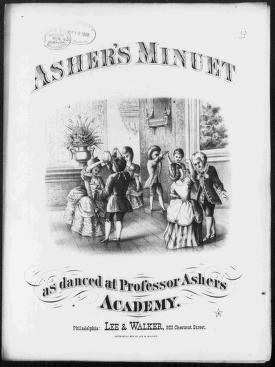
Asher's minuet
Unknown artist
- Source:
- Library of Congress
- Rights:
- Public domain — free to use, share and adapt.
- Recorded as:
- Public Domain
This engraving provides direct visual evidence of the minuet's survival into the late nineteenth century, long after its departure from aristocratic favor. It shows how the dance was institutionalized and democratized through the dancing academy—how it became pedagogy rather than spontaneous social practice. For dancers and historians, the image documents the formal technique, the dress, the social setting, and the gendered roles that structured Victorian ballroom culture.
What you are looking at
A crowded interior ballroom scene in which at least a dozen figures in mid-Victorian dress are assembled for a social dance. The composition is centered on a minuet in progress: a couple occupies the floor in formal pose while spectators line the walls, some seated and some standing. The setting appears to be an elegant townhouse or academy room, suggested by the classical columns and tall windows with drapery in the background. The lighting is even and engraved; the figures are rendered in fine detail characteristic of mid-nineteenth-century print reproduction. The title announces this as a minuet danced at Professor Asher's Academy, and the crowd suggests a demonstration or formal social occasion rather than private recreation. The women wear full skirts with fitted bodices; the men are in dark coats. The overall mood is one of formal instruction or exhibition—this is a dance being watched and judged as much as performed.
The dancing
The central couple displays the closed hold and upright carriage characteristic of the minuet: the man's right arm extended toward the woman, her left arm raised to meet it, both bodies vertical and separated by formal distance. The woman's skirt is voluminous enough to suggest the full circumference typical of 1870s fashion. The surrounding figures are stationary, arranged as witnesses rather than participants. The positioning and posture of the lead couple suggest a moment of formal progression or turning rather than vigorous movement—the minuet's restrained elegance is evident in the stillness and dignity of the frame.
The dance depicted
This is a minuet, one of the most enduring social dances of the European ballroom tradition. The minuet originated in seventeenth-century France as a court dance, but by the 1870s it persisted as a formal social accomplishment taught in dancing academies to young people of the middle and upper classes. The image documents a demonstration or examination at Professor Asher's Academy, suggesting that the minuet was still a standard curriculum item in Victorian ballrooms, where it served as a marker of refinement and proper training. The formal, stationary composition of the dancers and the presence of witnesses indicates that this is minuet as pedagogy and social performance, not spontaneous recreation.
How it was made
This is a wood engraving or steel engraving, evident from the fine cross-hatching, sharp line work, and tonal gradations achieved through parallel lines. The technique allowed for mass reproduction in newspapers, journals, and sheet music covers of the era. The print shows no color and relies entirely on line and texture to convey form, fabric, and light. The quality of engraving—the precision of detail in architectural elements, the fabric of the dancers' clothing, and the crowd—suggests this was a professional commercial print, likely produced for sale as sheet music cover art or as an illustration in a period journal. Such prints circulated widely and were affordable to the middle-class families who patronized dancing academies.
About this work
This is a mid-Victorian engraving documenting a minuet performance or examination at a London or provincial dancing academy, dated to 1875. The minuet, though more than two centuries old by this date, remained a fundamental social dance taught to respectable young people as a marker of breeding and accomplishment. The image captures not a moment of private recreation but of formal instruction and social display: a couple dancing under the eyes of an assembled company, their movement constrained by convention and propriety. The work is both a dance document and a social artifact, showing how ballroom dancing functioned as a form of class performance and moral education in the Victorian era.
How to look at it
Observe the geometry of the couple's frame—how far apart they stand, where their arms are positioned, how their bodies are aligned. Notice that despite the title's promise of animation, the artist has frozen the dancers in a moment of stillness or slow, measured progression; there is no suggestion of vigorous movement or swinging drapery. Compare the central couple to the watching crowd: the contrast between the performers' formal constraint and the relative ease of the spectators' postures. Attend also to the architectural setting and the furnishings, which place this dance firmly in the genteel interior world of the academy, not in a ballroom of pleasure or spontaneous social mixing.
The artist
The artist is not recorded. The engraving is credited to 'Lee & Walker, 33 Theobald Street,' which appears to be a publishing firm rather than the engraver's name. This was standard practice in the Victorian print trade: commercial publishers employed engravers without consistent attribution. The quality of execution suggests a professional workshop experienced in dance imagery, as such scenes were common on sheet music covers and in illustrated periodicals.
The period
In 1875, the minuet was seventy years or more past its heyday as a fashionable social dance. It had been superseded in popular favor by the quadrille (1800s onward) and the waltz (1810s onward), but it persisted in formal education as a sign of old-fashioned respectability and proper training. The mid-Victorian dancing academy was a ubiquitous institution in towns and cities, teaching young women (and to a lesser extent young men) the dances considered necessary for successful entry into society. The minuet served a symbolic function: learning it proved that one had been educated, that one's family valued tradition and refinement, and that one could be trusted to behave correctly in mixed company. By the 1870s, the dance was archaic but still ritually important.
Where it lives
The print is held in the Library of Congress. It bears the publisher's imprint 'Lee & Walker, 33 Theobald Street' at the foot, suggesting it was a commercial print issued for sale, likely as sheet music cover art or as a periodical illustration.
Dance in this work
Questions about this work
Was the minuet still danced socially in the 1870s?
Not commonly, but it was learned and performed in formal or educational contexts. By 1875 it had been out of fashion for decades, but dancing academies taught it as part of a young person's accomplishment, a way of proving one's breeding and correct upbringing. It was performed at formal balls and examinations, but not at the dances where people actually socialized and enjoyed themselves.
What was Professor Asher's Academy?
The catalogue record does not identify this academy further. It was evidently a dancing school in London or a major British city. Many such establishments existed in the Victorian era, each run by a dancing master or mistress who taught the current fashionable dances alongside older, 'refined' ones like the minuet.
Why are there so many spectators?
This appears to be a formal demonstration or examination, not a social gathering. Victorian dancing academies would hold public or semi-public events to display their students' progress and skill. Parents and prospective pupils would attend to assess the instruction. The minuet, being old and formal, was a frequent choice for such demonstrations because it showed technique and propriety rather than fashionable novelty.
What would the music have been?
A minuet in common time, in a moderate tempo, with a clear three-beat measure. The form was highly standardized by the 1870s. Minuet music had been published for centuries, and any dancing academy would have had multiple arrangements to choose from.
More dance artwork





