49 works in this view — arrow keys or swipe to move between them.
Dance in Art · 1888
Spring lessons minuet
Unknown artist
- Source:
- Library of Congress
- Rights:
- Public domain — free to use, share and adapt.
- Recorded as:
- Public Domain
This print documents the minuet at a moment when it had become a quaint, formalized, and teachable rather than spontaneous or fashionable dance—relegated to instruction of the young and the curious. It reveals attitudes toward courtly dance as something fixed, transmissible, and slightly ridiculous by the late 19th century, offering a window into how earlier dance traditions were being remembered and sometimes mocked as taste changed.
What you are looking at
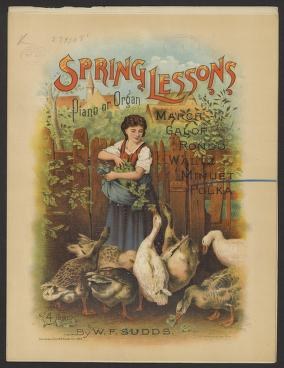
A young woman in a modest dark dress stands in a garden or pastoral setting, instructing a group of ducks and geese in the minuet. The birds cluster around her feet and legs in various attitudes of attention, their white plumage contrasting with the darker tones of the composition. She holds her skirts slightly gathered, her posture upright and composed as if demonstrating the dance's formal bearing. The setting is lush with foliage rendered in soft greens and browns, and the whole scene has the quality of a gentle satire—the notion of teaching courtly dance to barnyard fowl is presented with earnest visual commitment. The title appears in decorative lettering above, identifying this as an instructional scene of sorts, though one pitched entirely at the absurd.
The dancing
The woman occupies the center, her body aligned vertically with the formal carriage expected of minuet dancers. Her arms are held in a relaxed but controlled manner, appropriate to the period style she is demonstrating. The birds arrange themselves around her without a clear partner or formation—there is no mirroring, no closed holds, no symmetry in their grouping. The absence of proper dance partnership is clearly the joke: poultry cannot execute the measured, partnered structure the minuet demands.
The dance depicted
This is a depiction of the minuet, the dominant social and theatrical dance of the 18th century and well into the 19th. The title explicitly states this is instruction in the minuet, and the woman's formal dress and posture align with how the dance was taught and performed. However, the image is comedic rather than documentary: it literalizes the phrase 'teaching one's grandmother to suck eggs' or its variants by showing an actual attempt to instruct animals in a human courtly dance. The minuet was danced by couples in a highly stylized, processional manner, but these birds offer no cooperation with the form, rendering the lesson absurd.
How it was made
This is a color-printed engraving or chromolithograph, as evidenced by the hand-tinted or separated color layers, the fine linear detail in the foliage and figure, and the decorative letterpress title. The technique allowed for wide circulation as a popular print—likely a sheet for hanging, amusement, or instruction. The bold outlines and soft color washes are characteristic of late 19th-century reproductive prints aimed at a mass domestic or educational market. The print's relatively fine detail and finish suggest it was an affordable but carefully produced commodity.
About this work
This is a humorous instructional print from 1888 depicting the improbable scenario of a young woman teaching the minuet to farmyard birds. The minuet was by this date no longer the dominant social dance—it had retreated into formal court practice, historical revival, and children's education—and the image plays on the formality and rigidity of the form by applying it to creatures utterly incapable of learning it. The print belongs to a long tradition of anthropomorphic animal prints and pedagogical satire. It is simultaneously an artifact of dance history (a record of how the minuet was taught and valued) and a critique of that tradition through absurdist humor.
How to look at it
Attend to the contrast between the woman's formal, upright posture (the correct bearing for minuet dancing) and the chaos of the birds around her. She is positioned as a teacher or demonstrator, not as a dancer in motion, which would be inappropriate to the slow, measured dignity of the minuet anyway. The artist has frozen the scene at the moment of instruction rather than in the midst of a step, emphasizing the pedagogical and the absurd. Notice too the care taken with her dress and the pastoral naturalism of the setting, which keeps the satire gentle rather than cruel—this is affectionate mockery of a formal dance tradition, not contempt for either the dance or the instruction of youth.
The artist
The artist is attributed as W. F. Sudds in the inscription. No further biographical information is recorded in the catalogue, and Sudds may be a relatively minor 19th-century illustrator or engraver working in the sentimental, humorous print tradition common to the period. The hand-tinted chromolithograph style was a standard commercial format for such work.
The period
By 1888, the minuet was nearly two centuries out of fashion as a living social dance. It had been the dominant courtly and ballroom dance from the 1650s through the early 1800s, when waltz, polka, and quadrille gradually displaced it. However, the minuet experienced a sustained revival in dance pedagogy and historical nostalgia during the 19th century, particularly in children's instruction and in the aesthetics of neo-rococo decoration and taste. This print appears during a period of intense interest in 'old dances' and dancing masters' revival of baroque and rococo forms. The print medium itself—the chromolithograph as a vehicle for humor, instruction, and domestic decoration—was at its commercial height in the 1880s–1890s.
Where it lives
The work is catalogued by the Library of Congress. It is a printed sheet, likely distributed as a popular chromolithographic print of the type that filled 19th-century homes, school collections, and gift albums. The LOC holding suggests it was either acquired as an example of period printmaking or as part of a thematic collection on education, animals, or dance instruction.
Dance in this work
Questions about this work
Why would anyone teach ducks the minuet?
They wouldn't—the print is a humorous satire. It exaggerates the formality and rigidity of minuet instruction by applying it to animals incapable of learning it, mocking both the pretensions of the dance and the earnestness of dance pedagogy. The joke relies on the reader's familiarity with the minuet as a real, prestigious form of instruction.
Was the minuet still danced in 1888?
Not as a living social dance. By 1888 the minuet was nearly extinct in ballrooms. However, it was actively taught in children's dancing schools, performed in historical revivals, and celebrated in nostalgic and neo-rococo culture. The print reflects this status: the minuet as a museum piece, a toy, and a marker of cultural refinement rather than living practice.
Who is W. F. Sudds?
Sudds is credited as the artist, but no biographical record is available. He appears to have been a commercial illustrator and engraver working in the late 19th-century chromolithographic print tradition, a field in which many talented practitioners left little archival trace.
More dance artwork





