49 works in this view — arrow keys or swipe to move between them.
Dance in Art · 1914
Tango tee
Unknown artist
- Source:
- Library of Congress
- Rights:
- Public domain — free to use, share and adapt.
- Recorded as:
- Public Domain
The work documents the tango craze of the 1910s from the inside: not as an exotic spectacle or a scandal, but as a lived experience of pleasure and liberation. For a historian of dance and gender, it is evidence of how new dance forms became part of everyday life and how women's relationship to public dancing shifted in this era.
What you are looking at
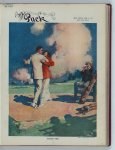
A young woman in a white sleeveless dress dances alone against a soft, hazy background rendered in blues and warm tones. She is captured mid-movement, her body angled slightly forward with her right leg extended behind her in a long line, suggesting motion and momentum. Her left arm extends outward while her right arm curves at her side. The dress is simple and modern for 1914—a shift silhouette that falls just below the knee, allowing full visibility of her legs and movement. The setting is minimal and atmospheric rather than representational; there is no defined floor or stage, only floating space rendered in watercolor washes. A small figure, possibly a musician or partner, appears in shadow at the lower right, suggesting she is dancing in response to music or direction. The overall mood is one of modernity, youth, and freedom—the kind of dancing that marked early twentieth-century popular culture.
The dancing
A single female dancer, likely in her late teens or early twenties, dominates the composition. Her body alignment shows an extended back leg with a pointed foot, a lifted torso, and arms positioned in a way that suggests both control and ease. The gesture is neither rigidly balletic nor purely social; there is an experimental quality to the pose—a modernist approach to the body in space. Her weight appears forward on her supporting leg, the free leg fully extended and turned outward. The small shadowed figure at right, rendered much smaller and less distinctly, provides scale and context but is secondary to the dancer's commanding presence.
The dance depicted
This is most likely a social dance or popular dance style of the early 1910s. The title 'Tango tee' (possibly "Tango Tea") and the date of April 1914 place this squarely in the period when tango was revolutionizing popular dance in America and Europe. The woman's dress, footwork, and the informal setting (rather than a ballroom) suggest this may depict a casual or informal tango, or the kind of fashionable popular dancing that tango fever inspired. The extended leg and forward momentum are consistent with tango aesthetics of that era. However, the solitary dancer and the experimental, modernist composition distinguish this from conventional tango representation, which typically showed couples in closed hold. This may be as much a statement about women's freedom to dance independently as it is a documentation of a specific dance style.
How it was made
This appears to be a watercolor or gouache on paper, with characteristic soft edges and translucent washes of color. The rendering is loose and impressionistic rather than photographic—the background is deliberately atmospheric and undefined, with colors (blues, pinks, warm ochres) that merge and soften. This technique was well-suited to capturing the ephemeral nature of a dance moment and the modernity of the subject. The fluidity of watercolor allows the artist to suggest movement and light without rigid line, and the spontaneity of the medium matches the subject's sense of liberation and contemporary style. Such works would have circulated as popular prints, posters, or illustrations in magazines and newspapers—mass media documentation of current fashion and social trends.
About this work
This 1914 watercolor captures a young woman in the grip of the tango craze that electrified popular culture in the early twentieth century. The painting is not a formal ballroom scene but an intimate, modernist study of a dancer caught mid-movement, alone with the music. Her white shift dress, the simplified background, and the experimental composition all mark this as a work of its moment—one that sees in tango not just a new dance step but a symbol of women's modernity, freedom, and energy. The artist has stripped away ballroom formality to focus on the body's line and the sheer joy of motion. This is social dance as art, and art as documentation of social change.
How to look at it
Notice how the artist has chosen a moment of extension and release rather than a closed partnered position. The backward leg and forward momentum suggest the body mid-turn or mid-stride, and this choice tells us something about what the artist valued in the dance—not the formal technical mastery of a strict hold, but the freedom and fluidity of the body in space. Watch how the watercolor technique itself mimics the softness and transience of a living moment; this is not a static, timeless pose but a fleeting instant caught in paint. The atmospheric background and the minimal setting emphasize the dancer rather than the venue, inviting us to focus on her physicality rather than the social setting.
The period
The tango arrived in New York and Europe around 1911–1912 and ignited a craze that reshaped popular dance culture. Unlike the waltz or earlier ballroom dances, tango was associated with modernity, sensuality, and social transgression. It was danced in cafés, tea rooms, and nightclubs as much as in ballrooms, and it became a symbol of both liberation and moral anxiety. By 1914, when this work was made, tango had moved from scandal to fashion; it was taught in studios, written about in magazines, and depicted in art, fashion, and illustration. This painting sits at the moment when tango was becoming mainstream rather than marginal—when a woman could dance it alone or in public without the same social censure, and when artists were beginning to see in it a subject worthy of serious aesthetic attention.
Where it lives
The work is held in the Library of Congress (per the source note in the catalogue record) and is dated to April 11, 1914. It appears to be part of the Library's holdings of early twentieth-century popular and commercial artwork documenting American cultural life.
Dance in this work
Questions about this work
Is this really a tango, or just a woman dancing?
The title strongly suggests tango, and the date (1914) places it in the height of the tango craze. The extended leg, the angle of the body, and the sense of forward momentum are consistent with tango aesthetics. However, the solitary figure and the impressionistic style mean we are not looking at a formal ballroom tango position. This may depict the kind of informal, social tango that was being danced in tea rooms and studios, or it may be an artistic interpretation emphasizing the freedom and modernity the dance represented.
Why is she dancing alone?
By 1914, women were increasingly dancing without male partners in social settings—in groups, in lines, or for their own pleasure. Solo dancing was also more acceptable in the context of informal social dance than it had been a generation earlier. The artist's choice to depict a solitary dancer emphasizes the woman's independence and the joy of movement for its own sake, rather than framing dance as a social ritual centered on coupling.
What does the figure in shadow at the bottom right represent?
It is most likely a musician or pianist providing accompaniment, or possibly another dancer or observer. The small scale and shadowed treatment suggest the artist was less interested in establishing the social context than in isolating and celebrating the central dancer. In many depictions of tango from this period, a musician was essential to the social scene.
More dance artwork





