49 works in this view — arrow keys or swipe to move between them.
Dance in Art · 1962
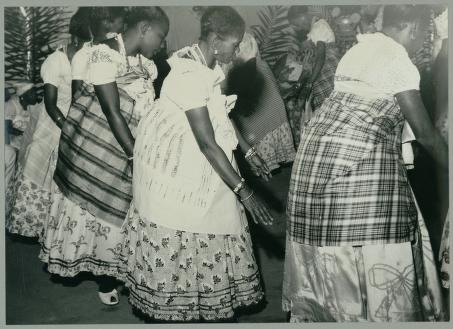
Candomblé in Bahía (Brazil) Ritual Dance.
Unknown artist
- Source:
- Library of Congress
- Rights:
- Public domain — free to use, share and adapt.
- Recorded as:
- Public Domain
Candomblé dance is a living African diasporic tradition that sustained African spiritual and aesthetic practices under centuries of oppression and legal prohibition. This photograph, made when such practices were still criminalized, documents an otherwise hidden history and affirms the continuity of African-rooted religion and movement in the Americas. For dancers and scholars, it provides visual evidence of how trance-possession dance functioned as both spiritual technology and cultural resistance.
What you are looking at
A black-and-white photograph captures a ritual gathering of women in Bahia, Brazil, their bodies arranged in close proximity in what appears to be an interior space. The women wear a mix of patterned cotton skirts—some with geometric designs, others with floral or striped motifs—and white short-sleeved blouses typical of mid-twentieth-century dress. Several wear white head wraps or scarves tied at the crown. The composition is tightly framed, focusing on the torsos and lower bodies of approximately six to eight women clustered together. Their posture suggests active engagement: some bend forward slightly, others maintain upright positions, and the arrangement suggests circular or processional movement rather than linear formation. The lighting is even and documentary in character, with no dramatic shadows, consistent with institutional or ethnographic photography of the period.
The dancing
The dancers' bodies are in close communion, shoulders nearly touching, creating an intimate spatial dynamic. Several women's arms hang at their sides or rest gently on neighbours' bodies; others show bent elbows and hands positioned near the torso, suggesting gestural rather than balletic arm vocabulary. Knees are slightly bent in several figures, indicating weight in the lower body and readiness for movement from the ground up. The overall frame reads as a moment of collective focus rather than synchronized precision: individual bodies are present and responsive within a shared ritual space, not locked into unison.
The dance depicted
This is Candomblé ritual dance, the sacred movement practice of the Afro-Brazilian religion that emerged from the fusion of Yoruba, Fon, and Bantu traditions with Catholicism. Candomblé dance is devotional and participatory rather than performative for an external audience: dancers enter trance states (possession) through rhythmic movement, percussion, and collective invocation of orixás (deities). The photograph shows the communal, embodied nature of the practice—women dancing together in what may be a terreiro (sacred house), their clothing reflecting both everyday dress and ritual propriety. The 1962 date places this documentation during a period when such practices were still legally restricted in Brazil, making this an important ethnographic record of living tradition.
How it was made
This is a black-and-white documentary photograph, likely shot on 35mm film or similar stock. The even lighting, sharp focus, and institutional framing suggest it was commissioned for archival or research purposes rather than artistic display—consistent with the Library of Congress attribution. The close cropping and interior setting indicate the photographer had access to the ritual space, a significant privilege. Documentary photography of this kind functioned as ethnographic evidence and was the primary visual technology for recording non-Western dance practices in the mid-twentieth century, before video became standard.
About this work
This photograph documents Candomblé ritual dance in Bahia, Brazil, around 1962—a moment of sacred, embodied practice within the Afro-Brazilian religious tradition. The image captures the participatory, communal nature of the dance: women in close physical proximity, wearing modest cotton dress, their bodies engaged in the devotional movement that characterizes Candomblé worship. The photograph is valuable both as a historical record of a living tradition and as evidence of how African diasporic spiritual practice persisted and flourished in Brazil despite legal and social suppression.
Candomblé dance resists the framings of "performance" or "spectacle" that dominated mid-twentieth-century ethnographic photography. This image, by its tight framing and attention to the women's faces and interaction, acknowledges the dancers as agents of their own spiritual practice rather than exotic subjects. The work belongs in a dance gallery because it documents a sophisticated, embodied ritual system—one where movement, music, and altered consciousness are inseparable from religious devotion.
How to look at it
Attend to the hands and the proximities: notice how the women's hands relate to each other's bodies, and how the tight clustering suggests both safety and spiritual intensity. The photograph does not show the full extension of a dramatic leap or turn; instead, it freezes the sustained, grounded work of possession—the subtle shifts of weight, the bent knees, the turned-in focus. Look also at the faces and the direction of gaze: several dancers appear inward-focused or eyes downcast, consistent with trance states rather than outward performance. The geometry of the group—nearly circular, overlapping—tells you this is communal ritual, not choreographed spectacle.
The period
In 1962, Candomblé practice in Brazil occupied a liminal legal and social space. While the religion had deep roots in Bahia dating to the slave trade, it faced persecution from the state and the dominant Catholic Church. Documentation by institutions like the Library of Congress reflects mid-twentieth-century anthropological interest in "folklore" and "ethnography," though the terms themselves carried problematic assumptions. Simultaneously, the Brazilian modernist movement (Tropicália would emerge within a decade) was beginning to reclaim Afro-Brazilian cultural forms as central to national identity rather than marginal or primitive. This photograph sits in that transitional moment: made as institutional documentation, yet capturing a practice on the verge of wider cultural acknowledgment.
Where it lives
The photograph is held by the Library of Congress, likely part of its ethnographic or Americana collections. The 1962 date and documentary character suggest it was collected as part of a research or documentation initiative, though the specific project and photographer remain unrecorded.
Dance in this work
Questions about this work
What is Candomblé and how does it relate to dance?
Candomblé is an Afro-Brazilian religion that emerged from the syncretism of Yoruba and other West African traditions with Catholicism. Dance is central to Candomblé worship: it is the primary means by which devotees invoke and welcome orixás (deities) into their bodies. Through rhythmic movement, percussion, song, and collective participation, dancers enter trance or possession states, allowing the orixás to communicate and bless the community. The dance is sacred, not entertainment.
Why was Candomblé illegal in 1962?
Brazil's dominant institutions—the state and the Catholic Church—viewed African-rooted religions as superstition, witchcraft, or threats to national order. Candomblé practitioners, overwhelmingly Black and poor, faced arrest and surveillance well into the twentieth century. Religious freedom for Candomblé was not legally guaranteed until the 1988 constitution. Photography like this, made during the period of restriction, is therefore a rare documentary record of practices that were deliberately hidden from official view.
How does Candomblé dance differ from ballet or other Western dance forms?
Candomblé dance is participatory and devotional rather than performative. There is no audience/performer divide, no choreographed sequence, no aesthetic of turned-out limbs or vertical extension. Instead, the dance is rooted in the ground, uses bent knees and grounded weight, incorporates rhythmic repetition and subtle variations, and aims toward spiritual transformation (possession) rather than technical display. The movement vocabulary draws from African retention and adaptation rather than European court dance.
More dance artwork





