49 works in this view — arrow keys or swipe to move between them.
Dance in Art
The Minuet
Unknown artist
- Source:
- Library of Congress
- Rights:
- Public domain — free to use, share and adapt.
- Recorded as:
- Public Domain
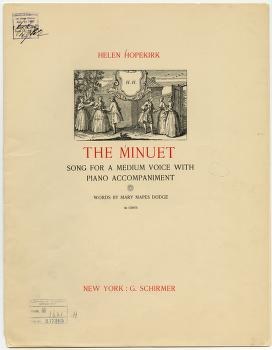
This document shows how the minuet was transmitted to non-courtly audiences through commercial music publishing. It also illustrates the aesthetic ideals of the minuet—restraint, dignity, formal spacing, and elaborate costume—making it valuable evidence for how the dance was understood and remembered long after it had ceased to be a regular feature of aristocratic life.
What you are looking at
This is the cover or title page of a published musical score, showing an engraved illustration of the minuet as a formal court dance. The image presents a symmetrical architectural setting with classical elements—a domed structure and ornamental framing—within which five figures are arranged in two couples plus a musician. The two couples occupy the center, dressed in elaborate 18th-century court costume: the women wear full skirts with panniers, fitted bodices, and elaborate headdresses; the men wear tailored coats and breeches. A fifth figure, likely a musician, stands to one side. The couples are posed in the formal, upright positions characteristic of the minuet, with considerable distance maintained between partners. The composition is orderly and stately, emphasizing the dignity and ceremonial nature of the dance. The engraving technique allows fine detail in the costume rendering and architectural surround, and the overall design conveys this as an instructional or commemorative document for an educated, courtly audience.
The dancing
The dancers maintain the upright, dignified posture required of the minuet, with the body held tall and the carriage formal. The two couples are shown at some distance from one another—consistent with the minuet's measured, restrained character—rather than in close contact. The men's arms are positioned with control, the women's skirts extend dramatically, suggesting the characteristic movements of the dance. The spacing and orientation of the figures suggest they are in one of the defined patterns of the minuet—possibly the opening honor or one of the turning sequences—rather than a moment of vigorous action.
The dance depicted
This is the minuet, the dominant social dance of the 18th century European court. The minuet was danced by educated nobility and gentry, following a codified sequence of steps and figures that emphasized grace, restraint, and careful partnering. It was typically performed in pairs, often in a formal court setting or ballroom, and required training in deportment and dance technique. The image illustrates it as a formal, stately dance—not energetic or athletic, but a display of refinement and social status. The costume and setting confirm an 18th-century date, and the publication as a song with piano accompaniment suggests this was marketed to amateur dancers or music students learning the form.
How it was made
This is a printed engraving, likely a wood or steel engraving based on the fine line work and the uniform tonal quality visible in the reproduction. The technique allowed for precise rendering of the costume detail and architectural framing, and would have been relatively economical to reproduce in quantity. The work was published by G. Schirmer in New York, a major music publisher, which means it was printed commercially and distributed to a broad audience of amateur musicians and music students. Engravings of this type were standard for music title pages in the late 19th and early 20th centuries, serving both as illustration and as legitimizing ornament.
About this work
This is a published musical score for a minuet arranged as a song with piano accompaniment, presented with a formal engraved title-page illustration. The image serves as both advertisement and instruction, showing educated amateurs how the minuet was danced in the 18th-century court. It belongs in a dance archive because it documents not only the appearance and costume of the minuet, but also the social and aesthetic contexts in which it was performed—the formal architectural setting, the careful spacing between partners, the emphasis on upright carriage. It is also evidence of how the minuet persisted in European and American culture well into the 19th and 20th centuries, transformed from a living court dance into a historical form studied and performed by amateurs.
How to look at it
Observe the formal spacing between the couples and the upright posture of all five figures—this conveys the restraint and discipline of the minuet, which was not a dance of close contact or vigorous movement but rather a demonstration of grace and control. Notice the detail lavished on the costume, especially the women's skirts and headdresses, which would have been integral to the visual effect of the dance. The symmetrical architectural framing emphasizes the formal, ceremony-like nature of the occasion. The engraving technique allows the viewer to read the fine details of fabric and decoration, suggesting this was made for an audience that understood and valued such refinement.
The period
The minuet dominated European court and ballroom dancing from roughly the 1660s through the late 18th century, after which it gradually became a historical form. By the 19th and early 20th centuries, when this score was published, the minuet was no longer a living social practice but had become a subject for musical composition, historical reenactment, and education. Music publishers like G. Schirmer issued arrangements and instructional materials aimed at amateur pianists and dancers who wanted to learn or recreate the forms of earlier centuries. This reflects the broader 19th-century fascination with historical reconstruction and the formalization of dance technique.
Where it lives
This is a published music score issued by G. Schirmer in New York, a major American music publisher. The holding institution is the Library of Congress, which acquired it as part of its collections of published music and sheet music cover art.
Dance in this work
Questions about this work
What is the minuet?
The minuet was the dominant social dance of the 18th-century European court, performed by educated nobility and gentry in pairs. It was stately, formal, and highly codified, requiring training in both dance steps and social deportment. By the 19th century, it had become primarily a historical form, preserved in music and occasionally performed at balls or by amateurs.
Why is this a musical score and not a dance manual?
By the 19th century, the minuet was no longer taught primarily as a social practice but was instead preserved and transmitted through musical arrangement and study. Amateur pianists and music students could learn the minuet's music and character through published scores like this one, and dancers could learn the form through existing dance notation or by watching historical reconstructions.
What do the formal spacing and posture tell us about how the minuet was danced?
The considerable distance between the couples and the upright, dignified carriage of all the figures emphasize that the minuet was a restrained, ceremonial dance. It was not about close contact or vigorous movement, but rather about the careful display of grace, control, and social refinement. The costume and setting convey that it was a dance for the educated elite.
More dance artwork





