49 works in this view — arrow keys or swipe to move between them.
Dance in Art · 1934
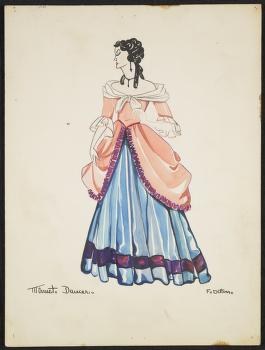
[Valley Forge: Minuet Dancer. Pink gown with blue underskirt and white shawl.]
Unknown artist
- Source:
- Library of Congress
- Rights:
- Public domain — free to use, share and adapt.
- Recorded as:
- Public Domain
Costume design drawings like this reveal how early 20th-century American theater translated historical dance into visual spectacle, and what elements of formal dress and bearing were considered essential to evoking the minuet and the colonial past. The work also documents the professional design and production infrastructure of regional or amateur theatrical productions during the 1930s.
What you are looking at
A single female figure stands in three-quarter view against a plain cream ground, posed in a formal stance typical of theatrical costume design. She wears a voluminous gown of pink silk with an off-shoulder neckline and a white shawl or fichu draped across her shoulders and upper arms. Beneath the pink overdress, a blue underskirt is visible, with a dark purple or navy hem band at its lowest edge. Her hair is styled up in a period arrangement, and her posture is upright and dignified. The figure is rendered in a delicate hand-colored drawing technique, with fine black line work defining the silhouette and garment details. There is a small signature or artist mark at the lower left that reads "Elizabeth Dunning" (or similar), and what appears to be a collection mark or catalog notation at lower right.
The dancing
The dancer stands with weight evenly distributed, legs close together, in a neutral frontward-facing position with a slight turn of the torso toward the viewer's right. Her arms hang naturally at her sides, one slightly forward. The posture is formal and presentational rather than dynamic—this is a standing display of the costume rather than a capture of movement in progress. The proportions and elongated figure are consistent with the conventions of theatrical costume illustration of the early twentieth century.
The dance depicted
The costume and pose suggest a minuet dancer of the 18th century, though this is a 1930s visual interpretation and costume design study rather than a record of a live performance. The minuet was a stately court dance in triple time, performed in formal dress by nobility and upper classes from the 17th through 19th centuries. The gown—with its fitted waist, voluminous skirts, and elaborate draping—is styled in a theatrical approximation of 1770s–1780s court dress. The drawing appears to be a costume design for a theatrical production, possibly for a historical play or pageant titled or themed around Valley Forge. Whether the wearer is depicted mid-performance or in a static presentational pose typical of costume studies cannot be determined from the image alone.
How it was made
This is a hand-colored drawing or gouache work on paper, executed in a delicate linear technique with applied watercolor or gouache pigment in pink, blue, and purple. The medium was standard for theatrical costume design and fashion illustration of the 1920s–1930s, allowing quick conceptual development and clear rendering of garment drape and color. The technique enabled efficient communication of design intent to costumers and producers, and such drawings circulated among theater companies, museums, and design firms. The hand-coloring and signature suggest this is an original design drawing rather than a mass-printed document.
About this work
This is a theatrical costume design drawing from 1934 depicting a female dancer in formal 18th-century ball gown. The work appears to be part of the visual preparation for a theatrical production, pageant, or historical reenactment set at or themed around Valley Forge. The image documents both the aesthetic of 1930s theatrical design practice and the specific visual vocabulary used to evoke colonial-era elegance through costume. It is a primary source for understanding how American theater of the Depression era visualized historical dance and formal court life.
How to look at it
Observe the relationship between the pink and blue fabrics: the pink is rendered as a sheer or semi-transparent overdress that allows the blue underskirt to show through at the hem, a detail that anchors the costume in 18th-century formal wear. Notice the careful attention to the drape of the white fichu and the way it frames the shoulders and neckline—elements that communicate elegance and historical specificity. The artist has chosen a frontal, still pose that shows the garment fully, prioritizing clarity of design communication over any sense of movement or choreographic action.
The artist
The signature and date suggest this is the work of a professional or semi-professional theatrical costume designer active in the 1930s, but the artist has not been identified in the catalogue record. Costume design drawings of this era were often produced by in-house theater staff, itinerant designers, or commercial costume houses, and attribution was sometimes not systematically recorded.
The period
The 1930s saw a flourishing of historical pageants and educational theatrical productions in the United States, many of them amateur or semi-professional efforts tied to civic, school, or community groups. The minuet and 18th-century court dance were familiar subjects for such productions because they carried associations with refinement, American colonial history, and formal European culture. The Valley Forge reference suggests a patriotic or educational context, possibly an anniversary pageant or history play. At the same time, theatrical costume design had become a recognized specialty craft, with published costume design conventions and a growing library of historical reference materials.
Where it lives
The work is held in the Library of Congress and entered the collection as an example of American theatrical design documentation. It is catalogued with minimal accompanying information, suggesting it arrived as part of a larger collection of costume or theater papers that were not fully itemized at acquisition.
Dance in this work
Questions about this work
What is a minuet and why would it appear in a 1930s theater production?
The minuet was a formal court dance of the 17th and 18th centuries, performed by nobility in elaborate dress. By the 1930s, it had become a symbol of refinement and European high culture, and was frequently staged in historical pageants, educational plays, and costume balls. A Valley Forge production would have used it to evoke the colonial past and the dignity of the founding era.
Is this a design for a real performance or just a concept sketch?
The signature, date, and finished hand-coloring suggest this was a formal design document prepared for production use, not a casual sketch. However, without additional archive records, it is impossible to confirm whether the costume was actually made and worn, or remained in the design phase.
What do the different fabrics tell us about the costume?
The combination of a pink overdress, blue underskirt, and white fichu reflects 18th-century formal wear conventions, where layering and contrasting colors were hallmarks of genteel dress. The theatrical designer was signaling 'historical' and 'elegant' through textile choice and color, using visual shorthand familiar to audiences of the period.
Why is the figure shown standing still rather than dancing?
Costume design drawings typically show the garment in neutral, full-view poses to communicate cut, drape, color, and construction clearly. Movement would obscure these details. This is a design document, not a choreographic record.
More dance artwork





