49 works in this view — arrow keys or swipe to move between them.
Dance in Art · 1913
Raffles dance
Unknown artist
- Source:
- Library of Congress
- Rights:
- Public domain — free to use, share and adapt.
- Recorded as:
- Public Domain
Sheet music covers are primary sources for understanding how ballroom dance was experienced and marketed in the early 20th century. This image shows how the visual representation of dance could emphasize romance and surrender rather than skill, and how commercial theater and dance instruction were intertwined in American entertainment culture.
What you are looking at
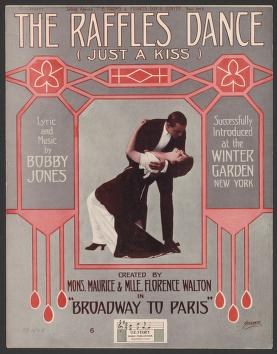
This is a sheet music cover for a popular song, printed in color with an Art Deco aesthetic. The design features a photograph or photomontage inset within a geometric art deco border of burgundy and cream. The central image shows a couple in a close embrace, the man in dark formal wear bending slightly forward while the woman in a dark dress leans back into his arms, their bodies creating a diagonal line across the frame. The setting appears to be an interior space, though rendered softly in monochrome tones. The border incorporates stylized ornamental elements — hanging jewels or teardrops at the corners, and geometric bands of decorative patterning. At the top, the title "THE RAFFLES DANCE" appears in bold serif capitals, with the subtitle "I JUST A KISS" below it. On either side of the central photograph are text panels: on the left, "Lyric and Music by BOBBY JONES"; on the right, "Specially Introduced at the WINTER GARDEN NEW YORK." At the bottom, the credits read "CREATED BY MONS MAURICE & WM. FLORENCE WALTON" and "BROADWAY TO PARIS." The overall effect is that of a commercial entertainment product designed for mass distribution and sale.
The dancing
Two figures are shown in a ballroom or salon hold, positioned diagonally across the frame. The man, in tailored dark evening dress, is slightly bent forward at the waist with one arm supporting the woman's back. The woman's body arches backward in a languid curve, her weight appearing to rest on his support; her posture suggests abandon or romantic surrender rather than active participation. The positioning and the softness of the photograph emphasize elegance and intimacy rather than technical precision or athleticism. The hold and frame suggest a formal dance of the era — likely a waltz or foxtrot — where the woman's surrender to the man's lead is part of the visual and kinetic vocabulary.
The dance depicted
This is a Gilded Age or Jazz Age ballroom dance, most likely a waltz or foxtrot given the formal evening dress and the intimate, flowing posture of the couple. The "Raffles Dance" was introduced at the Winter Garden in New York, a major theatrical venue, suggesting this was a popular ballroom or cabaret dance of the 1910s era, likely part of a musical revue. The image emphasizes the romantic and sensual character of the dance — the backward lean and the close hold convey a particular cultural moment when dance could express desire and intimate connection within the frame of formal propriety. The photograph's soft focus and the couple's expressions communicate the emotional tenor of the dance rather than its steps.
How it was made
This is a lithographic or color-printed sheet music cover, a common commercial format of the early 20th century. The photograph or photomontage at the center has been halftone-printed or hand-colored and integrated into a designed border. Sheet music covers of this period were produced in large quantities for distribution through music stores and were often the primary visual advertising for songs and theatrical productions. The color separation and printing technique allowed for relatively inexpensive mass production while maintaining attractive color and photographic imagery, making this an accessible product for middle-class consumers. The combination of photographic realism with graphic design elements was typical of the period's commercial art practice.
About this work
This sheet music cover documents a popular ballroom dance introduced at a major New York theater in the 1910s. The "Raffles Dance" appears to have been a waltz or foxtrot, promoted as a fashionable entertainment for theatergoers and ballroom dancers. The image is primarily valuable as evidence of how ballroom dance was marketed and visualized in the commercial entertainment industry of the era — not as a demonstration of technique, but as an expression of romantic mood and fashionable leisure. The photograph emphasizes the emotional and social dimensions of ballroom dancing: intimacy, formal elegance, and the pleasurable surrender implied by the woman's arched posture. As a printed artifact, it reveals the commercial machinery that circulated dance styles and ballroom fashions among the urban middle and upper classes.
How to look at it
Attend to the posture and positioning of the couple rather than any visible footwork or steps — the photographer and designer have chosen to emphasize the emotional and social content of the dance, the mood of romantic connection, rather than its technical or choreographic details. The backward arch of the woman's body and the forward lean and support of the man's create a visual narrative of desire and trust. The soft focus and studio lighting typical of 1910s portrait photography heighten this emotional effect. The art deco border and typography frame the dance as a fashionable, modern leisure activity consumed by urban audiences.
The artist
The cover credits "Mons Maurice & Wm. Florence Walton" as creators, though it is unclear whether they composed the music, choreographed the dance, or designed the cover. The printing and distribution information — "Broadway to Paris" — suggests a professional theatrical and music publishing apparatus. The photographer and designer of the cover are not identified in the visible text.
The period
The 1910s were the height of the ballroom dance craze in America. Dances like the waltz, foxtrot, tango, and various novelty dances were central to urban entertainment, taught in dedicated dance studios, and featured in musical revues and theater productions. Theatrical venues like the Winter Garden introduced new dances and dance styles that then spread to ballrooms and social venues across the country. Sheet music covers became a primary medium for marketing both songs and the dances associated with them. This period also saw the rise of commercial dance photography and the use of photographic imagery in advertising, as technological improvements made halftone printing more practical and economical.
Where it lives
This is a sheet music cover from the Library of Congress collection, part of the extensive documentation of American popular music and commercial print culture of the early 20th century.
Dance in this work
Questions about this work
What was the Raffles Dance?
It was a ballroom dance introduced at the Winter Garden theater in New York around 1913, promoted as a fashionable novelty. Based on the posture and hold shown here, it was likely a variation of the waltz or foxtrot. Little is known about the actual choreography or whether it survived beyond the initial theatrical promotion.
How were new dances taught and spread in this period?
Through a combination of theatrical performance, sheet music and song lyrics, dance instructors, and commercial dance halls. Popular songs often had associated dances, and the cover images helped market both the music and the dance to consumers. Theaters like the Winter Garden premiered new dances that then spread to ballrooms and social venues.
Why does the woman look like she's falling backward?
The backward arch was a conventional pose in ballroom and theatrical dance photography of the era, expressing surrender, trust, and romantic emotion. It was both a real feature of some dances (particularly the waltz) and a pose adopted for dramatic effect in photographs and theatrical scenes.
Who created this cover?
The credits name Mons Maurice and Wm. Florence Walton as creators, though it's unclear whether they composed the music, choreographed the dance, or designed the cover. The photographer and graphic designer are not identified.
More dance artwork





