49 works in this view — arrow keys or swipe to move between them.
Dance in Art · 1973
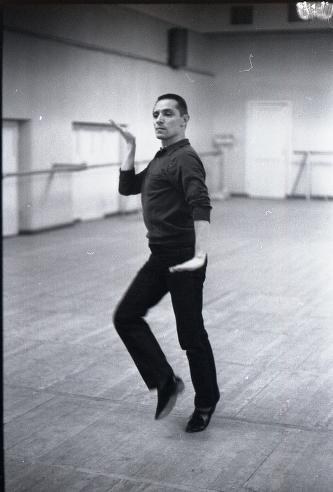
Grigorovich Dancing.
Unknown artist
- Source:
- Library of Congress
- Rights:
- Public domain — free to use, share and adapt.
- Recorded as:
- Public Domain
Grigorovich's career spanned the transformation of Soviet dance from revolutionary abstraction to state-sanctioned classical excellence. This image of him dancing—rather than choreographing or directing—is evidence of a master technician at work, and a rare documentary record of mid-twentieth-century Soviet modern dance technique in practice. For historians of Soviet culture and Cold War-era modernism, the photograph offers a window into how the Soviet Union cultivated and displayed a distinctly Soviet body and movement vocabulary.
What you are looking at
A male dancer in dark rehearsal clothes stands alone in a large, empty studio lit by overhead fixtures. He is captured mid-movement in a dynamic pose: his body twists sharply to the left, his right arm extended forward at chest height with fingers splayed, his left arm bent behind him. His weight is thrown onto his left leg while his right leg lifts and extends, creating a sense of ballistic energy and torque through the torso. The studio is austere—bare walls, a wooden floor, minimal props visible in soft focus behind him. The black-and-white photograph emphasizes the isolation of the figure and the geometric clarity of the movement, freezing a moment of intense physical articulation.
The dancing
A single male dancer, lean and muscular, exhibits a sharply rotated torso with the spine as the primary engine of movement. His arms work asymmetrically: the right arm projects forward and open, the left compressed and backward, suggesting a wringing or spiraling action through the core. His legs show clear weight shift and extension, with the torso leading and the limbs following—a hallmark of modern dance technique. The head follows the rotation of the spine, and the overall frame suggests deliberate, controlled power rather than balletic épaulement.
The dance depicted
This is modern dance, most likely of the Soviet school. The image shows characteristics consistent with the technical vocabulary developed by Merce Cunningham and contemporaneous Soviet choreographers: a sharp, geometric use of the torso as an independent articulator, asymmetrical arm work, and grounded weight management. The dancer's name in the title—Grigorovich—refers almost certainly to Yuri Grigorovich, the legendary Soviet choreographer and dancer (1927–2018) who was a principal dancer and later artistic director of the Bolshoi Theatre. If this is Grigorovich dancing in 1973, the work would demonstrate the vocabulary of Soviet theatrical modern dance of the late Cold War era, a tradition distinct from both Western contemporary dance and classical Soviet ballet.
How it was made
This is a black-and-white photograph, likely a documentary studio photograph or promotional image. The clarity of focus and studio lighting suggest professional photography, probably taken by a dance photographer or theatre documentarian. The medium captures movement in a single frozen instant, a technique that reveals the geometry of the pose but necessarily flattens the temporal and spatial flow of dance. For Soviet dance of this period, such photographs served both as rehearsal documentation and as cultural artifacts distributed through official channels.
About this work
This photograph documents a male modern dancer in a studio, captured in a moment of sharp torsal rotation and asymmetrical limb work. The image is attributed to the Soviet period (1973) and the title suggests it may depict Yuri Grigorovich, one of the twentieth century's most influential choreographers and dancers. The work exemplifies a distinctly Soviet approach to modern dance that synthesized classical ballet training with geometric, spine-led movement vocabulary. The austere studio setting and documentary nature of the photograph reflect mid-twentieth-century dance practice: recording technique for posterity, for teaching, and for cultural documentation during an era when Soviet dance was asserting its place in the international modern dance discourse.
How to look at it
Focus on the torso first: note how it is rotated sharply while the legs and arms create a counter-rhythm. Observe that the movement appears to be driven from the spine outward, not from the limbs inward—a key distinction between modern and classical ballet vocabulary. The photograph freezes the moment just past the maximum extension, suggesting the dancer is mid-phrase, moving through space. The emptiness of the studio is intentional: it isolates the body as the sole subject and allows the viewer to read the geometry of the pose without distraction.
The artist
The photograph is uncredited in the record, but the subject is almost certainly Yuri Grigorovich (1927–2018), the Soviet choreographer, dancer, and director who dominated Soviet ballet for over four decades. Grigorovich trained at the Vaganova Academy and danced with the Kirov Theatre before becoming one of the Bolshoi Ballet's most celebrated artistic directors (1964–1995). He created ballets that synthesized classical technique with modernist narrative and movement innovation. As a dancer, he was known for his athleticism and dramatic presence; this photograph captures him in a modern dance vocabulary that suggests he retained an active practice in studio technique well into his career.
The period
In 1973, Soviet dance stood at a midpoint between revolutionary abstraction and neo-classical retrenchment. The Bolshoi Ballet, under Grigorovich's direction, was at the height of its international prestige, exporting a style of grand classical ballet infused with dramatic intensity. Simultaneously, modern dance and contemporary techniques were present in Soviet artistic training but less publicly celebrated than classical ballet. In the West, modern dance was in a phase of intense technical innovation (Cunningham, Graham, Limón techniques were evolving); Soviet dance existed in a more isolated cultural sphere, developing its own synthesis of ballet and modern movement. Photographs like this one served documentary and propaganda functions, recording Soviet artistic excellence for both internal training and international cultural presentation.
Where it lives
The image is catalogued in the Library of Congress collections (loc) with minimal metadata. It is dated January 1, 1973, and the title 'Grigorovich Dancing' appears to be a descriptive caption rather than an artwork title. The photograph has no recorded artist, medium details, or accession information in the current record, indicating it may be part of a larger archival collection on Soviet dance or theatre.
Dance in this work
Questions about this work
Is this Yuri Grigorovich, the famous Bolshoi director?
The title strongly suggests it is, but the catalogue record does not confirm the subject's identity. Yuri Grigorovich (1927–2018) was a principal dancer of the Kirov Theatre before becoming artistic director of the Bolshoi Ballet in 1964. If this is him, it documents him as a performer in a modern dance vocabulary, which would be consistent with his training and active studio practice.
What kind of dance is this?
This is modern dance, employing a movement vocabulary centered on the torso as an independent articulator—characteristic of mid-twentieth-century Soviet modern dance technique. The style shows influence from both classical ballet training and contemporary European and American modern dance, synthesized into a distinctly Soviet approach.
Why was this photograph taken?
Soviet dance documentation served multiple purposes: rehearsal records for technique and choreography, promotion of Soviet artistic achievement, and archival preservation. A photograph of a master choreographer-dancer would have been valued both as a training document and as a cultural record.
What does the pose tell us about the movement?
The sharp rotational twist and asymmetrical arm work suggest a movement phrase based on spinal articulation and weight shift rather than symmetrical classical ballet positions. The extended leg and the torso's torque indicate the dancer is mid-motion, captured at the moment of maximum geometric interest.
More dance artwork





