49 works in this view — arrow keys or swipe to move between them.
Dance in Art · 1873
Society Quadrille
Unknown artist
- Source:
- Library of Congress
- Rights:
- Public domain — free to use, share and adapt.
- Recorded as:
- Public Domain
This object documents the moment when European ballroom dance became a published, standardized, and widely distributed practice rather than a localized tradition. It shows how dance was packaged and sold to the middle class in printed form, revealing the relationship between dance instruction, print culture, and social aspiration in the nineteenth century.
What you are looking at
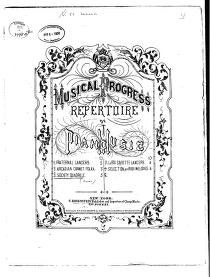
This is a decorative title page for a dance instruction manual or repertoire guide, printed in the mid-nineteenth century. The page is dominated by an ornate rococo-style border of scrollwork, flourishes, and floral ornaments in black ink on white paper. The title "Musical Progress" appears at the top in large serif capitals, with the subtitle "Repertoire" below it. The words "Quadrille" appear prominently, identifying the dance form covered. At the center bottom, partially legible text indicates this is part of a published series, likely with multiple volumes or editions. The overall design is typical of sheet music covers and dance instruction books of the 1870s—elegant, formal, and aimed at a genteel, literate middle-class audience learning ballroom dances at home or in dance schools.
The dancing
No human figures are depicted on this page. It is a title-page composition entirely typographic and decorative, with no representation of dancers or bodies in motion.
The dance depicted
The quadrille was the dominant social ballroom dance of the mid-nineteenth century, danced in sets of four couples arranged in a square. This title page announces instruction or notation for quadrille figures, presented as part of a series on musical progress and dance repertoire. The quadrille typically consisted of five figures performed to repeated strains of music, each with its own choreography and conventions. By 1873, the quadrille had long been established in ballrooms across Europe and North America, and published guides like this one helped dancers learn and standardize figures.
How it was made
This is a printed page, likely from a lithographed or relief-printed music and dance instruction book. The ornamental border and typography suggest lithographic printing, a technology that allowed for fine detail and decorative effects. The page demonstrates the high production values of mid-century dance publishing—professional composition, ornamental design, and careful typesetting signal that this was a commercial product aimed at an affluent market. The survival of such pages in archives reflects their value as cultural documents and their original circulation among dance studios and private music rooms.
About this work
This is a title page from a published dance instruction series focused on the quadrille, a foundational social dance of the 1870s. It represents the formalization and commodification of ballroom dance knowledge in the nineteenth century—the moment when oral tradition, studio practice, and improvisation gave way to printed manuals, standardized figures, and published repertoires. The page itself reveals nothing about how the quadrille was actually performed or how bodies moved; instead, it testifies to the existence of a publishing industry dedicated to making dance teachable, learnable, and ownable in printed form. For historians of dance literacy, ballroom culture, and the transition from social to theatrical dance, such pages are primary evidence of how dance knowledge circulated and how the middle class engaged with dance as a refined leisure practice.
How to look at it
Examine the typography, layout, and decorative conventions: this page announces a commercial product, professionally designed and aimed at a specific market. The formal, ornamental border signals respectability and refinement—this is not folk knowledge but curated, published expertise. The prominence of the word 'Quadrille' on a page devoted to 'Musical Progress' reveals the hierarchy of ballroom dances at this time. Notice what is *not* here: no images of dancers, no notation, no figures or steps—only the promise of access to standardized knowledge about a form of dance that, by 1873, was beginning to decline in popularity as the waltz and newer dances took hold.
The period
The 1870s marked the height of the ballroom dance craze in Europe and America. The quadrille, which had arrived from France in the early nineteenth century, had become the standard opening figure at formal balls and the foundation of ballroom dance education. By the 1870s, published guides to the quadrille were numerous, as were manuals on waltz, polka, and other social dances. This explosion of dance publishing reflected both the growth of a middle-class leisure culture and the professionalization of dance teaching. Dancing masters and authors capitalized on the demand for instructional material, producing illustrated guides, musical scores with choreographic notation, and etiquette books on how to conduct oneself on the ballroom floor. Simultaneously, the development of lithography and advances in printing made such publications economically viable and widely available.
Where it lives
This page is held by the Library of Congress and comes from their collection of dance and music historical materials. It is catalogued as a printed book or manual page from 1873. The object type is a page from a bound or published dance instruction text, part of a series on musical progress and dance repertoire.
Dance in this work
Questions about this work
What is a quadrille?
A quadrille is a social ballroom dance performed by four couples arranged in a square formation. Each dance consisted of five figures, each with a specific choreography performed to instrumental music. The quadrille was immensely popular throughout the nineteenth century and was a standard part of formal ball repertoires. By the 1870s, when this page was printed, the quadrille was still widely taught and danced but was beginning to lose ground to newer forms like the waltz.
Why were dance instruction books published in this period?
As ballroom dancing became a marker of middle-class respectability and refinement in the nineteenth century, there was enormous demand for instruction books, guides, and manuals that would allow people to learn dances at home or in dance schools without relying solely on a dancing master. Publishers capitalized on this demand, producing illustrated guides, musical scores with choreographic notation, and etiquette books. This page is evidence of that thriving industry.
What does this page tell us about how dance was understood?
The absence of images of dancers or notated steps on this title page reflects a broader nineteenth-century assumption that dance knowledge could be commodified, standardized, and transmitted through print—yet also that the physical details of movement itself were not something that could be fully captured or explained in visual form. Dancers would still need a teacher or partner to learn the actual footwork and timing.
More dance artwork





